NUR 2063 Pathophysiology Rasmussen
College Final Exam. Summer 2022.
Graded A+
Explain primary prevention - Ans-Preventing"; altering susceptibility or reducing exposure of disease for
people
Explain secondary preven
...
NUR 2063 Pathophysiology Rasmussen
College Final Exam. Summer 2022.
Graded A+
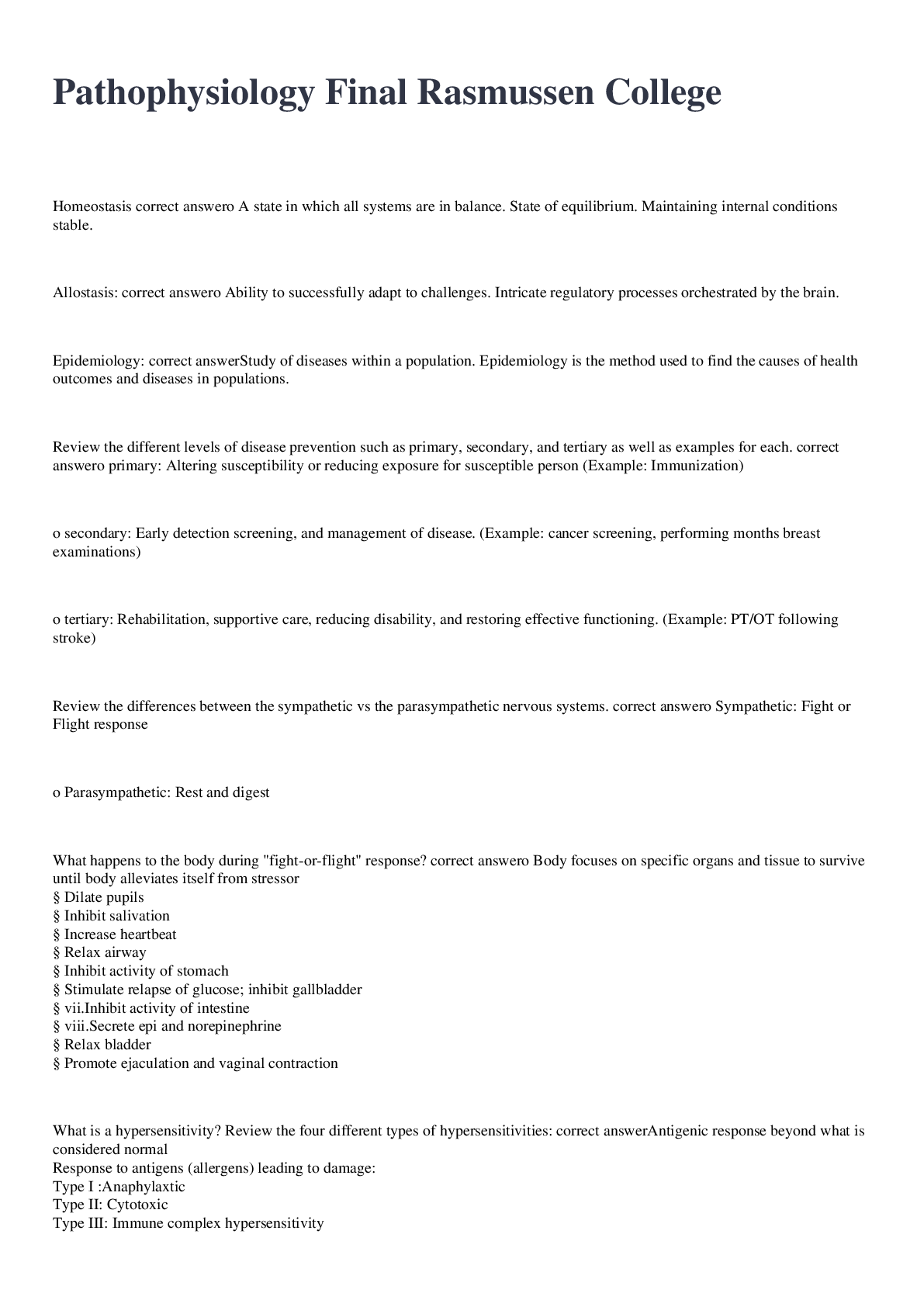
Explain primary prevention - Ans-Preventing"; altering susceptibility or reducing exposure of disease for
people
Explain secondary prevention - Ans-"Screening"; early detection, screening, and management of disease
to catch disease early before it spreads
Explain tertiary prevention - Ans-"Treating" and preventing further complications from a disorder or
disease after the person has the condition
What are examples of primary prevention? - Ans-Vaccinations and Handwashing
What are examples of secondary prevention? - Ans-PAP smears for STDs, lab work for HBA1C check,
mammogram
What are examples of tertiary prevention? - Ans-Rehab for hip surgery, relearning ADL's after
amputation, Wound care after stroke to prevent pressure ulcer
What happens to the body during the sympathetic phase of the flight or fight response? - Ans-Pupils
dilate, salivation inhibited, increase in HR, bronchodilation of airway, increased respirations, glucose
release, inhibit GI/GU.
What happens to the body during the parasympathetic phase of the flight or light response? - Ans-Rest
and Digest. Pupils constrict, salivation occurs, decreased HR, bronchoconstriction,decreased respiration,
GI/GU systems resume actionExplain the role of the nucleus - Ans-control center of the cell, where DNA and genes are stored,
produces mRNA to help build body proteins
Explain the role of the mitochondria - Ans-Powerhouse of the cell. Provides energy in ATP, and has its
own set of DNA
Explain the role of the ribosome - Ans-produces RNA to produce proteins through transcriptions of DNA
and translation of RNA into a protein
Explain the role of the lysosomes - Ans-helps breakdown and digest dead cells, organelles, or tissues
Explain the role of the rough ER - Ans-folded membranes that move proteins around the cell. Has
ribosomes attached to it and helps produce proteins for the cell membrane
Explain the role of the smooth ER - Ans-helps the Liver and kidney cells to detoxify, lipid metabolism,
synthesis of hormones, and calcium storage
Explain the role of the peroxisome - Ans-membrane cells that contain oxidase and catalase to detoxify
harmful chemicals, breakdown hydrogen peroxide and filter metabolic wastes
Explain the role of the Golgi body - Ans-stacked membranes that act as the sorter and packager for
proteins from the ER. Helps move things in and out of cell
Explain passive immunity - Ans-the transfer of preformed antibodies against specific antigens from a
protected or immunized individual to an unprotected or non immunized person. Provides immediate
and short term protection. No memory cells are produced. IgA and IgE. Passes protection
What are examples of passive immunity? - Ans-mom to fetus through placenta or mom to infant
through breast milk. SerotherapyExplain active immunity - Ans-a protective state owing to the immune system response as a result of
active infection or immunization. It has to be activated in the body and the body has to fight it to have
long term immunity
What are examples of active immunity? - Ans-Vaccinations
Explain what edema is - Ans-accumulation of fluid in the interstitial space. Leads to tissue swelling
What are some causes of edema? - Ans-increase in the forces that move fluid from capillaries to
interstitial compartments or decrease in the opposite.
What are factors that contribute to edema? - Ans-Increase in hydrostatic forces in the capillaries that
increases the blood volume, increased capillary permeability, CHF, HYPTN, decrease in plasma proteins
like albumin (causes liver to hold onto more water- ascites, cirrhosis), blockage of lymph drainage
What is a hypersensitivity? - Ans-an overreaction to antigens or allergens that is beyond the normal
range, leading to damage
What is a type 1 hypersensitivity? - Ans-anaphylactic. Occurs within 2-30mins of exposure. Can be
systemic or localized. Binds to IgE and mast cells that release histamine, leukotrienes, and
prostaglandins to create inflammation
Mediating Factor for type 1 hypersensitivity - Ans-IgE
Examples of type 1 hypersensitivity - Ans-allergic reaction to dust. someone eats peanuts and breaks out
in hives and runny nose
How do we treat type 1 hypersensitivity reactions? - Ans-antihistamines to block histamine, beta
adrenergics to bronchodilator , corticosteroids, to decrease inflammation. IgE therapy, epinephrine
given during anaphylaxis through IV or through IM in epipens
[Show More]