NEWBORN
A A A
The nurse is performing an assessment on a 39-week neonate an hour after a spontaneous
vaginal delivery. What are common expected newborn findings? Select all that apply.
1. One artery and one vein in t
...
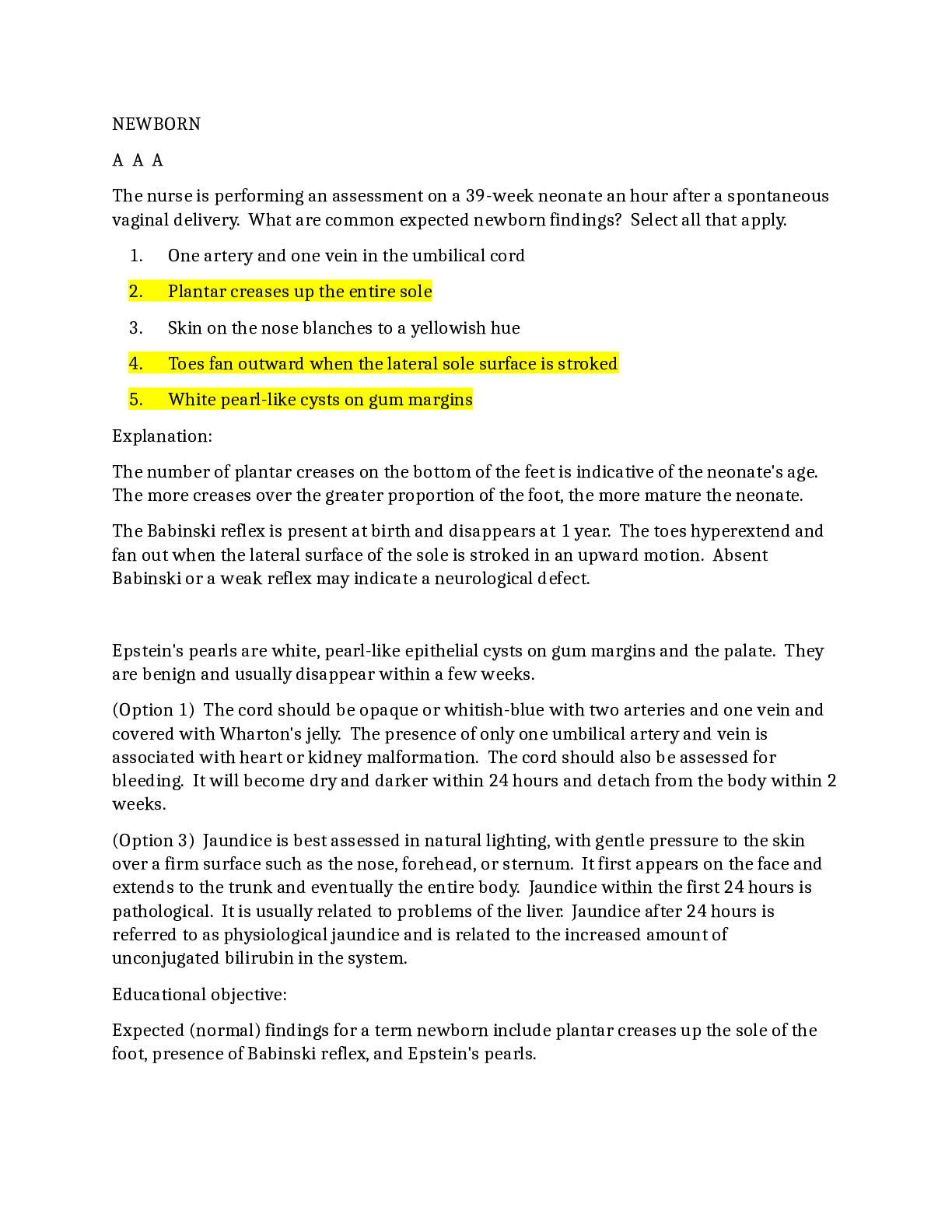
NEWBORN
A A A
The nurse is performing an assessment on a 39-week neonate an hour after a spontaneous
vaginal delivery. What are common expected newborn findings? Select all that apply.
1. One artery and one vein in the umbilical cord
2. Plantar creases up the entire sole
3. Skin on the nose blanches to a yellowish hue
4. Toes fan outward when the lateral sole surface is stroked
5. White pearl-like cysts on gum margins
Explanation:
The number of plantar creases on the bottom of the feet is indicative of the neonate's age.
The more creases over the greater proportion of the foot, the more mature the neonate.
The Babinski reflex is present at birth and disappears at 1 year. The toes hyperextend and
fan out when the lateral surface of the sole is stroked in an upward motion. Absent
Babinski or a weak reflex may indicate a neurological defect.
Epstein's pearls are white, pearl-like epithelial cysts on gum margins and the palate. They
are benign and usually disappear within a few weeks.
(Option 1) The cord should be opaque or whitish-blue with two arteries and one vein and
covered with Wharton's jelly. The presence of only one umbilical artery and vein is
associated with heart or kidney malformation. The cord should also be assessed for
bleeding. It will become dry and darker within 24 hours and detach from the body within 2
weeks.
(Option 3) Jaundice is best assessed in natural lighting, with gentle pressure to the skin
over a firm surface such as the nose, forehead, or sternum. It first appears on the face and
extends to the trunk and eventually the entire body. Jaundice within the first 24 hours is
pathological. It is usually related to problems of the liver. Jaundice after 24 hours is
referred to as physiological jaundice and is related to the increased amount of
unconjugated bilirubin in the system.
Educational objective:
Expected (normal) findings for a term newborn include plantar creases up the sole of the
foot, presence of Babinski reflex, and Epstein's pearls.A A A: A neonate on ventilator support is diagnosed with trisomy 18 (Edwards syndrome).
What would be an appropriate action by the nurse?
1. Discuss a plan to decrease ventilator support as the lungs become stronger with the
parents [7%]
2. Provide parents with information on the medical treatment plan for the neonate
[37%]
3. Provide the test results to the parents and give them information to read about
trisomy 18 [16%]
4. Request a meeting with the palliative care team and the parents to discuss end-oflife choices [38%]
Explanation:
Life expectancy of a neonate with trisomy 18 is typically a few weeks. A discussion of endof-life choices would be appropriate in this situation as the neonate is already experiencing
respiratory difficulty. A palliative care team will be an asset in this discussion.
(Option 1) Trisomy 18 is a genetic disorder with a short life expectancy. Discussing the
improvement of the neonate's lungs will give the parents false hope regarding recovery and
would be inappropriate at this time.
(Option 2) There is no cure or treatment for a neonate with trisomy 18 at this time.
(Option 3) Providing test results to the parents is out of the scope of nursing practice as it
is the health care provider (HCP) who discusses this with them. The nurse may provide
information for the parents to read, but this would be appropriate after the HCP has
discussed the disorder.
Educational objective:
Trisomy 18 (Edwards syndrome) is a chromosome anomaly characterized by severe cardiac
defects and multiple musculoskeletal deformities. Life expectancy for trisomy 18 is a few
weeks after birth, neonates rarely survive to their first birthday. End-of-life issues should
be discussed early after the diagnosis is confirmed. Trisomy 13 (Patau syndrome) also
results in early death.
A A A
The registered nurse is teaching a class of expectant parents about infant safety. Which
statement by a class participant indicates a need for further instruction?
1. "I will make sure there is a firm mattress in the crib." [1%]
2. "I will put my baby to bed with a pacifier." [26%]
3. "I will tie bumper pads to the sides of the crib to protect my baby's head." [42%]4. "I will use a sleeping sack or a thin tucked blanket to cover my baby." [28%]
Explanation:
Sudden infant death syndrome (SIDS) is the leading cause of death among infants aged 1
month to 1 year. Nurses play a crucial role in informing parents about child care practices
that reduce the risk of SIDS.
These measures include:
Placing infants age less than 1 year on their backs to sleep on a firm surface. The prone or
side sleep position should never be used. Infants should not share a bed with
parents/caregivers.
Avoiding soft objects such as stuffed animals, heavy blankets, and pillows in the infant's
bed. A thin blanket tucked into the sides and bottom of the mattress can be used to cover
the infant.
Avoiding bumper crib pads, which have not been shown to be effective in preventing infant
injury and likely increase the risk of SIDS (Option 3)
Maintaining a smoke-free environment
Avoiding overheating; if the infant is wearing a sleeper ("onesie") or a sleeping sack, even a
blanket may not be necessary. A fan may help reduce the temperature and circulate air in a
warm room.
Use of a pacifier when placing the infant to sleep (after age 1 month to ensure that
breastfeeding has been established for infants who are breastfed)
Breastfeeding and keeping the infant's immunizations up to date
(Option 1) Infants should sleep on a firm surface/mattress.
(Option 2) Placing infants to sleep with a pacifier may reduce the risk of SIDS.
(Option 4) If a blanket is used, it should be thin and tucked around the sides and bottom of
the mattress.
Educational objective:
The risk of SIDS can be reduced by following safe sleep practices and prevention guidelines.
Infants should always be placed on the back on a firm surface without loose bedding or
toys. Preventive measures include maintaining a smoke-free environment, avoiding
overheating, promotion of breastfeeding, and pacifier use.
A A A
A nurse is assessing a newborn with an infection due to Candida albicans. Which
assessment data support this diagnosis?1. Diffuse skin rash that resembles flea bites [2%]
2. Small, white cysts on the hard palate [6%]
3. Vesicles on the skin surrounding the lips [2%]
4. White, adherent patches on the tongue and palate [88%]
Explanation:
Manifestations of oral candidiasis (thrush) include white patches on the oral mucosa,
palate, and tongue. The patches are nonremovable and tend to bleed when touched. The
affected infant may have difficulty sucking or feeding due to the associated pain. Thrush is
generally linked to antibiotic therapy or poor caregiver hand hygiene. The infection is
usually self-limiting, but treatment with a fungicide (eg, nystatin) may hasten recovery.
(Option 1) Erythema toxicum neonatarum is characterized by firm, white or yellow
papules or pustules surrounded by erythema. This idiopathic rash, which closely
resembles flea bites, appears in the first few days after birth and resolves within 5-7 days.
There are no additional systemic effects, and the rash requires no treatment.
(Option 2) Epstein pearls are small, white cysts found on the hard palate of newborns.
These cysts are considered common findings, and they disappear a few weeks after birth.
(Option 3) Vesicular skin lesions could be from an infection caused by varicella-zoster
virus (chickenpox) or Staphylococcus aureus (impetigo). These lesions are not associated
with a fungal infection.
Educational objective:
Oral candidiasis (thrush) is a fungal infection. Manifestations include white patches on the
oral mucosa, palate, and tongue, and difficulty sucking or feeding. The patches are
nonremovable and tend to bleed when touched.
A A A
The nurse is evaluating a parent's understanding of post-circumcision care for a newborn.
Circumcision was performed using the clamp method. Which statement by the parent
demonstrates a need for further teaching?
1. "Bleeding should be no larger than the size of a quarter." [15%]
2. "I should apply petroleum jelly to the glans at diaper changes." [19%]
3. "My baby should have 4-6 wet diapers in 24 hours." [17%]
4. "Yellow exudate on the glans penis indicates infection." [47%]
Explanation: Circumcision is performed relatively close to the time of discharge due to the
lack of clotting
[Show More]