COUC 667 Quiz Week 2 with Questions And Answers. Latest Update.Question 1
1. An awareness of a client’s representational system will assist you in which nondirective
listening technique?
The metaphorical paraphrase
T
...
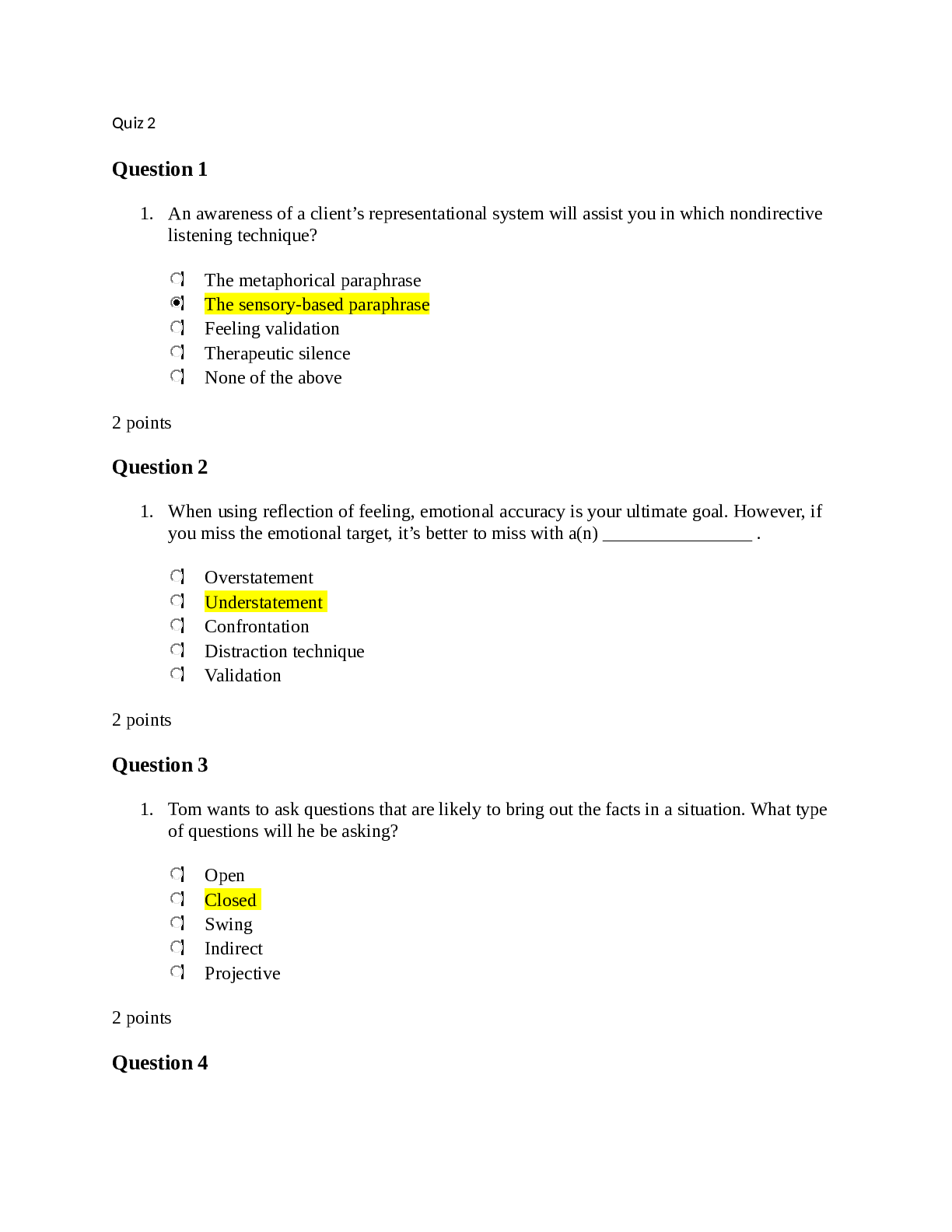
COUC 667 Quiz Week 2 with Questions And Answers. Latest Update.Question 1
1. An awareness of a client’s representational system will assist you in which nondirective
listening technique?
The metaphorical paraphrase
The sensory-based paraphrase
Feeling validation
Therapeutic silence
None of the above
2 points
Question 2
1. When using reflection of feeling, emotional accuracy is your ultimate goal. However, if
you miss the emotional target, it’s better to miss with a(n) ________________ .
Overstatement
Understatement
Confrontation
Distraction technique
Validation
2 points
Question 3
1. Tom wants to ask questions that are likely to bring out the facts in a situation. What type
of questions will he be asking?
Open
Closed
Swing
Indirect
Projective
2 points
Question 4
1. Clarice’s supervisor tells her to use fewer questions and more paraphrasing. When Clarice
asks, “Why?” her supervisor says:
I’m worried that you’re leading so much that your client won’t be spontaneous.
You need to pressure your client more.
You need to take a more expert role.
Because your questions focus on the client, you’re not getting your own interests
and values into the room.
Your questions are over-valuing your client’s perspective.
2 points
Question 5
1. The clinical interview involves a sequential or organized set of interactions between
clinician and client. It should be:
Conducted using a rigid step-by-step approach.
A relatively smooth and continuous process.
Conducted without any direct questioning.
Both c and d.
None of these are true because the clinical interview is unstructured.
2 points
Question 6
1. Which of the following is most true about questions?
They never put the client on the spot.
They are difficult to control.
They are too easy for clients to answer.
They give the counselor more control regarding the direction of the interview.
None of the above is true
[Show More]