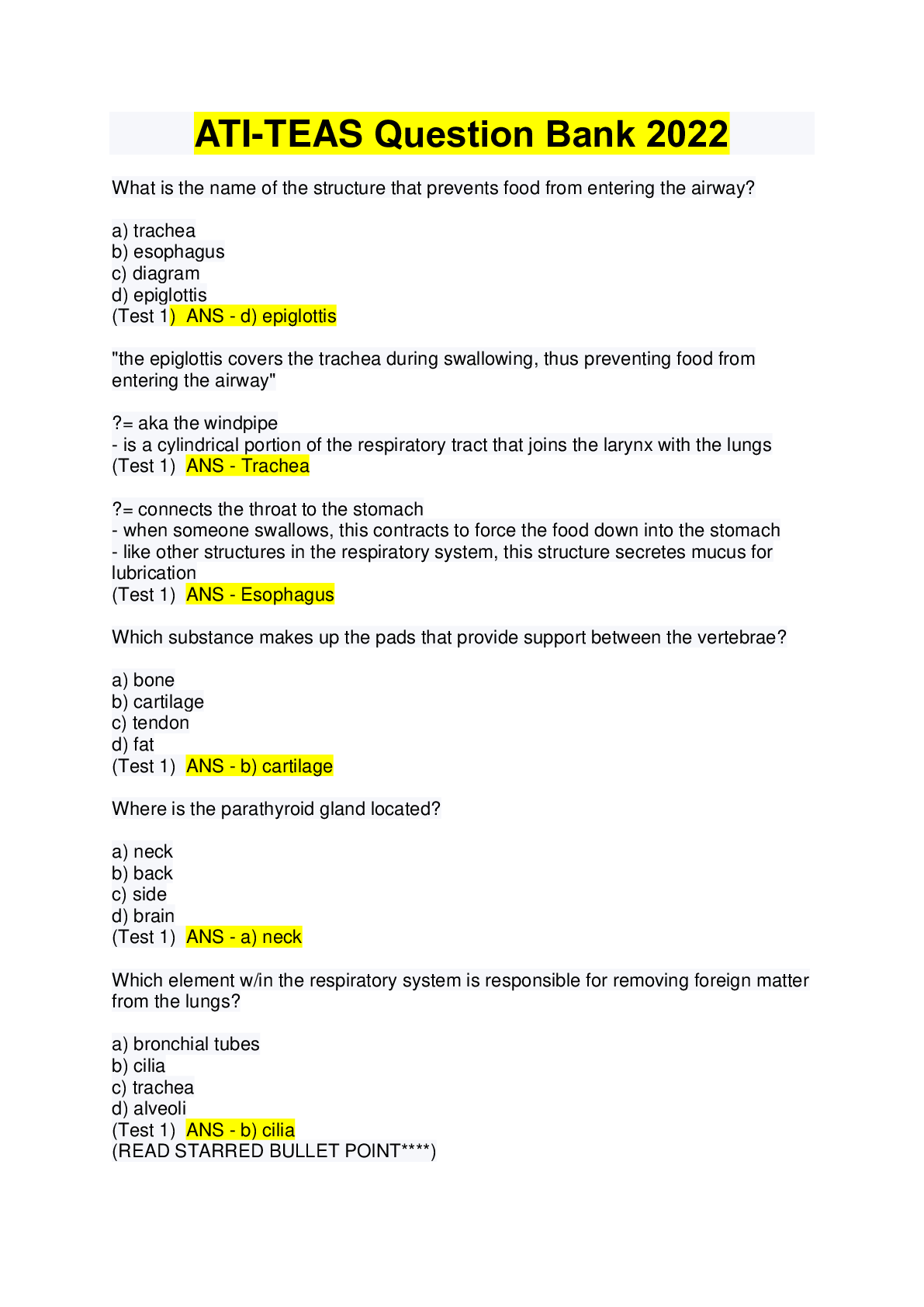
ATI-TEAS Question Bank 2022
What is the name of the structure that prevents food from entering the airway?
a) trachea
b) esophagus
c) diagram
d) epiglottis
(Test 1) ANS - d) epiglottis
"the epiglottis covers the t
...
ATI-TEAS Question Bank 2022
What is the name of the structure that prevents food from entering the airway?
a) trachea
b) esophagus
c) diagram
d) epiglottis
(Test 1) ANS - d) epiglottis
"the epiglottis covers the trachea during swallowing, thus preventing food from
entering the airway"
?= aka the windpipe
- is a cylindrical portion of the respiratory tract that joins the larynx with the lungs
(Test 1) ANS - Trachea
?= connects the throat to the stomach
- when someone swallows, this contracts to force the food down into the stomach
- like other structures in the respiratory system, this structure secretes mucus for
lubrication
(Test 1) ANS - Esophagus
Which substance makes up the pads that provide support between the vertebrae?
a) bone
b) cartilage
c) tendon
d) fat
(Test 1) ANS - b) cartilage
Where is the parathyroid gland located?
a) neck
b) back
c) side
d) brain
(Test 1) ANS - a) neck
Which element w/in the respiratory system is responsible for removing foreign matter
from the lungs?
a) bronchial tubes
b) cilia
c) trachea
d) alveoli
(Test 1) ANS - b) cilia
(READ STARRED BULLET POINT****)
- the cilia are the tiny hairs in the respiratory system that are responsible for
removing foreign matter from the lungs
**the cilia are located within the BRONCHIAL TUES, BUT it is the cilia that have the
responsibility for removing inappropriate materials b4 they enter the lungs**
Organized from high to low, the hierarchy of the human body's structure is as
follows:
organism, organ system, organs, tissues
Which of the following comes next?
a) molecules
b) atoms
c) cells
d) muscle
(Test 1) ANS - d) cells
after cells comes molecules & then atoms
On average, how many neutrons does one atom of bromine (Br) have?
NOTE:
- atomic #= 35
- atomic mass= 79.9
a) 35
b) 44.90
c) 45
d) 79.90
(Test 1) ANS - b) 44.90
to determine the number of neutrons (n), subtract the atomic number (35) from the
atomic mass (79.9)
79.9 - 35 = 44.90
On average, how many protons does one atom of zinc (Zn) have?
NOTE:
- atomic # = 30
- atomic mass = 65.39
a) 30
b) 35
c) 35.39
d) 65.39
(Test 1) ANS - a) 30
- The number of protons is the atomic number
- The number of protons is the same for every atom of a given element
What is the name of the process in the lungs by which oxygen is transported from
the air to the blood?
a) osmosis
b) diffusion
c) dissipation
d) reverse osmosis
(Test 1) ANS - b) diffusion
cannot be osmosis- osmosis is the movement of a solution from an area of low conc
to an area of higher conc through a permeable membrane
cannot be dissipation- dissipation is any wasteful consumption or use
cannot be reverse osmosis- a process for purifying a solution by forcing it through a
membrane that blocks only certain pollutants
Which gland is responsible for the regulation of calcium levels?
a) parathyroid glands
b) thyroid glands
c) adrenal glands
d) pancreas
(Test 1) ANS - a) parathyroid glands
"The parathyroid glands are 4 small glands that sit on top of the thyroid gland and
regulate calcium levels by secreting parathyroid hormone. The hormone regulates
the amount of CALCIUM & MAGNESIUM that is excreted by the KIDNEYS into the
URINE"
Which secretion of the digestive system is responsible for water reabsorption?
a) large intestine
b) duodenum
c) small intestine
d) gallbladder
(Test 1) ANS - a) large intestine
LI main functions:
- reabsorption of water into body to form solid waste**
- allows for absorption of vit K
Which of the following describes one responsibility of the integumentary system?
a) distributing vital substances (such as nutrients) throughout the body
b) blocking pathogens that cause diseases
c) sending leaked fluids from the cardiovascular system back to the blood vessels
d) storing bodily hormones that influence gender traits
(Test 1) ANS - b) blocking pathogens that cause diseases
"The integumetnary system includes skin, hair, & mucous membranes, all of which
are responsible (in part) for blocking disease-causing pathogens from entering the
blood stream"
IT CANNOT be A b/c the circulatory system distributes vital substances through the
body
IT CANNOT be C b/c the lymphatic system sends leaked fluids from the
cardiovascular system back to the blood vessels
IT CANNOT be D b/c the reproductive system stores bodily hormones that influence
gender traits
When are the parasympathetic nerves active w/in the nervous system?
When an individual....
a) experiences a strong emotion, such as fear or excitement
b) feels pain or heat
c) is either talking or walking
d) is either resting or eating
(Test 1) ANS - d) when an individual is either resting or eating
When are the sympathetic nerves active w/in the nervous system?
When an individual....
a) experiences a strong emotion, such as fear or excitement
b) feels pain or heat
c) is either talking or walking
d) is either resting or eating
(Test 1) ANS - a) when an individual experiences a strong emotion, such as fear or
excitement
When are the sensory neurons active w/in the nervous system?
When an individual....
a) experiences a strong emotion, such as fear or excitement
b) feels pain or heat
c) is either talking or walking
d) is either resting or eating
(Test 1) ANS - b) when an individual feels pain or heat
When are the sensory-somatic ns active w/in the nervous system?
When an individual....
a) experiences a strong emotion, such as fear or excitement
b) feels pain or heat
c) is either talking or walking
d) is either resting or eating
(Test 1) ANS - c) when an individual is either talking or walking
Which of the following best describes the relationship b/w the circulation system &
the integumentary system
a) removal of excess heat from body
b) hormonal influence on bp
c) regulation of blood's pressure and volume
d) development of blood cells w/in marrow
(Test 1) ANS - a) removal of excess heat from body
"the integumentary system (ie: skin, hair, etc) coordinates with the circulatory system
to remove excess heat from the body. The superficial blood vessels (nearest the skin
surface) dilate to allow the heat to exit the body"
NOT B b/c the hormonal influence on bp is the result of the relationship b/w the
circulatory system and the endocrine system
NOT C b/c the urinary system is responsible for assisting in the regulation of blood's
pressure and volume
NOT D b/c the skeletal system is responsible for assisting in the development of
blood vessels w/in the marrow
The hormonal influence on bp is the result of the relationship between the circulatory
system & the ? system
(Test 1) ANS - Endocrine System
The ? system is responsible for assisting in the regulation of blood's pressure and
volume
(Test 1) ANS - Urinary System
The ? system is responsible for assisting in the development of blood vessels w/in
the marrow ANS - Skeletal System
Once blood has been oxygenated, it travels through the pulmonary veins, through
the left atrium, and then through the ? before entering the left ventricle
a) tricuspid valve
b) mitral valve
c) pulmonary arteries
d) aorta
(Test 1) ANS - b) mitral valve
The part of the human excretory system most responsible for maintaining normal
body temperature is the:
a) kidney
b) bladder
c) liver
d) sweat glands
(Test 1) ANS - d) sweat glands
NOTE: the kidney, bladder, & liver are not involved in regulating body temperature
A part of which body system controls fluid loss, protects deep tissues, and
synthesizes vitamin D?
a) skeletal system
b) muscular system
c) lymphatic system
d) integumentary system
(Test 1) ANS - d) integumentary system
(includes skin, hair, mucous membranes)
There are three insects that are being compared under a microscope.... Which unit
of measurement would be best for this situation?
a) centimeters
b) meters
c) micrometers
d) kilometers
(Test 1) ANS - c) micrometers
(smallest unit of measurement; note also using microscope to measure so it is very
small)
The respiratory system ? oxygen and ? carbon dioxide
a) inhales; exhales
b) delivers; expels
c) creates; absorbs
d) exhales; inhales
(Test 1) ANS - b) delivers; expels
Our respiratory systems (RS) INHALE AIR, of which oxygen is one component. From
that inhaled air, the RS DELIVERS OXYGEN
Through gas exchange, it EXPELS CARBON DIOXIDE from the body as we
EXHALE
** We do not use our RS to exhale o2 or inhale co2
(re: d)
What is the name for any substance that stimulates the production of antibodies
a) collagen
b) hemoglobin
c) lymph
d) antigen
(Test 1) ANS - d) antigen
The name for a substance that stimulates the production of antibodies is an antigen.
An antigen is any substance perceived by the immune system as dangerous. When
the body senses an antigen, it produces an antibody
Which group of major parts and organs make up the immune system?
a) lymphatic system, spleen, tonsils, thymus, & bone marrow
b) brain, spinal cord, & nerve cells
c) heart, veins, arteries, & capillaries
d) nose, trachea, bronchial tubes, lungs, alveolus, & diaphragm
(Test 1) ANS - a) lymphatic system, spleen, tonsils, thymus, & bone marrow
Which of the following cannot exist in RNA?
a) uracil
b) thymine
c) cytosine
d) guanine
(Test 1) ANS - b) thymine
In which of the following muscle types are the filaments arranged in a disorderly
manner?
a) cardiac
b) smooth
c) skeletal
d) rough
(Test 1) ANS - b) smooth
smooth muscle tissue is said to be arranged in a disorderly fashion b/c it is NOT
STRIATED like the other 2 types of muscle (cardiac and skeletal)
Rough muscle does not exist
(1) Identify the tissue(s) that is/are striated
(2) Identify the tissue(s) that is/are NOT striated
a) cardiac
b) smooth
c) skeletal
d) rough
(Test 1) ANS - (1) Striated
- a- cardiac
- c- skeletal
(2) Not Striated
- a- smooth
** rough does not exist!!
Which hormone is produced by the pineal gland?
a) insulin
b) testosterone
c) melatonin
d) epinephrin
(Test 1) ANS - c) melatonin
MELATONIN= primary function is regulation of the circadian cycle (rhythum of
sleep/wakefulness)
INSULIN= helps regulate the amount of glucose in the body
- w/o insulin, the body is unable to convert blood sugar into energy
TESTOSTERONE= the main hormone produced by the testes; responsible for male
sex characteristics
EPINEPHRINE= AKA ADRENALINE; quickens/strengthens the heartbeat & dilates
the bronchioles; secreted when the body senses danger
In the development of genetic traits, one gene must match to one ? for the traits to
develop correctly
a) codon
b) protein
c) amino acid
d) chromosome
(Test 1) ANS - b) protein
Which of the following is not composed of skeletal muscle
a) quadriceps
b) uterus
c) triceps
d) gastrocnemius
(Test 1) ANS - b) uterus
SKELETAL MUSCLES are voluntary muscles that help support the skeletal
structures
(ex: biceps, triceps, quads, gluteus, gastrocnemius muscles, etc)
SMOOTH MUSCLES are involuntary muscles primarily found in the visceral organs
(ex: intestines, prostate, reproductive organs, bladder, trachea)
Which of the following best describes the careful ordering of molecules w/in solids
that have a fixed shape?
a) physical bonding
b) polar molecules
c) metalloid structure
d) crystalline order
(Test 1) ANS - d) crystalline order
"solids with a fixed shape have a crystalline order that defines and maintains that
shape"
Which of the following structures move downward during inspiration?
a) lungs
b) diaphragm
c) ribs
d) heart
(Test 1) ANS - b) diaphragm
The diaphragm moves downward or contracts to increase the space in the thoracic
cavity. This downward motion inflates the lungs and contracts the ribs. The heart's
position does not change during inspiration or expiration
Which of the following describes the transport network that is responsible for the
transference of proteins throughout the cell?
a) golgi apparatus
b) endoplasmic reticulum
c) mitochondria
d) nucleolus
(Test 1) ANS - b) endoplasmic reticulum
Note: the golgi apparatus assists in the transport but the ER is the actual transport
network
Which of the following statements is correct about normal human lung anatomy?
R= right; L= left
a) the R lung has 3 lobes; the L lung has 2 lobes
b) the R lung has 2 lobes; the L lung has 3 lobes
c) both lungs have 2 lobes
d) both lungs have 3 lobes
(Test 1) ANS - a) the right lung has 3 lobes; the left lung has 2 lobes
All of the following belong together except:
a) ventricle
b) alveoli
c) atrium
d) septum
(Test 1) ANS - b) alveoli
ALVEOLI are air sacs found w/in the lung parenchyma and are not part of the
cardiac system
(a,c,d are part of cardiac system)
SEPTUM= is the dividing wall b/w the R and L sides of the heart
ATRIUM= Upper 2 chambers of the heart
VENTRICLE= Lower 2 chambers of the heart
Which system's primary function is to release hormones?
a) cardiovascular
b) endocrine
c) integumentary
d) immune
(Test 1) ANS - b) endocrine
The endocrine system is made up of the pituitary gland, thyroid gland, parathyroid
glands, adrenal glands, pancreas, ovaries, and testicles. They secrete hormones
that help regulate mood, growth and development, tissue function, metabolism, and
sexual function and reproductive processes
The heart is located in which of the following areas?
a) pelvic
b) abdominopelvic
c) abdominal
d) thoracic
(Test 1) ANS - d) thoracic
The thoracic cavity extends from the neck to the diaphragm
Major structures of the thoracic cavity are ribs, heart, lungs, mediastinum, trachea,
and the esophagus
A substance is considered acidic if it has a pH (LESS/MORE?) than 7 ANS - Less
than 7
Which of the following choices best describes the location of the trachea in relation
to the esophagus?
a) lateral
b) anterior
c) posterior
d) dorsal
(Test 1) ANS - b) anterior
A triple beam balance would show the units of measurement in which form?
a) liters
b) grams
c) meters
d) gallons
(Test 1) ANS - b) grams
A triple beam balance measures the weight of an object
Which of the following best describes one of the roles of RNA?
a) manufacturing the proteins needed for DNA
b) creating the bonds b/w the elements that compose DNA
c) sending messages about the correct sequence of proteins in DNA
d) forming the identifiable "double helix" shape of DNA
(Test 1) ANS - c) sending messages about the correct sequence of proteins in DNA
Which of the following do CATALYSTS alter to control the rate of a chemical reaction
a) substrate energy
b) activation energy
c) inhibitor energy
d) promoter energy
(Test 1) ANS - b) activation energy
How many layers of skin do humans have?
a) 1
b) 2
c) 3
d) 4
(Test 1) ANS - c) 3
3 Layers of skin called the epidermis, dermis, and subcutaneous fat
Which item in the following list is NOT one of the major types of bones in the human
body?
a) dense bone
b) long bone
c) short bone
d) irregular bone
(Test 2) ANS - a) dense bone
The human body has 5 types of bones:
- long
- short
- irregular
- flat
- sesamoid
While bones may be dense, this is not a major category of bones in the body
Which of the following bone types is embedded in tendons?
a) long bones
b) sesamoid bones
c) flat bones
d) verticle bones
(Test 2) ANS - b) sesamoid bones
Which of the following is not a product of respiration?
a) carbon dioxide
b) water
c) glucose
d) ATP
(Test 2) ANS - c) glucose
"In respiration, food is used to produce energy as glucose and oxygen that reaction
to produce carbon dioxide, water, and ATP"
Of the following, the blood vessel containing the least-oxygenated blood is:
a) the aorta
b) the vena cava
c) the pulmonary artery
d) the capillaries
(Test 2) ANS - c) the pulmonary artery
Test 2 #10- see p292
Since the pulmonary artery is the last step b4 replenishment of the blood's oxygen
content, it contains the blood which is the most oxygen depleted
Which layer of the heart contains striated muscle fibers for contraction of the heart?
a) pericardium
b) epicardium
c) endocardium
d) myocardium
(Test 2) ANS - d) myocardium
The myocardium is the layer of the heart that contains the muscle fibers responsible
for contraction
**HINT: MYO is the prefix for muscle**
The endocardium & epicardium are the inner and outer layers of the heart wall
the pericardium is the sac in which the heart sits inside the chest cavity
Which blood vessel carries oxygenated blood back to the heart?
a) pulmonary vein
b) pulmonary artery
c) aorta
d) superior vena cava
(Test 2) ANS - a) pulmonary vein
TRICKY QUESTION!
Most of the time veins carry deoxygenated blood and arteries carry oxygenated
blood
However, in this case, the pulmonary veins carry oxygenated blood from the lungs to
the heart and the pulmonary arteries carry deoxygenated blood from the heart to the
lungs
How is meiosis similar to mitosis?
a) both produce daughter cells that are genetically identical
b) both produce daughter cells that are genetically different
c) both occur in humans, other animals, and plants
d) both occur asexually
(Test 2) ANS - c) both occur in humans, other animals, and plants
MITOSIS produces cells that are genetically IDENTICAL
**ONLY mitosis occurs ASEXUALLY**
MEIOSIS produces cells that are genetically DIFFERENT
How do DNA and RNA function together as part of the human genome?
a) DNA carries genetic info from RNA to the cell cytoplasm
b) RNA carries genetic info from DNA to the cell cytoplasm
c) DNA and RNA carry genetic info from the cell nucleus to the cytoplasm
d) DNA and RNA do not interact w/in the cell
(Test 2) ANS - b) RNA carries genetic info from DNA to the cell cytoplasm
DNA is the primary carrier of genetic info in most cells
RNA serves as a messenger that transmits genetic info from DNA to the cytoplasm
of the cell
The majority of nutrient absorption occurs in the:
a) mouth
b) stomach
c) small intestine
d) large intestine
(Test 2) ANS - c) small intestine
Food passes thru the SI....
(SI= where nutrients are absorbed)
....and then into the LI
(LI= where extra water is absorbed)
Which of the following characteristics is part of a person's genotype:
a) brown eyes that appear hazel in the sunlight
b) CFTR genes that cause cystic fibrosis
c) black hair that grows rapidly
d) being a fast runner
(Test 2) ANS - b) CFTR genes that cause cystic fibrosis
GENOTYPE= describes a person's genetic makeup
PHENOTYPE= describes a person's observable characteristics
Among the choices, the CFTR gene refers to genetic makeup while the other
choices describe traits that are observable
Where is the interstitial fluid found?
a) in the blood an in the lymphatic vessels
b) in the tissues around cells
c) in the cells
d) in the ventricles of the brain
(Test 2) ANS - b) in the tissues around cells
INTERSTITIAL FLUID
INTRACELLULAR FLUID is found w/in the cells (c)
CEREBROSPINAL FLUID is found in the ventricles of the brain and down into the
spinal cord (d)
BLOOD & LYMPH are the fluids that carry nutrients, oxygen, waste, and lymph
material throughout the body (a)
Which type of cell secretes antibodies?
a) bacterial cell
b) viral cell
c) lymph cell
d) plasma cell
(Test 2) ANS - d) plasma cell
Plasma cells secrete antibodies ****
What type of molecules are enzymes?
a) water molecules
b) protein molecules
c) tripolar molecules
d) inorganic molecules
(Test 2) ANS - b) protein molecules
Which structure controls the hormones secreted by the pituitary gland?
a) hypothalamus
b) adrenal gland
c) testes
d) pancreas
(Test 2) ANS - a) hypothalamus
ADRENAL GLANDS lie above the kidneys, secrete steroidal hormones, epinephrine,
and norepinephrine (b)
PANCREAS secretes insulin and a fluid that aids in digestion (d)
Where does gas exchange occur in the human body?
a) alveoli
b) bronchi
c) larynx
d) pharyn
(Test 2) ANS - a) alveoli
ALVEOLI= the minute air sacs on the interior of the lungs
BRONCHI= large cartilage-based tubes of air; they extend from the trachea into the
lungs, where they branch apart
LARYNX= houses the vocal cords, is positioned b/w the trachea and the pharynx; is
involved in swallowing, breathing, and speaking
In order to enter the BRONCHI or LARYNX, air and other matters must pass through
the PHARYNX
The PHARYNX extends from the nose to the uppermost portion of the trachea and
esophagus
All of the following belong together except:
a) trachea
b) bronchi
c) esophagus
d) larynx
(Test 2) ANS - c) esophagus
**** The esophagus is the only structure that is not part of the respiratory system; it is
part of the digestive system ****
An atom has 5 protons, 5 neutrons, and 6 electrons. What is the electric charge of
this atom?
a) neutral
b) positive
c) negative
d) undetermined
(Test 2) ANS - c) negative
protons= +
neutrons= neutral
electrons = -
Which of the following best describes the structures found underneath each rib in
descending order?
a) vein, nerve, artery
b) artery, vein, nerve
c) vein, artery, nerve
d) nerve, vein, artery
(Test 2) ANS - c) vein, artery, nerve
Which of the following is true regarding the primary function of the spleen?
a) it produces bile to emulsify fats
b) it filters microorganisms and other foreign substances from the blood
c) it helps control blood glucose levels and regulates bp
d) it regulates blood clotting factors
(Test 2) ANS - b) it filters microorganisms and other foreign substances from the
blood
The spleen's job is to filter the blood by removing dead or dying red blood cells as
well as microorganisms
Which of the following is a protein that interferes with virus protection?
a) lysozyme
b) prion
c) interferon
d) keratin
(Test 2) ANS - c) interferon
INTERFERE
"Interferons are members of a larger class of proteins called cytokines.
Cytokines are specialized proteins that carry large signals b/w cells.
Interferons are proteins that are produced by cells infected by pathogens such as
viruses. They signal neighboring cells to produce antiviral proteins which help
prevent the spread of infection"
Which of the following does not contain blood vessels?
a) hyperdermis
b) hypodermis
c) dermis
d) epidermis
(Test 2) ANS - d) epidermis
What structure releases hormones that stimulate the gonads during puberty?
a) hypothalamus
b) midbrain
c) basal ganglia
d) hippocampus
(Test 2) ANS - a) hypothalamus
Hypothalamus also helps regulate temperature, sleep, emotions, sexual function,
and behavior
Which of the following structures has the lowest blood pressure?
a) arteries
b) arteriole
c) venule
d) vein
(Test 2) ANS - d) vein
VEINS carry oxygen-poor blood from the outlying pats of the body to the heart
An ARTERY carries oxygen-rich blood from the heart to the peripheral parts of the
body
An ARTERIOLE extends from an artery to a capillary
A VENULE is a tiny vein that extends from a capillary to a large vein
Which of the heart chambers is the most muscular?
a) left atrium
b) right atrium
c) left ventricle
d) right ventricle
(Test 2) ANS - c) left ventricle
Which part of the brain interprets sensory information?
a) cerebrum
b) hindbrain
c) cerebellum
d) medulla oblongata
(Test 2) ANS - a) cerebrum
CEREBRUM= interprets sensory info; largest part of the brain
CEREBELLUM= controls voluntary and involuntary movements
MEDULLA OBLONGATA= responsible for blood flow and breathing among other
things
Which part of the brain controls voluntary and involuntary movements?
a) cerebrum
b) hindbrain
c) cerebellum
d) medulla oblongata
(Test 2) ANS - c) cerebellum
Which part of the brain is responsible for blood flow and breathing (among other
things as well)
a) cerebrum
b) hindbrain
c) cerebellum
d) medulla oblongata
(Test 2) ANS - d) medulla oblongata
A vaccination is a way of acquiring which type of immunity?
a) passive natural immunity
b) active natural immunity
c) active artificial immunity
d) passive artificial immunity
(Test 2) ANS - c) active artificial immunity
"A vaccination is a way of acquiring active artificial immunity, where antigen is
deliberately induced into an individual to stimulate the immune system"
Which component of the nervous system is responsible for lowering the heart rate?
a) central NS
b) sympathetic NS
c) parasympathetic NS
d) distal NS
(Test 2) ANS - c) parasympathetic NS
Which component of the nervous system is responsible for accelerating the heart
rate?
a) central NS
b) sympathetic NS
c) parasympathetic NS
d) distal NS
(Test 2) ANS - b) sympathetic NS
Which of the following is NOT classified as a synovial joint?
a) femur and pelvis
b) skull bone
c) humerus and ulna
d) humerus and scapula
(Kaplan p203 skeletal system) ANS - b) skull bones
Recall that synovial joints are MOVABLE joints
Types of synovial joints are the pivot, the ball-and-socket, and the hinge
A defect in which of the following parts of bone would be most likely to result in
stunted growth?
a) diaphysis
b) epiphysis
c) epiphyseal plate
d) periosteum
(Kaplan p205 skeletal system) ANS - c) epiphyseal plate
**Epiphyseal Plate (growth plate), is the site of new bone growth**
DEFNS for other options:
- DIAPHYSIS: the cylindrical shaft of the long bone
- EPIPHYSIS: the dilated ends of long bone
- PERIOSTEUM: a fibrous sheath, surrounds and protects the bone
An overactivation of which of the following bone cells could lead to osteoperosis?
a) osteon
b) osteoblast
c) osteoclast
d) osteocyte
(Kaplan p207 skeletal system) ANS - c) osteoclast
recall, osteoporosis results from a demineralization of bone, thus the function of the
cell responsible for osteoporosis must be breaking down bone
osteoclasts "cleave" or break down bone
Drugs designed to treat osteoporosis would most likely increase the activity of which
of the following bone cells?
a) osteoblast
b) osteoclast
c) osteocyte
d) osteon
(Kaplan p208) ANS - a) osteoblast
Which of the following bones can be characterized as a long bone?
a) carpal
b) humerus
c) pelvis
d) vertebra
(Kaplan p208) ANS - b) humerus
The autonomic nervous system would be involved in all of the following EXCEPT
a) digesting a meal
b) exhaling after holding your breath
c) maintaining blood pressure
d) jerking away from a painful stimulus
(Kaplan p211) ANS - d) jerking away from a painful stimulus
ANS regulates body processes that do not require conscious control. The ANS
carries impulses b/w smooth and cardiac muscle and the CNS
Re: D- reacting to a painful stimulus is a reflex action under involuntary control.
However, reflex actions are controlled by skeletal muscles- this is therefor NOT
regulated by the ANS
NOT A- b/c digestion is an involuntary process involving the smooth muscle of the
stomach and intestions and glandular secretions
(FOR MORE INFO SEE P211)
Which of the following neuromuscular processes are involved in chemical digestion?
a) autonomic control by the sciatic nerve
b) somatic control by the vagus nerve
c) smooth muscle contraction in the small intestine
d) skeletal muscle contraction in the stomach
(Kaplan p212) ANS - c) smooth muscle contraction in the small intestine
Recall that chemical digestion is an involuntary process that occurs primarily in the
stomach and intestines
- predict that the correct answer will involve either smooth muscle or autonomic
nerves
Muscular contraction will only occur if
a) acetylcholine is released by the dendrite
b) an action potential travels down the axon
c) all the motor units are activated
d) the muscle tissue is polarized
(Kaplan p214) ANS - b) an action potential travels down the axon
Recall that muscle contraction begins with the polarization of the dendrite and ends
with the binding of actin and myosin
NOT A- b/c ach is released at the synapse, not the dendrite (and is only 1 of many
neurotransmitters)
NOT C- b/c while motor units always contract in an all-or-none fashion, a muscle
may contract when only some of its motor units are activated (if only a few units are
activated, the contraction will be weak)
NOT D- b/c it is the polarization of the neuron, not the muscle tissue, that initiates
contraction
Signals from touch receptors in the hand are transmitted to the brain via
a) an afferent neuron
b) the brain stem
c) an efferent neuron
d) a motor neuron
(Kaplan p215) ANS - a) an afferent neuron
Sensory info (such as temp, pain, or pressure) is conveyed to the brain along
afferent (sensory) neurons
Response commands from the CNS are transmitted back to the musculate along
efferent (motor) neurons
Damage to the cerebellum would most likely result in
a) speech impairment
b) difficulty walking
c) loss of short-term memory
d) life-threatening injury
(Kaplan p215) ANS - b) difficulty walking
Cerebellum= coordinates muscle control & balance
Which of these statements is correct regarding muscle contraction?
a) when a person is at rest, no muscles are contracting
b) muscle contraction is activated by actin and myelin cross-bridges
c) sensory neurons stimulate muscle tissue to contract
d) muscle fibers contract in an all-or-none fashion
(Kaplan p215) ANS - d) muscle fibers contract in an all-or-none- fashion
NOT A- b/c even when a person is at rest, vital muscular contractions involving
smooth muscle are still occurring
NOT B- b/c muscle contraction is activated by ACTIN & MYOSIN (not myelin!!!!)
********
- MYELIN is the insulation surrounding axons****
NOT C- b/c sensory neurons carry signals from the muscle to the brain
- motor neurons stimulate muscle tissue to contract
Which of the following blood component levels would be expected to increase in
response to a viral infection?
a) erythrocytes
b) leukocytes
c) plasma
d) platelets
(Kaplan p217) ANS - b) leukocytes
Luekocytes (WBCs) release antibodies as part of the immune response to disease or
infection
NOT A- b/c erythrocytes (RBCs) are the oxygen transporting component of blood
NOT C- b/c plasma makes up the majority of the blood volume, which does not
change as a result of infection
NOT D- b/c platelets are the blood-clotting component
Which of the following statements regarding the pulmonary arteries is correct?
They carry.....
a) oxygenated blood away from the heart
b) oxygenated blood away from the lungs
c) deoxygenated blood to the heart
d) deoxygenated blood to the lungs
(Kaplan p219) ANS - d) they carry deoxygenated blood to the lungs
Recall that arteries transport blood away from the heart
The pulmonary artery is transporting blood away from the heart to the lungs, so the
blood is deoxygenated at this time
Which of the following valves prevents blood from backflowing b/w the right atrium &
right ventricle
a) aortic
b) bicuspid
c) mitral
d) tricuspid
(Kaplan p221) ANS - d) tricuspid
Which of the following correctly describes the flow of blood through the double loop
system?
a) L ventricle - R ventricle - capillaries - pulmonary vein - R atrium
b) L ventricle - pulmonary vein - lungs - pulmonary artery - R ventricle
c) L ventricle - aorta - capillaries - vena cava - R ventricle
d) L ventricle - arteries - veins - R ventricle - R atrium
(Kaplan p221) ANS - c) L ventricle - aorta - capillaries - vena cava - R ventricle
Which of the following blood particles are responsible for blood clotting?
a) platelets
b) antibodies
c) hemoglobin
d) lymph
(Kaplan p221) ANS - a) platelets
Which of the following correctly describes the pathway of air into the lungs?
a) larynx- pharynx - trachea - bronchi - alveoli
b) pharynx - larynx - trachea - bronchi - alveoli
c) trachea - pharynx - larynx - bronchi - alveoli
d) pharynx - larynx - bronchi - trachea - alveoli
(Kaplan p223) ANS - b) pharynx - larynx - trachea - bronchi - alveoli
Mneumonic: please leave the breathing alone
Which of the following would NOT be expected to cause a decrease in ventilation
rate?
a) inc in blood oxygen concentration
b) dec in blood carbon dioxide concentration
c) inc in blood pH
d) dec in blood pH
(Kaplan p224) ANS - d) dec in blood pH
Recall that the medulla oblongata regulates breathing rate by sensing co2 levels and
pH
Ventilation rate would dec in response to elevated blood Ph caused by low co2
concentrations in the blood
NOT A- b/c the medulla oblongata does not meaure o2 concentration of the blood
NOT B- b/c a dec in CO2 concentration in the blood would lead to an inc in pH
(see p24 in notebooks!)
Which of the following lung volumes is responsible for preventing lung collapse?
a) tidal volume
b) residual volume
c) vital capacity
d) total lung capacity
(Kaplan p227) ANS - b) residual volume
residual volume is the amount of air that always resides w/in the lungs and functions
to prevent lung collapse
NOT A- b//c tidal volume is the amount of air inhaled and exhaled during normal
breathing
(a component of vital capacity)
NOT C- b/c vital capacity is the total volume of air that can be exchanged throughout
inhalation and exhalation
(GREAT CHART ON P225)
Which of the following would lead to an increase in ventilation rate?
a) the concentration of oxygen in the blood is decreased
b) the pH of the blood is increased
c) the pH of the blood is decreased
d) the concentration of carbon dioxide in the blood is decreases
(Kaplan p227) ANS - c) the pH of the blood is decreased
Recall the medulla oblongata senses changes in blood carbon dioxide concentration
and blood pH
When CO2 concentration inc, the pH of the blood dec, triggering an inc in ventilation
rate
NOT A- b/c the medulla oblongata does not sense changes in O2 levels
(SEE P24 OF NOTEBOOK, GREAT NOTES!!!!)
Which of the following lung ailments is caused by a mycobacterium infection?
a) influenza
b) pneumonia
c) tuberculosis
d) asthma
(Kaplan p227) ANS - c) tuberculosis
Tuberculosis is caused by a mycobacterium
Symptoms include coughing up blood and weight loss. If not treated, tuberculosis
leads to scarring of the lungs
Which of the following lung ailments is caused by a coronavirus?
a) influenza
b) pneumonia
c) tuberculosis
d) asthma
(Kaplan p227) ANS - a) influenza
Influenza is caused by a coronavirus
Symptoms include coughing, sneezing, runny nose, and fatigue
Which of the following lung ailments is caused by a infection by mycoplasma
bacteria?
a) influenza
b) pneumonia
c) tuberculosis
d) asthma
(Kaplan p227) ANS - b) pneumonia
Which of the following organs is part of the alimentary canal?
a) trachea
b) pharynx
c) larynx
d) salivary glands
(Kaplan p229) ANS - b) pharynx
Recall that the alimentary canal describes the pathway food takes through the body
(predict the organ will be in the oral cavity, esophagus, stomach, or intestines)
Stimulation of the pharynx triggers swallowing, and food passes through the pharynx
from the mouth to the esophagus
NOT A- b/c the trachea connects the oral cavity to the lungs. During swallowing, the
EPIGLOTTIS covers the trachea so that food does not enter the trachea
NOT C- b/c the larynx holds the vocal cords and lies b/w the trachea and pharynx.
During swallowing, the larynx rises as is covered by the EPIGLOTTIS so that food
does not enter the respiratory tract
NOT D- b/c the salivary glands are accessory organs that release digestive enzymes
into the oral cavity. Food does not pass through the salivary glands
Which of the following macromolecule groups is chemically digested for the first time
in the stomach?
a) carbohydrates
b) proteins
c) lipids
d) nucleic acids ANS - b) proteins
Recall that chemical digestion begins in the mouth with salivary lipase and amylase
- SALIVARY LIPASE digests LIPIDS
- AMYLASES digest CARBS
Chemical digestion continues in the stomach with the release of pepsin(ogen), which
breaks down the amino acids
-- thus predict that chemical digestion of proteins begins in the stomach
Nucleic Acid digestion begins in the SI
Which of the following describes the region of the kidney where blood is filtered?
a) tubule
b) pelvis
c) corpuscle
d) medulla
(Kaplan p236) ANS - c) corpuscle
Renal Corpuscle is the filtration unit of the kidneys; it is comprised of the glomerulus
and bowman's capsule
NOT A- b/c the renal tubule is where reabsorption of water and ions from the filtrate
occurs
Which of the following hormones would directly cause urine to become more
concentrated?
a) epinephrine
b) renin
c) aldosterone
d) ADH
(Kaplan p237) ANS - d) ADH
Recall that urine is formed after the filtrate passes through the collecting duct. The
amount of water reabsorbed in the collecting duct determines how diluted or
concentrated urine will be.... so predict the correct hormone will act directly on the
collecting duct
ADH prevents fluid loss to maintain blood volume by increasing reabsorption of
water from renal tubules and collecting ducts
NOT B- b/c renin helps increase blood pressure by increasing secretion of
aldosterone
GREAT CHART ON P236!!!!!!
Which of the following is absorbed in the colon?
a) vit B6
b) vit C
c) vit D
d) vit K
(Kaplan p233) ANS - d) vitamin K
Vit K is absorbed in the colon (LI) & elsewhere in the body
Vits B6, C, & D are ONLY absorbed in the SI
After passing through the pyloric sphincter, a food high in protein would be in which
of the following states?
a) acidic and partially digested
b) acidic and completely digested
c) alkaline and partially digested
d) alkaline and completely digested
(Kaplan p233) ANS - a) acidic and partially digested
Recall that the pyloric sphincter separates the stomach from the duodenum
- the pH of the stomach is acidic due to gastric secretions
- the acid also converts pepsinogen to pepsin, which begins protein digestion
- protein digestion continues in the SI
Which of the following hormones signals satiety?
a) gastrin
b) ghrelin
c) leptin
d) secretin
(Kaplan p233) ANS - c) leptin
(great chat on p232)
GHRELIN= is triggered by an empty stomach, signaling unger
GASTRIN= stimulates teh release of gastric acid in the stomach
SECRETIN= stimulates the pancreas to release bicarbonate and other enzymes
After passing through the collecting duct, urine flows into which of the following
genitourinary structures?
a) bladder
b) nephron
c) ureter
d) urethra
(Kaplan p238) ANS - c) ureter
Urine is produced in the collecting ducts of the kidneys
- from there, it flows into the renal pelvis b4 moving into the ureters
- the ureters transport urine to the urinary bladder (for storing) until it is expelled from
the body by traveling through the urethra
Which of the following vessels directs blood into the glomerulus
a) afferent arteriole
b) bowman's capsule
c) efferent arteriole
d) renal artery
(Kaplan p238) ANS - a) afferent arteriole
Blood leaves the heart and travels to the kidneys through the ?
a) afferent arteriole
b) bowman's capsule
c) efferent arteriole
d) renal artery
(Kaplan p238) ANS - d) renal arteries
Which of the following hormones increase sodium reabsorption in the renal tubule?
a) adrenal and renin
b) aldosterone and epinephrine
c) angiotensin and aldosterone
d) renin and ADH
(Kaplan p238) ANS - c) angiotensin and aldosterone
Recall that sodium reabsorption in the renal tubule increases the osmolarity of blood,
causing more water to be reabsorbed into the blood by osmosis
- predict that the correct hormones will cause an increase in BP and act directly on
the renal tubule
NOT B- b/c while epinephrine does inc bp, it does so by vasoconstriction and does
not act on the renal tubule
NOT A or D- b/c renin activates angiotensin
- ADH acts on the collecting duct
Which of the following hormones would be secreted following a drop in blood calcium
levels
a) epinephrine
b) calcitonin
c) parathyroid hormone
d) insulin
(Kaplan p240) ANS - c) parathyroid hormone
Recall CALCITONIN & PARATHRYROID HORMONE (PH) act
ANTAGONISTICALLY to regulate blood calcium levels
PH is released when blood calcium is too low
NOT B- b/c CALCITONIN is released when blood calcium is too high
NOT A- b/c epinephrine is released by the adrenal cortex to initiate the "fight or
flight" response
NOT D- b/c insulin regulates blood glucose not calcium
[Show More]


.png)





.png)


