Full EMT Midterm Study Guide
What is the purpose of modern day EMS? - Decrease the incidence of death and or disability related to injury and illness.
What is Medical Direction? - The medical director is responsible
...
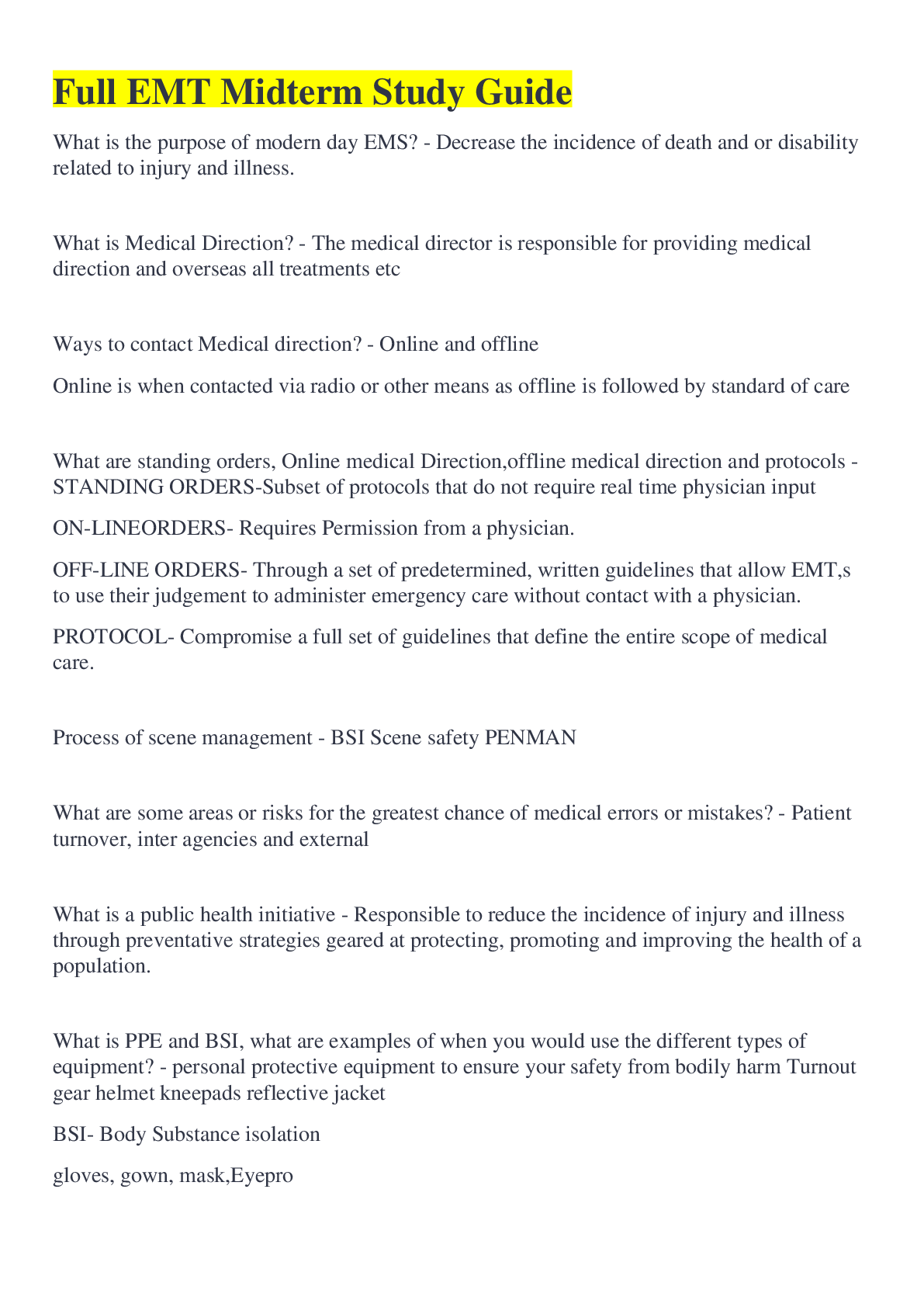
Full EMT Midterm Study Guide
What is the purpose of modern day EMS? - Decrease the incidence of death and or disability related to injury and illness.
What is Medical Direction? - The medical director is responsible for providing medical direction and overseas all treatments etc
Ways to contact Medical direction? - Online and offline
Online is when contacted via radio or other means as offline is followed by standard of care
What are standing orders, Online medical Direction,offline medical direction and protocols - STANDING ORDERS-Subset of protocols that do not require real time physician input
ON-LINEORDERS- Requires Permission from a physician.
OFF-LINE ORDERS- Through a set of predetermined, written guidelines that allow EMT,s to use their judgement to administer emergency care without contact with a physician.
PROTOCOL- Compromise a full set of guidelines that define the entire scope of medical care.
Process of scene management - BSI Scene safety PENMAN
What are some areas or risks for the greatest chance of medical errors or mistakes? - Patient turnover, inter agencies and external
What is a public health initiative - Responsible to reduce the incidence of injury and illness through preventative strategies geared at protecting, promoting and improving the health of a population.
What is PPE and BSI, what are examples of when you would use the different types of equipment? - personal protective equipment to ensure your safety from bodily harm Turnout gear helmet kneepads reflective jacket
BSI- Body Substance isolation
gloves, gown, mask,Eyepro
What are the 5 stages of grief? - 1. Denial
2. Anger
3. Bargaining
4. Depression
5. Acceptance
What types of job related stress is the EMT subject to - Cumulative, Acute, Burnout, Chronic, Delayed
What is Burnout and examples of burnout - Prolonged exposure to stressors
and leads to irritability lack of interest complacency
What are the different types of communicable diseases that can possibly be contracted by the EMT, know the signs and symptoms and correct PPE. - TB, HIV, Hepatitis A,B,C, Pneumonia
M95 mask, HEPA Filter mask, Gloves, Gown
What is Negligence and what are the components of negligence that must be provided in the court of law? - A tort in which there is no intent to do any harm to the patient but in which a breach in the duty to act occurred.
1. EMT had the duty to act
2. EMT breached that duty to act
3. The patient suffered a injury or harm that is recognized by the laws as a compensable injury
4. Proximate Cause
What is good samaritan law? - Laws are statutory provisions enacted by many states to protect citizens from liability for errors and omissions in giving good faith emergency medical care
What are the different types of consent? - 1. Expressed Consent
2. Implied Consent
3. Minor Consent
4. Involuntary Consent
Transfer of Care, Abandonment, Kidnapping, Assault, Battery, Slander - TOC- Passing a patient to a healthcare provider of equal or greater level.
Abandonment- Leaving a patient without proper Transfer of Care
Kidnapping- Transporting a patient against their will
Assault- attacking of intent to harm them
Battery-touching without consent
Slander- Verbal defamation of character
Requirements for PCR? - 1. Chief Complaint
2. mental Status
3. Vitals
4. Patient Demographics(age,sex,race,weight)
5. Time the incident was reported
6. Time unit was notified
7. Time of arrival to the patient
8. Time nit left the scene
9. Time unit arrived ad destination
10. Time of transfer of care
Advantages and Disadvantages of E-PCR vs PCR - E-PCR Syncs with other EMS providers and hospital disadvantages is not user friendly
PCR- faster and reliable documentation disadvantage is legibility of writing
Different areas and categories in a PCR? - 1. Administrative Information
2. Patient Demographics
3. Vital signs
4. Patient Narrative
5. Treatment
Pertinent Negative - Signs and symptoms expected to be found based on the chief complaint or physical exam but is denied by the patient and not found on examination
Signs vs Symptoms - Signs- what the patient visually presents to you
Symptoms- What the patient describes to you
Acronyms on the back of documentation chapter - SOAP- Subjective, Objective, Assessment, Plan
CHART- Chief Complaint, History, Assessment, Rx, Transport,
CHEATED- Chief Complaint, History, Exam, Assessment, Treatment, Evaluation, Disposition
Most effective and least effective way of communication in disaster situations and why? - Face to Face you get confirmation that it was received correctly
What is the FCC and what do they do? - Federal Communications Commission
They are in charge of all forms of communication
What is the process of dealing with a walk-up medical aid? - BSI Scene safety, Notify dispatch, Assess the patient,
How to communicate with dispatch? - Use clear text, speak clearly, avoid codes
Proper lifting technique - 1. Bend your hips and knees
2. Use your legs
3. Keep close to the center of your body
Difference between squat lift and power lift? - ones legs even other is staggered (squat and Lunge)
Different types of moves and when to utilize which ones? - 1. Power lift- offers best defense against injury and protests the patient with a safe and stable move
2. Squat lift- Alternative technique you can use if you have one weak ankle or if both your knees and legs are strong and healthy
3. one handed equipment- Carrying Technique
4. Reaching
5. Pushing and pulling
Know the different patient positioning and when to utilize which ones? - Supine-CPR, Respiratory Arrest
left recumbent position-vomit, shock, pregnancy
semi fowlers-shock,
Tendleberg- used to be for shock
Know the anatomical terms and locations terms for the body. - 1. Midline
2. Sagittal Plane
3. Frontal Plane
4. Transverse Plane
5.Midaxillary Line
6. Anterior/Posterior
7. Dorsal/Ventral
8. Right/Left
9. Superior/Inferior
10. Medial/Lateral
11. Proximal/Distal
12. Plantar
13. Palmer
14. Abdominal quadrants...r/l upper, r/l lower
Know the types of muscle (3 types) - Skeletal, Smooth, Cardiac
Anatomy of the airway - PG 205-206
Electrical pathway of conduction through the heart - 1. SA Node
2. AV Node
3. Bundle of HIS
4. R+L Bundle Branch
5. Purkinje Fibers
[Show More]