This week we learned about the potential benefits and drawbacks to clinical
decision support systems (CDSSs). Create a “Pros” versus “Cons” table with a column
for “Pro” and a separate column for “Con”. Include at leas
...
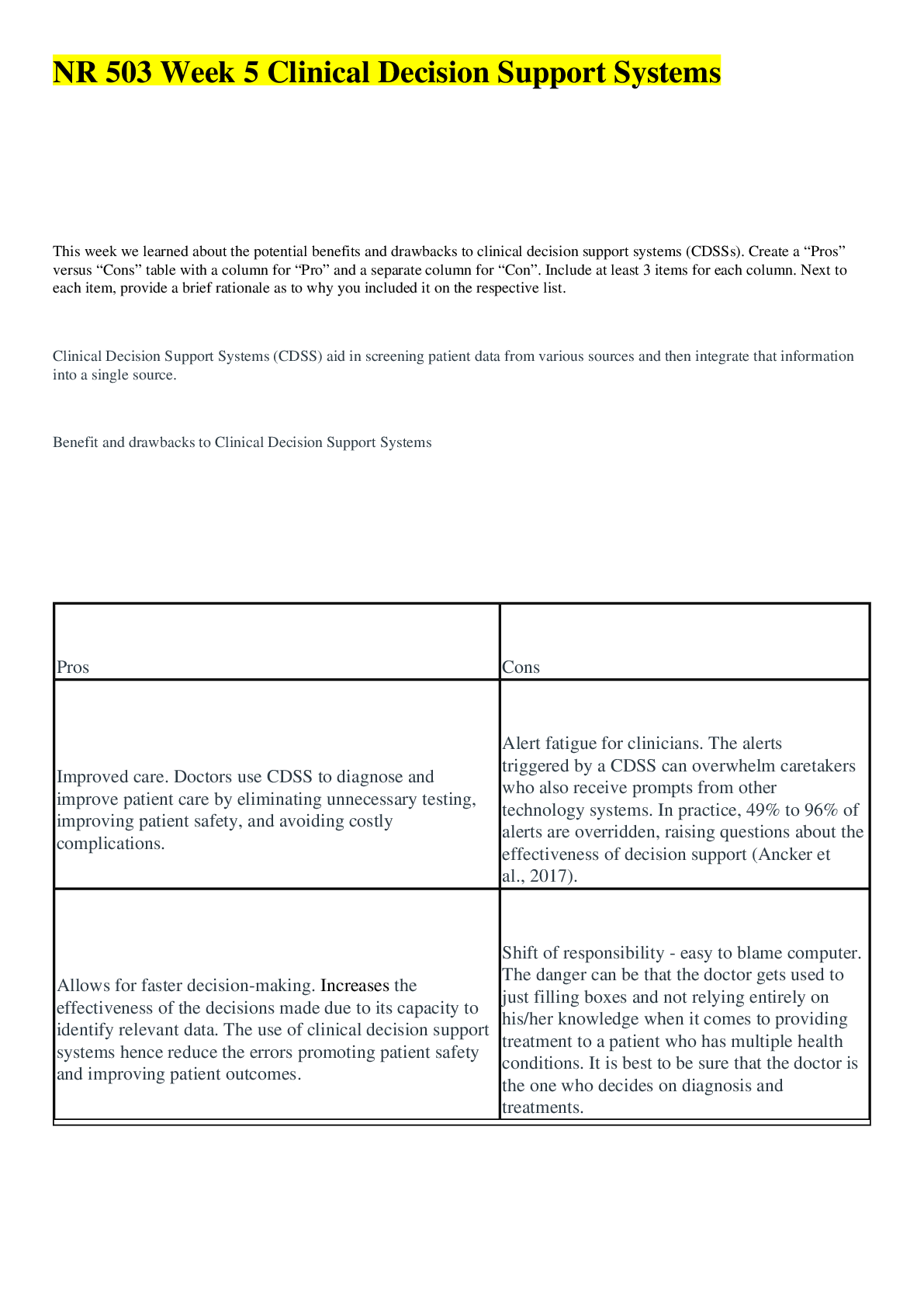
This week we learned about the potential benefits and drawbacks to clinical
decision support systems (CDSSs). Create a “Pros” versus “Cons” table with a column
for “Pro” and a separate column for “Con”. Include at least 3 items for each column.
Next to each item, provide a brief rationale as to why you included it on the respective
list.
Clinical Decision Support Systems (CDSS) aid in screening patient data from various
sources and then integrate that information into a single source.
Benefit and drawbacks to Clinical Decision Support Systems
Pros Cons
Improved care. Doctors use CDSS to
diagnose and improve patient care by
eliminating unnecessary testing,
improving patient safety, and avoiding
costly complications.
Alert fatigue for clinicians. The alerts
triggered by a CDSS can overwhelm
caretakers who also receive prompts
from other technology systems. In
practice, 49% to 96% of alerts are
overridden, raising questions about the
effectiveness of decision support (Ancker
et al., 2017).
Allows for faster decision-making.
Increases the effectiveness of the
decisions made due to its capacity to
identify relevant data. The use of clinical
decision support systems hence reduce
the errors promoting patient safety and
improving patient outcomes.
Shift of responsibility - easy to blame
computer. The danger can be that the
doctor gets used to just filling boxes and
not relying entirely on his/her knowledge
when it comes to providing treatment to a
patient who has multiple health
conditions. It is best to be sure that the
doctor is the one who decides on
diagnosis and treatments.
Has been seen to improve collaboration
and communication within groups. Helps
communicate with healthcare team
immediately. Have the ability and tools to
help physicians and nurses make better
care decisions. For example, clinical
decision support tools, like making
medication recommendations based on
diagnosis, and built-in clinical pathways,
which help guide a hospital through
May reduce skill in staff, because they
become dependent on the computers. If
misused, it can be detrimental to the
patient's health. Also, the danger can be
that the doctor gets used to just filling
boxes and not relying entirely on his/her
knowledge when it comes to providing
treatment to a patient who has multiple
health conditions.
This study source was downloaded by 100000832361371 from CourseHero.com on 07-21-2022 02:39:59 GMT -05:00
https://www.coursehero.com/file/53667922/WEEK-5-INFORMATIC-POSTdocx/
recommended procedures, and help
ensure patients receive the best care.
2. The primary goal of a CDSS is to leverage data and the scientific evidence to
help guide appropriate decision making. CDSSs directly assist the clinician in making
decisions about specific patients. For this discussion thread post, you are to assume
your future role as an APN and create a clinical patient and scenario to illustrate an
exemplary depiction of how a CDSS might influence your decision. This post is an
opportunity for you to be innovative, so have fun!
A CDS (Clinical Decision Support) usually provides clinicians, patients, staff or other
people with person-specific information, and knowledge in enhancing health care. The
system encompasses various tools that help in decision making in the clinical workflow.
Some of the tools are computerized alerts as well as reminders for patients and
providers. Programs are being developed to help the clinician make his or her job easier
and faster. There are benefits regarding the CDSS in the hospital setting. Some of the
benefits include increased care quality, improved health results, and avoidance of errors
as well as adverse events. More so, there is enhanced efficiency, cost-benefit, and
patient and provider satisfaction. The CDSS helps in reducing the risks associated with
medication errors especially to children and infants during emergency situations. The
system can do complex calculations fast and efficiently with minimal mistakes. There is
a reduction of misdiagnosis, and the CDSS drastically improves the margin existing in
the diagnostic error. The CDSS provides the medical team with reliable, and consistent
information. As an APN, I would use the CDSS on a patient with Obstructed Sleep
Apnea (OSA), who is experiencing frequent episodes of partial or complete upper
airway obstruction during sleep. These frequent obstructions result in recurrent oxygen
desaturations, hypercarbia, sleep fragmentation, and increased fluctuations in
intrathoracic pressure. Over time, these effects contribute to substantial morbidity and
mortality (Williams, 2017, p. 42). As the APN inputs that the patient has a history of
OSA, a BPA comes up on the screen to order the OSA order set. This includes having a
Respiratory Therapist to come talk with the patient to determine if CPAP use is needed,
if supplemental oxygen should be set up, or if a sleeping trial should be ordered after
discharge. The BPA notifies the APN that the patient has OSA, and it is flagged for
discussion during any sedating procedure. According to Mei-Chen et al (2015), when
patients use their CPAP long-term, they have increases in sleep quality and reduced
cardiovascular comorbidities with lower blood pressure. Knowing this information can
provide the nurse with more facts to present to the patient who has OSA, in order to
help with compliance. Another example is that an EKG or Lab work can be performed
and uploaded to a record in real-time and the doctor can plan treatment faster, which
shortens delays and improves patient outcome. This helps to keep all the patient’s
information in one location, and allows patient to be more pro-active in their care.
This study source was downloaded by 100000832361371 from CourseH
[Show More]