AADE STUDY QUESTIONS AND CORRECT
ANSWERS 2022
Gestational diabetes mellitus definition - Correct Answer- diagnosed in the second or third trimester of
pregnancy that is not clearly either type 1 or type 2 diabetes.
...
AADE STUDY QUESTIONS AND CORRECT
ANSWERS 2022
Gestational diabetes mellitus definition - Correct Answer- diagnosed in the second or third trimester of
pregnancy that is not clearly either type 1 or type 2 diabetes. Women with diabetes in the first trimester
would be classified as having type 2 diabetes.
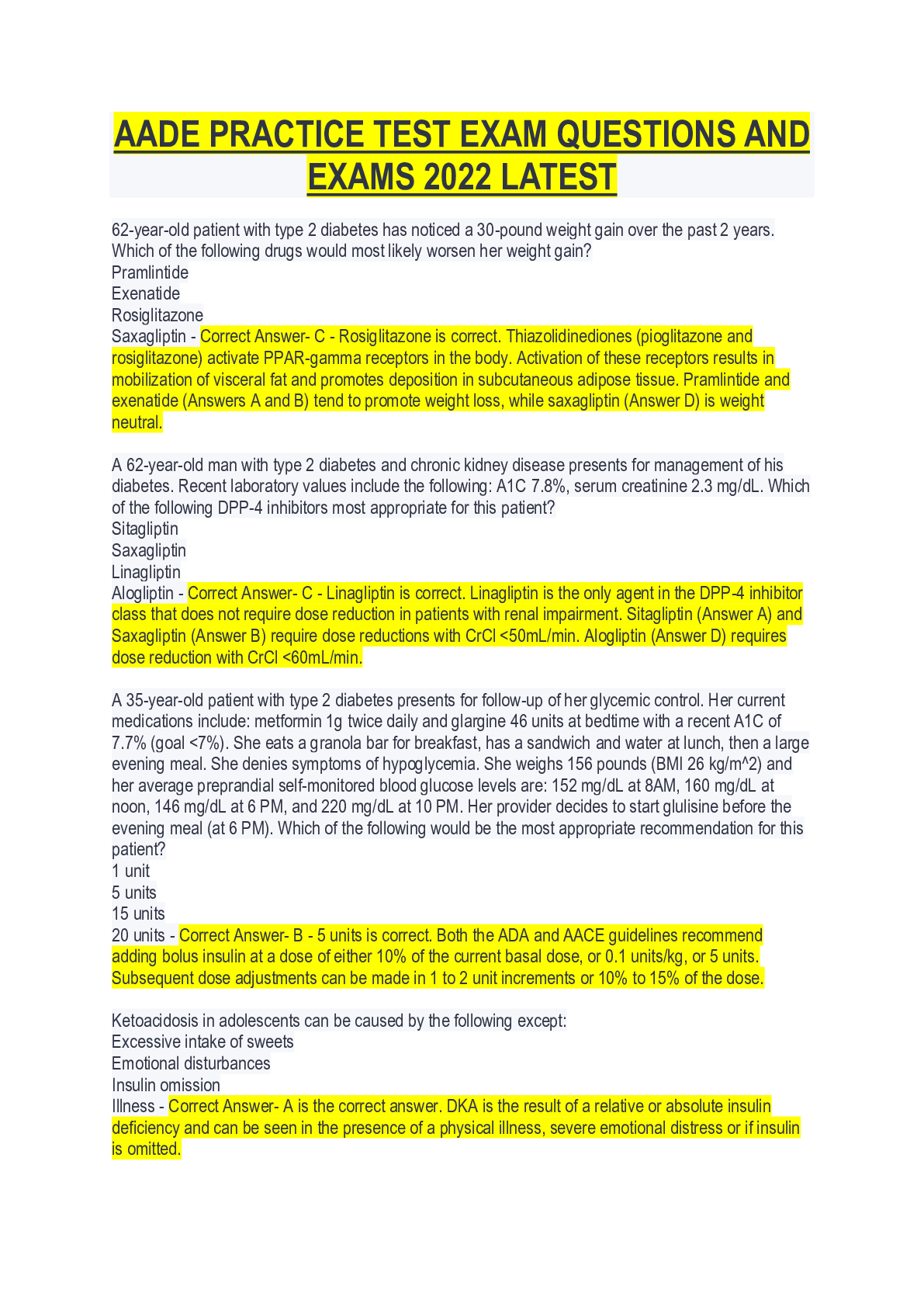
Which of the following lab values is most consistent with the presentation of diabetic ketoacidosis?
pH 7.0
Bicarbonate 20 mEq/L
Glucose 200 mg/dL
Anion gap 10 mmol/L - Correct Answer- pH 7.0 is correct. Patients with diabetic ketoacidosis present
with blood pH <7.30, serum bicarbonate <18 meq="" l="" answer="" b="" glucose="">250 mg/dL
(Answer C), and anion gap >12 (Answer D) with moderate or severe ketoacidosis.
The main difference between a compliance model and empowerment approach to behavior change is
the:
Clinical outcomes
Financial cost
Individual's role in self-management
Degree of behavior change - Correct Answer- The correct answer is C. The empowerment approach
recognizes that the person living with diabetes has as important a contribution to make as the diabetes
educator. The healthcare professional is a source of expertise, support and inspiration rather than a
teacher or caregiver.
Supplement additional carbohydrate when beginning to exercise if blood sugar is less than: - Correct
Answer- 150 mg/dL. , 0.5-1 g/kg of body mass per hour
Which of the following is the most appropriate daily protein intake for a patient with nondialysis�dependent diabetic kidney disease who weighs 121 lb. (55 kg)? - Correct Answer- 44 g is correct. The
2016 ADA guidelines recommend that dietary protein intake should be 0.8 g/kg body weight per day for
patient with nondialysis-dependent diabetic kidney disease
Which of the following was a significant benefit (occurred less often in intensive blood pressure
treatment group) in the ACCORD trial?
Nonfatal myocardial infarction
Total and nonfatal stroke
Cardiovascular death
Hyperkalemia - Correct Answer- B - Total and nonfatal stroke is correct. The ACCORD trial compared
the effect of intensive systolic blood pressure goals (<120 mmHg) with standard care (130 to 140
mmHg) on cardiovascular events. The composite primary endpoint, nonfatal myocardial infarction
(Answer A), cardiovascular death (Answer C) and all-cause mortality were not statistically different
between the groups. Total and nonfatal stroke were lower in the intensive group but did not alter the
primary composite endpoint. Patients in the intensive control group also experienced more orthostasis
and hyperkalemia (Answer D).
The only medication that currently has FDA approval for use in children with type 2 diabetes who are
ages 10 years and older is:
Glimepiride
Glyburide
Metformin
None of the above - Correct Answer- The correct answer is C. Metformin is currently the only FDA
approved medication for use in children with type 2 diabetes.
Which of the following is most associated with an increased risk of diabetic retinopathy?
Hypertension uncontrolled on two medications
Hypercholesterolemia on low intensity statin
Diabetic Kidney Disease on thiazide diuretics
Diagnosis of Type 1 diabetes before age 10 - Correct Answer- Hypertension uncontrolled on two
medications is correct. Diabetic retinopathy results from a combination of uncontrolled hypertension
(blood pressure >140/90 mmHg) and poor glycemic control (A1C >7%) over time.
Hypercholesterolemia increases the risk of macrovascular complications and should be treated with a
statin of appropriate intensity (Answer B), either moderate or high-intensity. The occurrence of
microvascular disease in one part of the body increases the likelihood of other organ involvement;
however, there is no data that associates increased risk with thiazide diuretics or other agents (Answer
C). The age of diabetes onset does not directly predict the occurrence of microvascular complications
(Answer D), especially with contemporary aggressive management of glycemic control.
An overweight 54-year-old man taking metformin 1g twice daily plus glimepiride 4mg daily presents for
evaluation. He is 5 feet, 9 inches tall and weighs 200 pounds (BMI 29.5 kg/m^2) with an A1C of 8%. His
diabetes care team decides to start basal insulin. Which of the following would be the most appropriate
insulin product?
Lispro
Glargine
Regular
Glulisine - Correct Answer- Glargine is correct. According to the 2016 ADA and 2016 AACE treatment
algorithms, patients failing oral therapy should be started on intermediate or long-acting insulin products
such as NPH insulin, glargine, detemir or degludec. Initiation of rapid-acting (Answer A and D) or short�acting insulin (Answer C) without background basal insulin is associated with increased hypoglycemia
and weight gain.
An 82-year-old patient with diabetes, benign prostatic hypertrophy and hypertension returns to clinic for
a 1-month follow-up of his blood pressure. He reports feeling fine and denies orthostasis symptoms. His
medications include lisinopril 20mg daily, hydrochlorothiazide 25mg daily, doxazosin 1mg daily, and
sitagliptin 100mg daily. His home blood pressure readings average 110/68 mmHg. In clinic today his BP
is 114/70 mmHg, heart rate 60 BPM; laboratory results include serum creatinine 0.9 mg/dL, potassium
3.8 mmol/L, and A1C 6.8%. Which of the following would be the most appropriate recommendation for
this patient?
Continue all medications at the current dose
Stop hydrochlorothiazide
Stop lisinopril
Stop doxazosin - Correct Answer- Stop doxazosin is correct. Although most adult patients with diabetes
may benefit from lower blood pressure goals, treatment to blood pressure <130/70 mmHg has been
associated with increased mortality in older adults (Answer A). Doxazosin should be discontinued
because it is not associated with mortality benefit (unlike lisinopril, Answer C; and hydrochlorothiazide,
Answer B) and other agents may adequately treat his benign prostatic hypertrophy.
Which of the following persons with diabetes is most likely to exhibit an increased readiness to learn? CONTINUES.....
[Show More]


.png)









.png)

