AADE PRACTICE TEST EXAM QUESTIONS AND
EXAMS 2022 LATEST
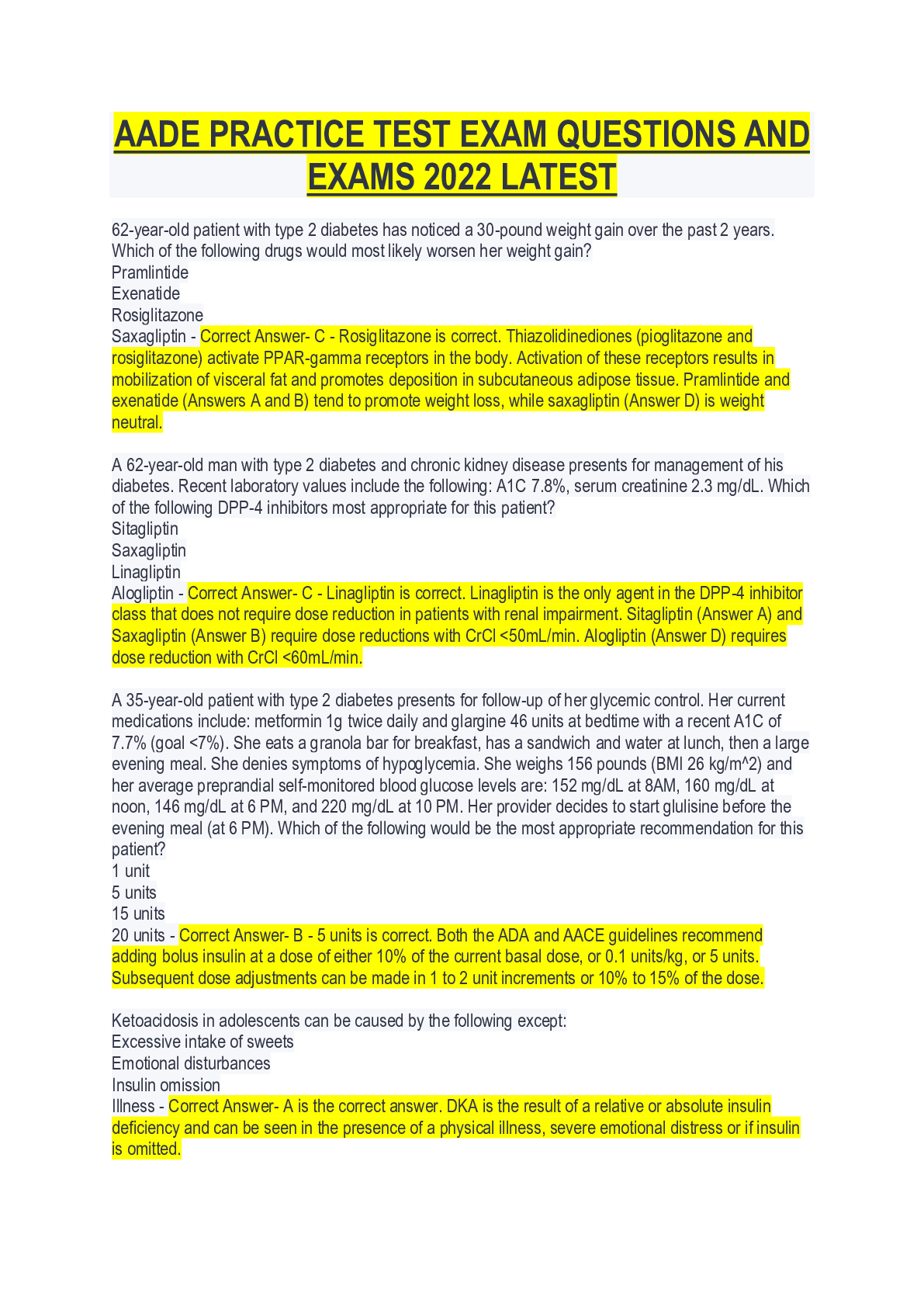
62-year-old patient with type 2 diabetes has noticed a 30-pound weight gain over the past 2 years.
Which of the following drugs would most likely worsen her we
...
AADE PRACTICE TEST EXAM QUESTIONS AND
EXAMS 2022 LATEST
62-year-old patient with type 2 diabetes has noticed a 30-pound weight gain over the past 2 years.
Which of the following drugs would most likely worsen her weight gain?
Pramlintide
Exenatide
Rosiglitazone
Saxagliptin - Correct Answer- C - Rosiglitazone is correct. Thiazolidinediones (pioglitazone and
rosiglitazone) activate PPAR-gamma receptors in the body. Activation of these receptors results in
mobilization of visceral fat and promotes deposition in subcutaneous adipose tissue. Pramlintide and
exenatide (Answers A and B) tend to promote weight loss, while saxagliptin (Answer D) is weight
neutral.
A 62-year-old man with type 2 diabetes and chronic kidney disease presents for management of his
diabetes. Recent laboratory values include the following: A1C 7.8%, serum creatinine 2.3 mg/dL. Which
of the following DPP-4 inhibitors most appropriate for this patient?
Sitagliptin
Saxagliptin
Linagliptin
Alogliptin - Correct Answer- C - Linagliptin is correct. Linagliptin is the only agent in the DPP-4 inhibitor
class that does not require dose reduction in patients with renal impairment. Sitagliptin (Answer A) and
Saxagliptin (Answer B) require dose reductions with CrCl <50mL/min. Alogliptin (Answer D) requires
dose reduction with CrCl <60mL/min.
A 35-year-old patient with type 2 diabetes presents for follow-up of her glycemic control. Her current
medications include: metformin 1g twice daily and glargine 46 units at bedtime with a recent A1C of
7.7% (goal <7%). She eats a granola bar for breakfast, has a sandwich and water at lunch, then a large
evening meal. She denies symptoms of hypoglycemia. She weighs 156 pounds (BMI 26 kg/m^2) and
her average preprandial self-monitored blood glucose levels are: 152 mg/dL at 8AM, 160 mg/dL at
noon, 146 mg/dL at 6 PM, and 220 mg/dL at 10 PM. Her provider decides to start glulisine before the
evening meal (at 6 PM). Which of the following would be the most appropriate recommendation for this
patient?
1 unit
5 units
15 units
20 units - Correct Answer- B - 5 units is correct. Both the ADA and AACE guidelines recommend
adding bolus insulin at a dose of either 10% of the current basal dose, or 0.1 units/kg, or 5 units.
Subsequent dose adjustments can be made in 1 to 2 unit increments or 10% to 15% of the dose.
Ketoacidosis in adolescents can be caused by the following except:
Excessive intake of sweets
Emotional disturbances
Insulin omission
Illness - Correct Answer- A is the correct answer. DKA is the result of a relative or absolute insulin
deficiency and can be seen in the presence of a physical illness, severe emotional distress or if insulin
is omitted.
A 28-year-old woman with Type 1 diabetes for 10 years needs to re-calculate a correction bolus based
on her new insulin regimen. Her current total daily dose (TDD) of insulin is 60 units. Which of the
following best estimates the amount 1 unit of insulin will lower her blood glucose level?
3 mg/dL
8 mg/dL
25 mg/dL
30 mg/dL - Correct Answer- D - 30 mg/dL is correct. The Rule of 1800 (some providers recommend
1700 for patients on insulin pumps, or 1500 for patients injecting regular insulin) estimates the amount
1 unit of insulin will lower her blood glucose level. This patient takes a total daily dose (TDD) of 60 units
(1800 divided by 60 units = 30 mg/dL). A general rule of thumb is that 1 unit of insulin will lower the
blood glucose by 50 mg/dL.
A 45-year-old man with type 2 diabetes recently started atorvastatin 40mg daily to lower his cholesterol.
Which of the following is the most appropriate frequency to recheck the fasting lipid profile?
1 to 3 weeks
4 to 12 weeks
6 to 9 months
Yearly - Correct Answer- B - 4 to 12 weeks is correct. The 2013 ACC/AHA Cholesterol Guidelines for
ASCVD Risk Reduction in Adults recommends that a repeat fasting lipid panel be checked within 4 to
12 months after statin initiation or dose adjustment. Once patients the dose is stabilized, then follow-up
can be set to every 3 to 12 months thereafter.
How frequently should you engage in moderate physical activity for weight loss?
Three times per week
Every other day
Daily
Five times per week - Correct Answer- C is the correct answer. Activity levels of at least one to one and
a half hours per day of moderate activity may be needed to achieve successful long term weight loss
and maintenance.
One of the most serious complications of type 2 diabetes in the older adult is:
Hyperosmolar hyperglycemic state (HHS)
Diabetic ketoacidosis (DKA)
Nocturnal hyperglycemia
Cataracts - Correct Answer- The correct answer is A. Because HHS develops slowly and does not
cause gastrointestinal pain, it can be overlooked or misdiagnosed. Delayed treatment and co�morbidities more common in the older adults result in a mortality rate of approximately 15%.
A 56-year-old overweight African-American patient with diabetes, heart failure and hypertension
presents for follow-up. He currently takes all of his medications in the morning. His provider recently
read in the ADA guidelines that taking at least one antihypertensive at bedtime has been shown to
reduce cardiovascular events and mortality. Which of the following antihypertensives should be moved
to bedtime?
Furosemide
Candesartan
Spironolactone
Hydrochlorothiazide - Correct Answer- B - Candesartan is correct. Patients who maintain elevated
blood pressure readings at night during sleep, called non-dippers, are at increased risk of
cardiovascular events and mortality. Moving one or more antihypertensives to bedtime has been found
to restore a normal blood pressure dipping pattern. Furosemide (Answer A), spironolactone (Answer C)
and hydrochlorothiazide (Answer D) are diuretics which may disrupt sleep patterns due to urinary
frequency.
CONTINUES....
[Show More]














.png)

