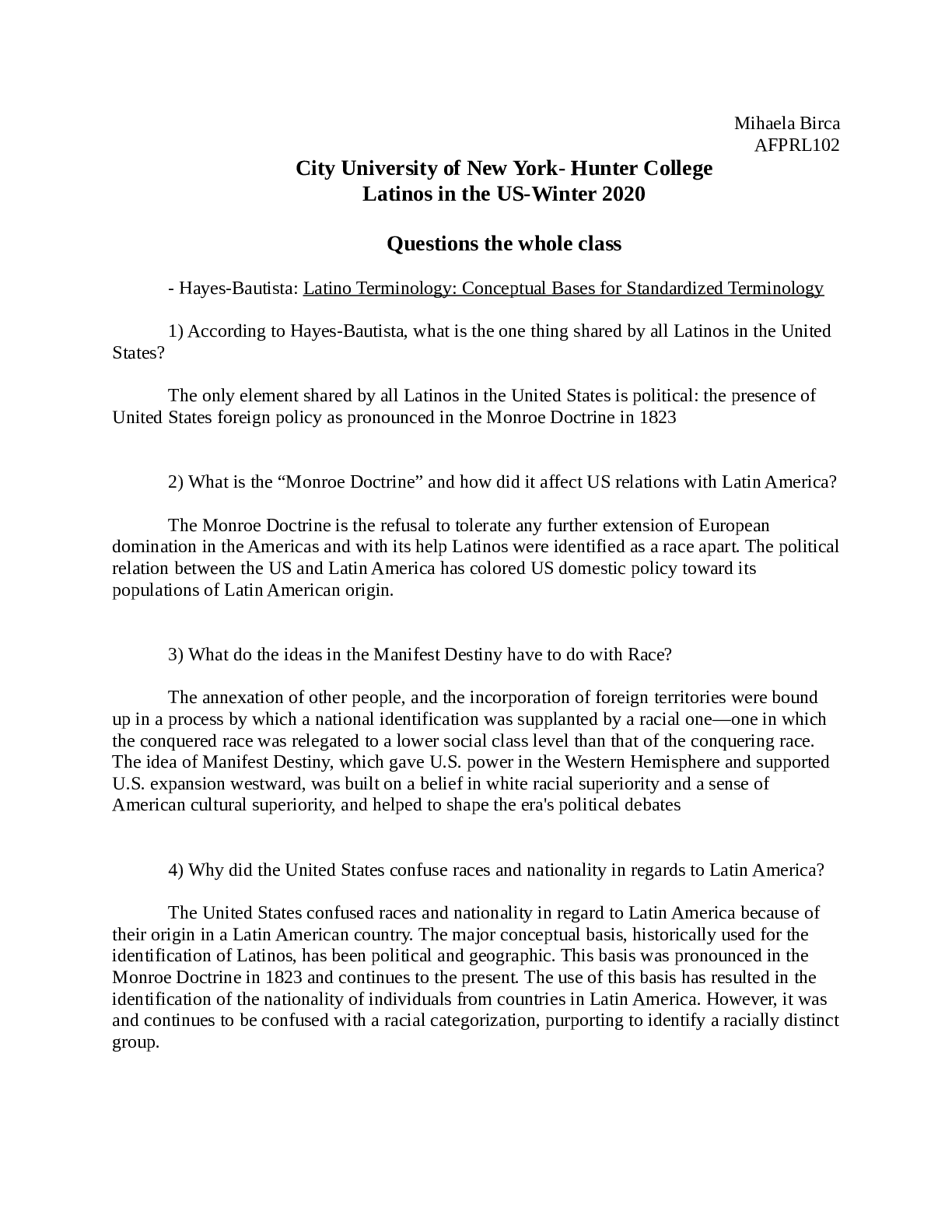
According to Hayes-Bautista, what is the one thing shared by all Latinos in the United
States?
The only element shared by all Latinos in the United States is political: the presence of
United States foreign policy as
...
According to Hayes-Bautista, what is the one thing shared by all Latinos in the United
States?
The only element shared by all Latinos in the United States is political: the presence of
United States foreign policy as pronounced in the Monroe Doctrine in 1823
2) What is the “Monroe Doctrine” and how did it affect US relations with Latin America?
The Monroe Doctrine is the refusal to tolerate any further extension of European
domination in the Americas and with its help Latinos were identified as a race apart. The political
relationship between the US and Latin America has colored US domestic policy toward its
populations of Latin American origin.
3) What do the ideas in Manifest Destiny have to do with Race?
The annexation of other people and the incorporation of foreign territories were bound
up in a process by which a national identification was supplanted by a racial one—one in which
the conquered race was relegated to a lower social class level than that of the conquering race.
The idea of Manifest Destiny, which gave the U.S. power in the Western Hemisphere and supported
U.S. expansion westward was built on a belief in white racial superiority and a sense of
American cultural superiority, and helped to shape the era's political debates
4) Why did the United States confuse races and nationality in regards to Latin America?
The United States confused races and nationalities in regard to Latin America because of
their origin in a Latin American country. The major conceptual basis, historically used for the
identification of Latinos, has been political and geographic. This basis was pronounced in the
Monroe Doctrine in 1823 and continues to the present. The use of this basis has resulted in the
identification of the nationality of individuals from countries in Latin America. However, it was
and continues to be confused with a racial categorization, purporting to identify a racially distinct
group.5) What does the term “Hispanic” mean, and when did it start to be used?
The term “Hispanic” was described as: "A person of Mexican, Puerto Rican, Cuban,
Central or South America or other Spanish culture or origin, regardless of race." This is a new
category that was created by executive fiat in the 1970s.
6) Why is “Latino” a better term than “Hispanic”?
After an investigative reporting by the Los Angeles Times among the Mexican and nonMexican Latino population in Southern California it was determined that most Latinos rejected
the term “Hispanic.”
7) What is the trait that most Latinos in the US accept to have in common?
The finding by the Times was that most respondents viewed "Latino" to be an adequate,
appropriate, and acceptable self-description that expressed to their own satisfaction their desire
to maintain a sense of national origin, while yet expressing links between them. As a result of
this effort, the Los Angeles Times Style Guide states that:
• Latino is the preferred umbrella term for all Spanish- surnamed groups in the United
States.
8) Who is included by the term Latino and who is not included?
Latino refers to geography, to the various countries in the Western Hemisphere.
Specifically, to Latin America, to people from the Caribbean (Puerto Rico, Cuba, Dominican
Republic), South America (Ecuador, Bolivia, Colombia, Peru, etc.), and Central America
(Honduras, Costa Rica, etc.) Non-Latinos are Whites, African Americans, and Asians.
-Juan Gonzalez: The Role of the Church
1) How did the Crown and the Church consider the colonization and conversion of
Natives?
In Spain, both Crown and the Church saw colonizing and conversion as a unified effort.
Priests accompanied each military expedition for the purpose of Christianizing the natives.
2) How do British and Spanish differ in their methods of subjugation?
As the Conquest proceeded, priests performed baptisms by the thousands. Before the holy
water could dry on their foreheads, the Indian women were routinely grabbed as concubines by Spanish soldiers and settlers. The priests even performed occasional marriages between
Spaniards and Indians.
The first English colonies, by contrast, began as family settlements. They maintained
strict separation from Indian communities, sometimes even bolstered by segregation laws. In
North America, Indians rarely served as laborers for settlers or ae household servants, and
unmarried sexual unions between natives and whites were rare except for captives of war.
3) What were the views of the Puritans in regards to the Indians?
New England Puritans segregated themselves from Indians. In 1643, sections of Harvard
College were built with money raised by the New England Company among Anglicans back
home. While donors were told the funds would be used for Indian education, some of the money
ended up buying guns and ammunition for the colonists. So minor was Puritan concern for the
Indians’ souls. They used people’s compassion towards the Indians to fulfill their needs with that
money.
[Show More]