Motion
Part I: Looking North
For this activity, imagine you are the observer shown on Earth in the Northern Hemisphere and that the time
is 6 P.M. Looking north, the sky will appear as shown in Figure I . The position
...
Motion
Part I: Looking North
For this activity, imagine you are the observer shown on Earth in the Northern Hemisphere and that the time
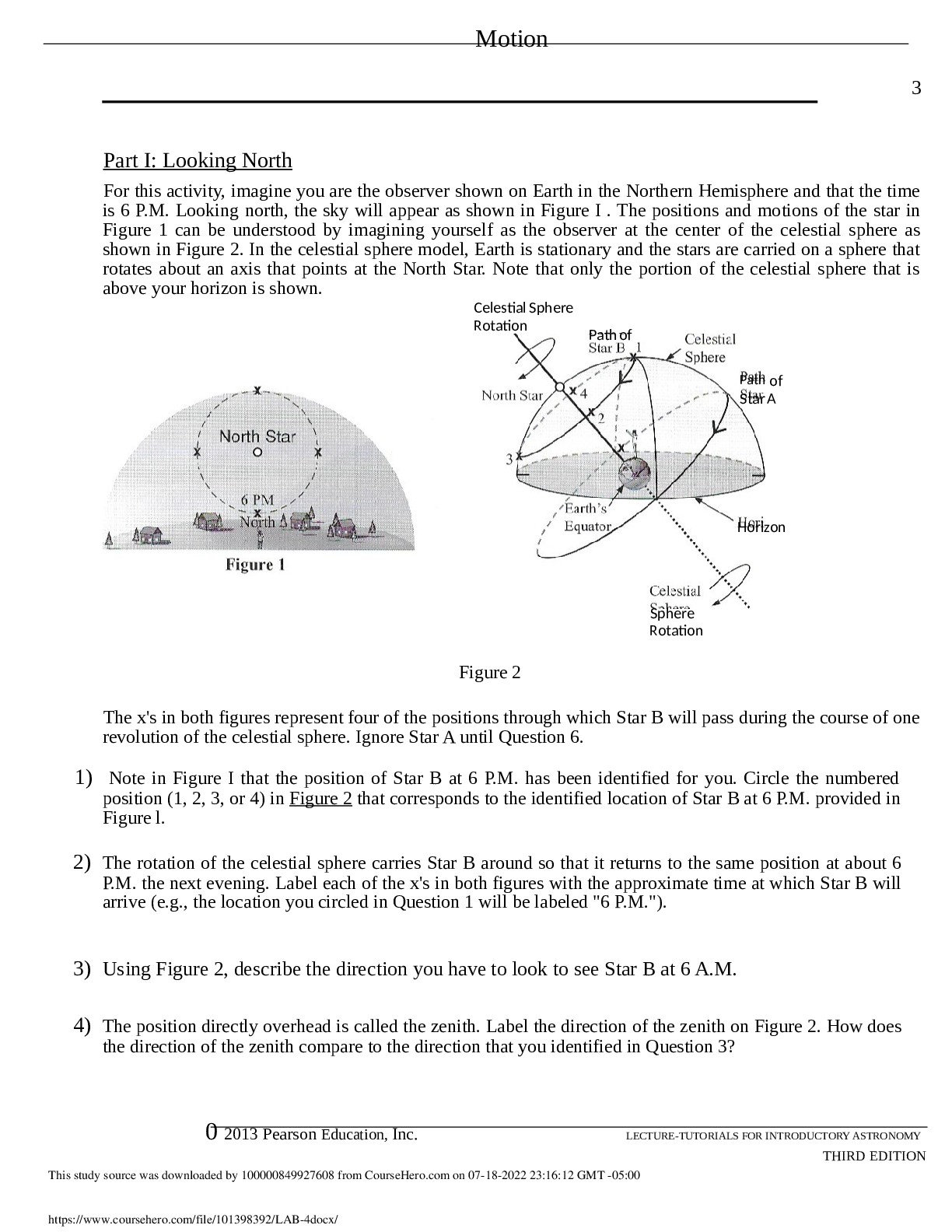
is 6 P.M. Looking north, the sky will appear as shown in Figure I . The positions and motions of the star in
Figure 1 can be understood by imagining yourself as the observer at the center of the celestial sphere as
shown in Figure 2. In the celestial sphere model, Earth is stationary and the stars are carried on a sphere that
rotates about an axis that points at the North Star. Note that only the portion of the celestial sphere that is
above your horizon is shown.
Figure 2
The x's in both figures represent four of the positions through which Star B will pass during the course of one
revolution of the celestial sphere. Ignore Star A until Question 6.
1) Note in Figure I that the position of Star B at 6 P.M. has been identified for you. Circle the numbered
position (1, 2, 3, or 4) in Figure 2 that corresponds to the identified location of Star B at 6 P.M. provided in
Figure l.
2) The rotation of the celestial sphere carries Star B around so that it returns to the same position at about 6
P.M. the next evening. Label each of the x's in both figures with the approximate time at which Star B will
arrive (e.g., the location you circled in Question 1 will be labeled "6 P.M.").
3) Using Figure 2, describe the direction you have to look to see Star B at 6 A.M.
4) The position directly overhead is called the zenith. Label the direction of the zenith in Figure 2. How does
the direction of the zenith compare to the direction that you identified in Question 3?
0 2013 Pearson Education, Inc. LECTURE-TUTORIALS FOR INTRODUCTORY ASTRONOMY
THIRD EDITION
Path of
Path of
Star A
Horizon
Rotation
Celestial Sphere
Sphere
Rotation
This study source was downloaded by 100000849927608 from CourseHero.com on 07-18-2022 23:16:12 GMT -05:00
https://www.coursehero.com/file/101398392/LAB-4docx/Motion
5) In Figure 1, the path that Star B follows is shown with a dashed line. Draw a small arrowhead on the path
to represent the direction Star B would be moving at the instant it is at each of the four locations marked
with an x. Check your answers with a nearby group.
6) Using Figure 2, describe in words where you would look to see Star A when it is halfway between rising
and setting.
Part Il: Looking East
Figure 3 shows an extended view along the eastern horizon showing the positions of Stars A
and B at 6 P.M. The arrow shown is provided to indicate the direction that Star B will be
moving at 6 P.M.
[Show More]





.png)