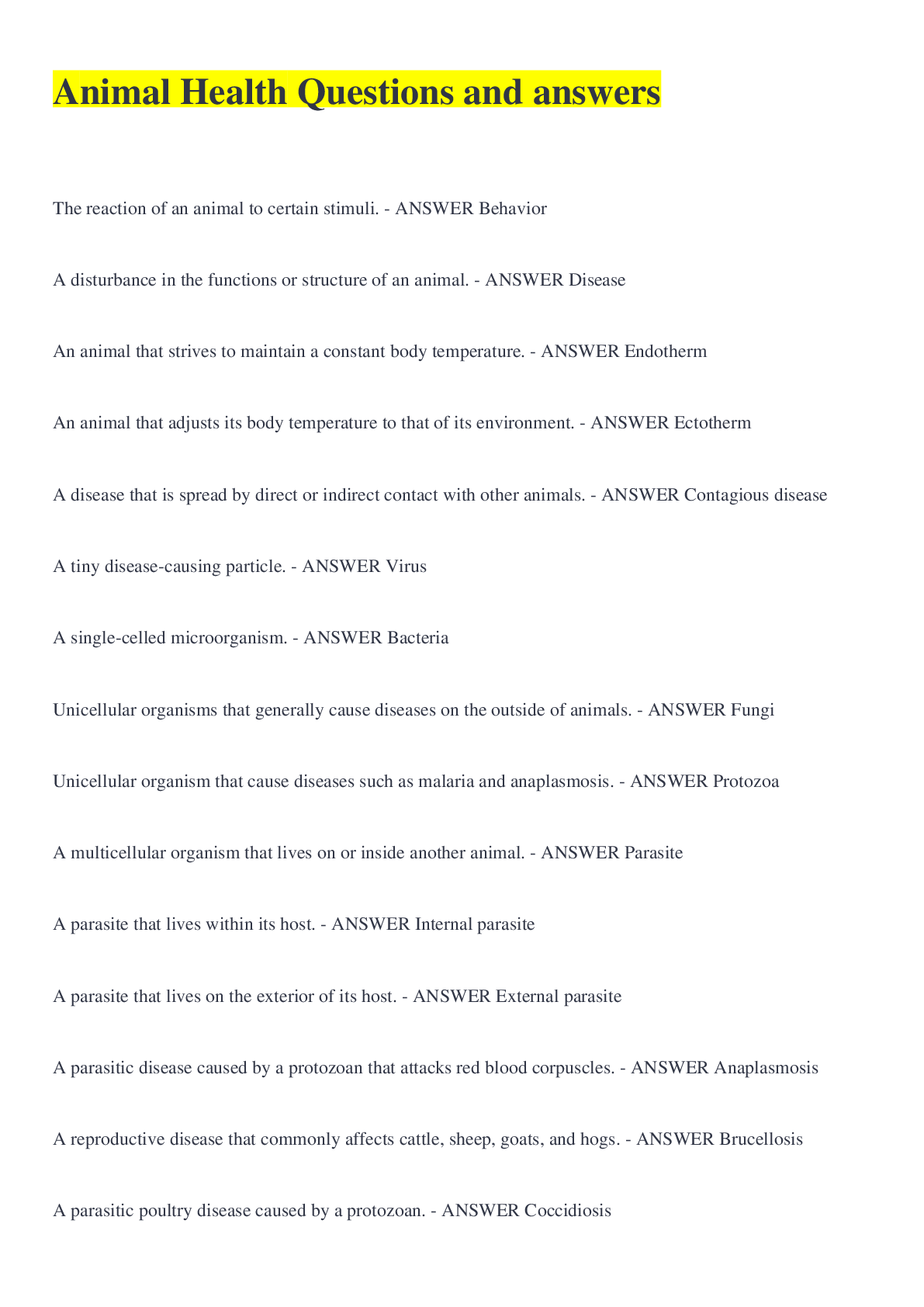
The reaction of an animal to certain stimuli. - ANSWER Behavior
A disturbance in the functions or structure of an animal. - ANSWER Disease
An animal that strives to maintain a constant body temperature. - ANSWER En
...
The reaction of an animal to certain stimuli. - ANSWER Behavior
A disturbance in the functions or structure of an animal. - ANSWER Disease
An animal that strives to maintain a constant body temperature. - ANSWER Endotherm
An animal that adju
sts its body temperature to that of its environment. - ANSWER Ectotherm
A disease that is spread by direct or indirect contact with other animals. - ANSWER Contagious disease
A tiny disease-causing particle. - ANSWER Virus
A single-celled microorganism. - ANSWER Bacteria
Unicellular organisms that generally cause diseases on the outside of animals. - ANSWER Fungi
Unicellular organism that cause diseases such as malaria and anaplasmosis. - ANSWER Protozoa
A multicellular organism that lives on or inside another animal. - ANSWER Parasite
A parasite that lives within its host. - ANSWER Internal parasite
A parasite that lives on the exterior of its host. - ANSWER External parasite
A parasitic disease caused by a protozoan that attacks red blood corpuscles. - ANSWER Anaplasmosis
A reproductive disease that commonly affects cattle, sheep, goats, and hogs. - ANSWER Brucellosis
A parasitic poultry disease caused by a protozoan. - ANSWER Coccidiosis
A disease of cattle caused by feeding meat meal infected with scrapie. - ANSWER Mad cow disease
Internal parasites of cattle caused by heel flies. - ANSWER Grubs
A bacterial disease of the udder that affects female cattle, sheep, goats,and swine. - ANSWER Mastitis
The process of keeping areas where animals are raised and feed clean. - ANSWER Sanitation
A substance that destroys the microorganisms that cause disease. - ANSWER Disinfectant
Acquired resistance to a disease. - ANSWER Immunity
Immune substances produced by the body to defend against the attack of disease-causing organisms. - ANSWER Antibodies
The first milk produced after birth containing material antibodies to protect the newborn against diseases early in life. - ANSWER Colostrum
A pellet placed under the skin to promote growth or control reproduction is called a(n)___________________. - ANSWER Implant
A(n) ___________________ injection is used to treat mastitis in dairy cattle. - ANSWER Intramammary
Bumps found on the back of cattle in late winter and spring may be caused by ________________. - ANSWER Grubs
Cattle with ____________ coloring around their eyes are more susceptible to eye diseases, such as pink eye. - ANSWER Light
Disease-preventing medications placed in food or water are called ________________. - ANSWER Additives
A(n) _______________ injection is made just beneath the skin. - ANSWER Subcutaneous
The ____________ of an endothermic animal may involuntarily contract or shiver to burn energy and keep the body warm. - ANSWER Muscles
Hollow tail is caused by severe ____________________. - ANSWER Malnutrition
Roundworms are __________________ parasites. - ANSWER Internal
New animals should be kept in __________________ for three to four weeks to ensure they are free of disease. - ANSWER Isolation
A(n) ______________ medicati
[Show More]