11.4.6 Test (TST): Applications of Trigonometry Test
Precalculus Honors
Points Possible:100
Date: 06/01/2022
Answer the following questions using what you've learned from this unit. Write your responses
in the spa
...
11.4.6 Test (TST): Applications of Trigonometry Test
Precalculus Honors
Points Possible:100
Date: 06/01/2022
Answer the following questions using what you've learned from this unit. Write your responses
in the space provided.
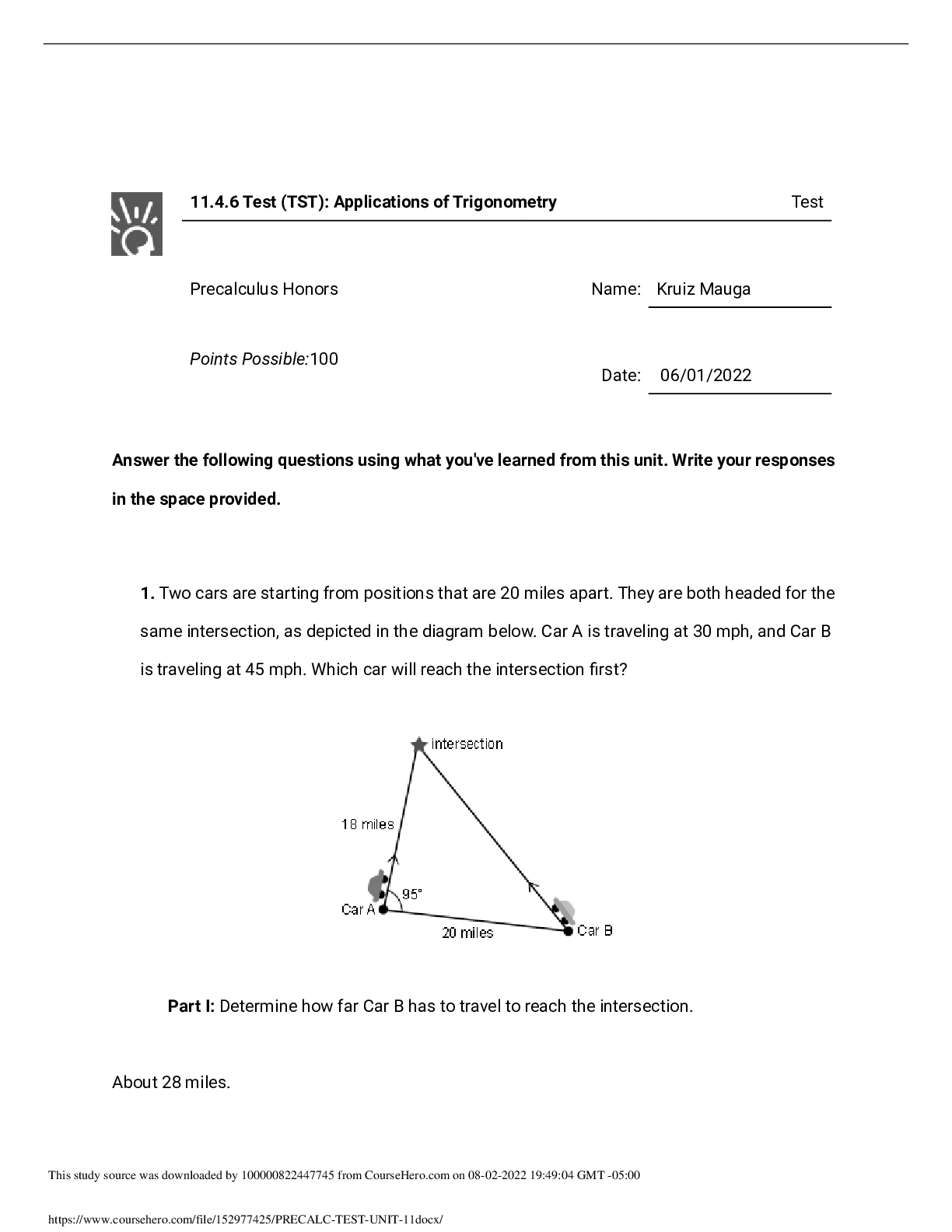
1. Two cars are starting from positions that are 20 miles apart. They are both headed for the
same intersection, as depicted in the diagram below. Car A is traveling at 30 mph, and Car B
is traveling at 45 mph. Which car will reach the intersection first?
Part I: Determine how far Car B has to travel to reach the intersection.
About 28 miles.
Part II: Determine the time necessary for each car to reach the intersection. Round your
answers to the nearest hundredth of an hour.
Part III: Which car reaches the intersection first, and by how many hours?
Car A will reach the intersection first by 0.02 hours.
2. Solve for the missing length and the other two angles in the triangle below.
Part I: Use any method you like to find the length of side BC.
12.9
Part II: Use the method of your choice to find the measure of angle C.
Part III: Use any method you like to find the measure of angle B.
3. Solve the triangle below.
Part I: Find the measure of angle B.
Part III: Use any method you like to find the measure of angle A.
°
4. Assume two people, Swanson and Suzie, are standing 35 feet apart and are watching a
boat race. At a given moment, Swanson approximates the angle formed by the lead boat,
himself, and Suzie to be . Suzie approximates the angle formed by the lead boat, herself,
and Swanson to be . How far is the boat from Swanson?
Part I: Use the law of sines to set up a proportion that will help you find the distance
from Swanson to the boat.
D=sin130°(35)/sin20°
Part II: How far is Swanson from the boat.
5. Solve the following triangle for all missing sides and angles.
Part I: What is the measure of angle A?
Part II: Find the length of side a.
Part III: Find the length of side b.
6. Solve the following triangle for all missing sides and angles.
Part I: Find the measure of angle B.
55°
Part II: Find the length of side a.
Part III: Use any method to find the length of side c.
212.04
7. Use the dot product to determine which of the following vector pairs are orthogonal.
A. and
Part I: What is the dot product of these two vectors?
Part II: Are the two vectors orthogonal?
No, they are not.
B. and
Part II: Are the two vectors orthogonal?
Yes, they are
8. Consider the vector .
A. What is the angle between and the positive x-axis?
Part I: Use the formula to find the cosine of the angle between the
two vectors (-7,8) and (1,0).
Cos(
B. Write in the form
Part I: Find the magnitude of vector v. Express your answer in radical form.
Sqrt113
Part II: Use the magnitude and the angle of vector v to write it in the form
Sqrt113cos(-48.81407) Sqrt113sin(-48.81407)
C. What is the angle between and ?
Part I: Use the formula to find the cosine of the angle between
these vectors.
9. Assume a plane is flying directly north at 200 mph, but there is a wind blowing west at 23
mph.
Part I: Express both the velocity of the plane and the velocity of the wind as vectors,
using proper notation to represent each direction of motion.
Part II: What is the velocity vector of the plane?
Part III: What is the ground speed of the plane?
201.32 mph
[Show More]


.png)
 2e Peter Olver, Chehrzad Shakiban.png)