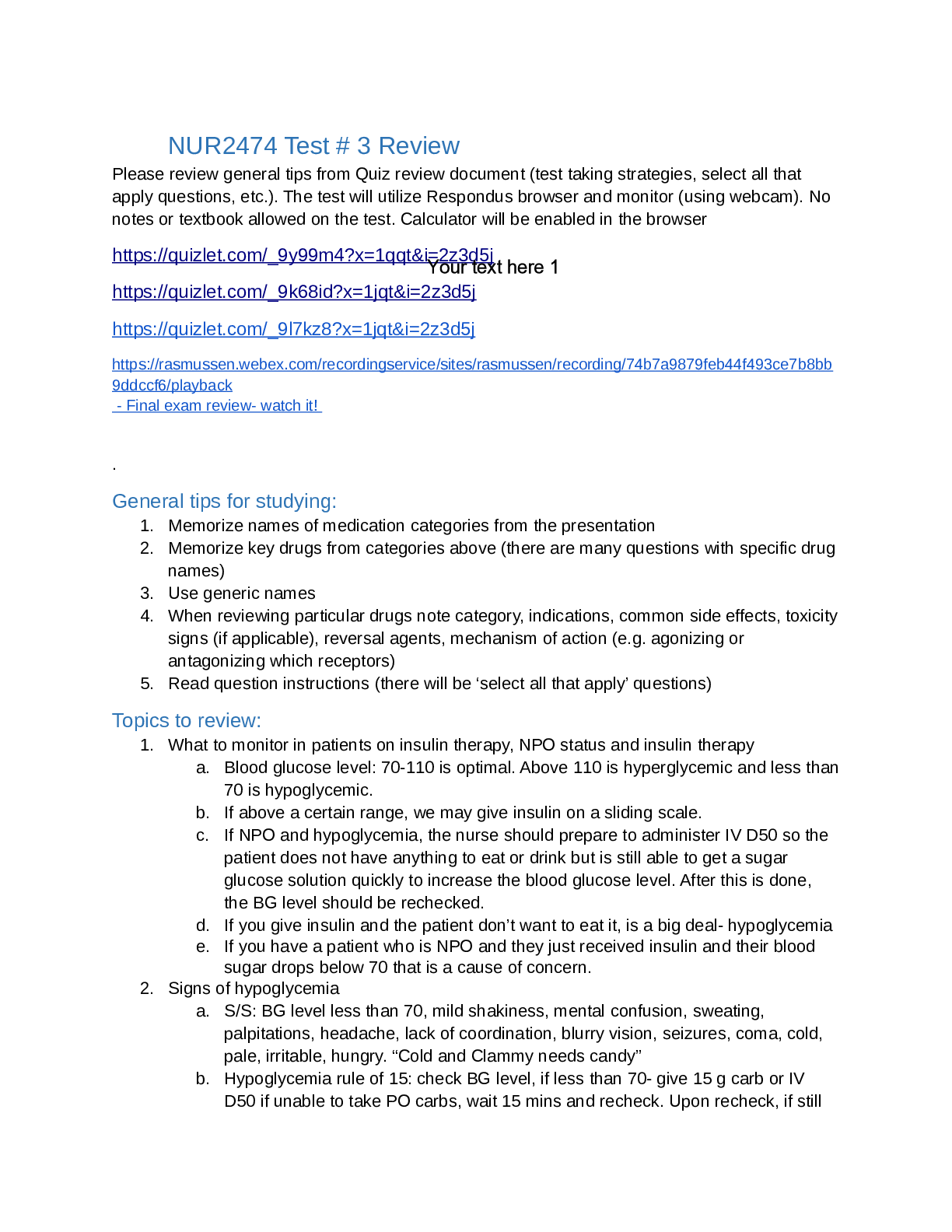
1. What to monitor in patients on insulin therapy, NPO status and insulin therapy
a. Blood glucose level: 70-110 is optimal. Above 110 is hyperglycemic and less than
70 is hypoglycemic.
b. If above a certain range, we
...
1. What to monitor in patients on insulin therapy, NPO status and insulin therapy
a. Blood glucose level: 70-110 is optimal. Above 110 is hyperglycemic and less than
70 is hypoglycemic.
b. If above a certain range, we may give insulin on a sliding scale.
c. If NPO and hypoglycemia, the nurse should prepare to administer IV D50 so the
patient does not have anything to eat or drink but is still able to get a sugar
glucose solution quickly to increase the blood glucose level. After this is done,
the BG level should be rechecked.
d. If you give insulin and the patient don’t want to eat it, is a big deal- hypoglycemia
e. If you have a patient who is NPO and they just received insulin and their blood
sugar drops below 70 that is a cause of concern.
2. Signs of hypoglycemia
a. S/S: BG level less than 70, mild shakiness, mental confusion, sweating,
palpitations, headache, lack of coordination, blurry vision, seizures, coma, cold,
pale, irritable, hungry. “Cold and Clammy needs candy”
b. Hypoglycemia rule of 15: check BG level, if less than 70- give 15 g carb or IV
D50 if unable to take PO carbs, wait 15 mins and recheck. Upon recheck, if stillless than 70- give another 15 g carbs and wait 15 mins and recheck and call
HCP. If still under 70 after 3rd BG recheck, give IV D50 and call HCP as this
could mean something serious is occurring.
c. Good sources of 15 g carbs: 4 oz fruit juice, 1 cup milk, 1 tbsp honey, 1 tbsp
sugar, 6-8 pieces of candy, soda.
d. Once the blood sugar returns, give a complex carb like peanut butter crackers.
3. Memorize insulin names by categories (rapid, short, intermediate, long-acting, and
mixed)
a. Rapid Acting Insulin
i. Common examples: Aspart (NovoLog), Lispro (Humalog), Glulisine
(Apidra)
1. Onset: 5-15 minutes. Administer with meals. DO NOT administer
unless a meal is readily available.
2. Peak: 1-3 hours
3. Duration: 3-5 hours.
ii. Monitor for hypoglycemia, hypokalemia, lipodystrophy.
iii. Always have oral carbohydrate available.
iv. May be given as a short-term IV therapy with very close monitoring
b. Short Acting Insulin (Regular)
i. Common examples: Humulin R, Novolin R,
1. Onset: 30 minutes to 1 hour
2. Peak: 2-4 hours
3. Duration: 6-8 hours.
ii. Used for dosing patients with Sliding Scale
iii. Can be administered IVP or via continuous infusion.
iv. Monitor for hypoglycemia, hypokalemia, lipodystrophy.
v. Always have oral carbohydrate available.
c. Intermediate Acting Insulin
i. Common examples: Isophane suspension (NPH, Humulin N, Novolin N)
1. Onset: 1-1.5 hours,
2. Peak: 6-12 hours
3. Duration: 18-24 hours.
ii. Cloudy suspension. Can mix with Regular or Rapid Acting Insulin, draw
up clear
1. (Regular or Rapid Acting) then cloudy (NPH), “Clear to Cloudy.”
iii. Monitor for hypoglycemia, hypokalemia, lipodystrophy.
iv. Always have oral carbohydrate available.
d. Long-Acting Insulin
i. Common examples: Glargine (Lantus), Levemir, Detemir
ii. For Long lasting remember: Levemir/Detemir “last all year”, Glargine is
Large lasting or Lantus is like a lantern that burns all night
1. Onset: 2-4 hours. No Peak, Duration: 24 hours.
2. Once daily Subq injection provides 24 hour coverage.
3. No peak, insulin delivered at steady level, less risk of
hypoglycemia. Often for basal coverage
iii. Monitor for hypoglycemia, hypokalemia, lipodystrophy
iv. Always have oral carbohydrate available.v. DO NOT mix with any other insulin (NO peak, NO mix)
e. Combination Insulin (Pre-mixed)
i. Common examples: Humulin 70/30, NovoLog
ii. Mix 70/30 Humalog Mix 75/25, Humalog Mix 50/50,
iii. Intermediate Acting Insulin combined with either Rapid Acting or Short
Acting
iv. (Regular) Insulin.
1. Onset and Peak depend on whether combined with a Rapid Acting
or Short Acting Insulin. All provide 24 hour duration.
v. Monitor for hypoglycemia, hypokalemia, lipodystrophy.
vi. Need Food Coverage with Insulin are Lispro and Aspart
f. Levemir/Lantus Long Acting (Once a day at bedtime)
g. Always check the insulin client first as they might go into hypoglycemia. Normal
glucose level (70-99)
4. How and when to administer different types of insulin (rapid- and short-acting before
meals, intermediate twice a day, long-acting at night)
a. Regular insulin is the only insulin that can be given other than subQ
b. Syringes have to match your concentration grading.
c. NPH insulin is cloudy- mix NPH and regular- clear before cloudy
d. What insulin for food coverage- lispro aspart, rapid acting or regular for meals
e. Long acting insulin at bedtime once per day
f. !!Rapid acting and regular insulin must follow up with food!!
g. Rapid and short-acting before meals, intermediate twice a day, long-acting at
night)
h. Long-acting insulin (Lantus/Levemir) are given once per day at bedtime
5. Know beta-blockers. Beta-blockers and hypoglycemia
a. Beta blockers- ends in lol- most significant side effect bradycardia, effects
asthma- no beta blockers for asthma may cause bronchospasms
b. Beta blockers- slow heart rate and may drop BP- if BP is low do not give beta
blockers call DR; may increase AV heart blocks, monitor
c. Beta blockers can mask symptoms of hypoglycemia- very dangerous
d. Use caution with using Beta-Blockers (-lol) in combination with insulin because it
can mask symptoms of HYPOGLYCEMIA
6. Review glipizide administration, side-effects, alcohol consumption
a. Glipizide is a sulfonylurea used to stimulate the secretion of insulin and decrease
stimulation of glucagon.
b. Used in early type 2 diabetes when the A1C is elevated after metformin use
c. SE: hypoglycemia
d. Alcohol will cause disulfiram-like reaction - syndrome includes flushing,
palpitations, and nausea. Can potentiate the hypoglycemic effects
e. Give 30 mins before breakfast daily if ER, or 2x daily if IR.
f. Can take if renal failure, but should not if liver disease.
7. Review acarbose administration, side-effects, interactions, etc.
a. Acarbose is used as a type 2 oral antidiabetic that blocks enzyme alpha
glucosidase decreasing and delaying intestinal absorption of glucose. Control
postprandial glucose levels.
b. Delays absorptions of carbs and reduces blood glucose rise after meals.c. AE: gas, diarrhea, GI upset and abdominal pain.
d. Monitor liver function as long term use can cause liver dysfunction. Monitor liver
tests every 3 months and every year thereafter.
e. Take with the first bite of food
8. Review levothyroxine administration (in the am), side-effects, interactions (calcium), etc.
a. Levothyroxine is used to replace thyroid hormone in patients who have
hypothyroidism, thyroid removal or in myxedema coma
b. SE: tachycardia, chest pain, tremors, sweating, anxiety, fever, weight loss
c. Interacts with drugs that reduce absorption or accelerate metabolism, warfarin,
calcium, catecholamines
d. Must give medication in the am 1 hr before breakfast, on an empty stomach at
the same time each day life long.
e. Space vitamins and iron pills several hours after med administration
9. Review cephalexin administration, side-effects, interactions (warfarin), etc.
a. Cephalexin is a first generation cephalosporin that works to kill gram positive
bacteria but is resistant to gram negative bacteria
b. Used for surgical infection prevention and staph infections
c. AE: N,V,D, abdominal pain, rash, pseudomonas colitis, bleeding,
thrombophlebitis
d. Can increase the effects of Warfarin
e. Interacts with: warfarin, probenecid, alcohol, drugs to promote bleeding, calcium
and ceftriaxone
10. Hypothyroidism and pregnancy (effects on fetus)
a. Pregnant women with uncontrolled hypothyroidism can get high blood pressure,
anemia (low red blood cell count), and muscle pain and weakness. There is also
an increased risk of miscarriage, premature birth (before 37 weeks of
pregnancy), or even stillbirth
b. Can cause mental retardation and derangement of growth
11. Menopause and estrogen administration (minimizing side-effects, different routes)
a. Routes of administration
i. Oral
ii. Transdermal-Transdermal estradiol is available in four formulations: •
Emulsion [Estrasorb] • Spray [Evamist] • Gels [EstroGel, Elestrin, Divigel]
• Patches [Alora, Climara, Estraderm, Estradot , Menostar, Vivelle-Dot,
Oesclim]. (Vaginal Cream/ Suppositories)-minimizes systemic effects
iii. Intravaginal
iv. Parenteral- rarely administered this way
v. Transdermal estrogen is better tolerated with fewer side effects
b. Adverse effects
i. Endometrial hyperplasia and carcinoma
ii. Promotes growth of existing breast cancer
iii. Ovarian cancer
iv. Cardiovascular events
v. Nauseavi. Others: Gallbladder disease, jaundice, headache, and chloasma
c. Metabolic actions
i. Positive effect on bone mass
ii. Favorable effects on cholesterol levels
iii. Blood coagulation
d. Therapeutic uses
i. Menopausal hormone
ii. Female hypogonadism
iii. Acne
1. HT increases the risk of stroke and venous thromboembolism.
12. Benefits of estrogen-progestin combination treatment vs side effects and complications
a. Estrogen alone is somewhat safer than providing a combination. Combining
reduces the risk of uterine cancer in patients who still have a uterus.
b. AE Progestin: Teratogenic effects, Gynecologic effects, Breast cancer,
Depression, Breast tenderness, Bloating
c. Give together because it prevents endometrial cancer
d. Progestin is often added to estrogen for hormone replacement therapy because
progestin helps REDUCE risks of endometrial cancer
e. Hormone therapy is often not used due to DVT, strokes, ovarian cancer.
13. Review estrogen administration, routes, side-effects, interactions, etc.
a. Estrogen comes in Transdermal Spray [Evamist] and should be applied to the
INSIDE of the forearm
b. Transdermal:
i. Spray [Evamist] and should be applied to the INSIDE of the forearm
ii. emulsion: applied 1x daily to top of both thighs & back of both calves
iii. Gel: is applied once daily to one arm, from the shoulder to the wrist or to
the thigh (Divigel).
iv. Patches: are applied to the skin of the trunk (but not the breasts).
v. Intravaginal: available as tablets, creams, and vaginal rings
c. Parenteral: (IV / IM) use of these routes is rare. Intravenous administration is
generally limited to acute emergency control of heavy uterine bleeding.
d. Oral: convenience
e. Adverse Effects:
i. Potential for endometrial hyperplasia, endometrial cancer, breast cancer,
and cardiovascular thromboembolic events. Nausea, headache,
especially migraine headache. Fluid retention with edema, chloasma, a
patchy brown facial discoloration, associated with gallbladder disease,
jaundice.
f. Interactions:
i. Decrease the effectiveness of some antidiabetic drugs and thyroid
preparations.
ii. Can also interact with anticoagulants and other drugs that affect clotting.
g. Contraindications:
i. history of DVT, PE, or conditions such as stroke or MI
14. Testosterone gel administration, side-effects, interactions, etc.a. Location for application- put on upper arms and shoulders
b. Skin-to-skin contact transfer
c. Women and children: Avoid contact- no hugging
d. Swimming
e. Showering
f. **wait 6 hours after application before swimming/showering. DO NOT shower for
at least 6 HOURS after administration. AVOID skin contact with other people.
Repeat labs to check levels within 14 days to find out levels of testosterone
because female hormones can also increase and if levels are high enough, a
female hormone blocker might be needed
g. SE: virilization, epiphyseal closure in kids, hepatotoxicity, low HDL, and high LDL
15. Androgen use side effects
a. Adverse effects
i. Virilization in women, girls, and boys
ii. Premature epiphyseal closure
iii. Hepatotoxicity
iv. Effects on cholesterol levels
v. Use in pregnancy
vi. Prostate cancer
vii. Edema
viii. Abuse potential (athletic performance)
1. ** heavy on liver, monitor for s/s liver damage: jaundice, abd. pain,
itching, gray colored stools etc...
16. Doxazosin administration, side-effects, interactions, benefits, etc.
a. Doxazosin is an alpha blocker used in men to treat BPH, enlarged prostate with
s/s of difficulty urinating, dribbling, weak stream, and incomplete bladder
emptying, urinary frequency and urgency.
b. Can also treat BP alone or in a combination
c. It relieves the symptoms of BPH by relaxing the muscles of the bladder and
prostate. It lowers blood pressure by relaxing the blood vessels so that blood can
flow more easily through the body
d. SE: reflex tachycardia, orthostatic hypotension, fainting, dizziness, somnolence.
e. If a Male patient is taking Doxazosin and c/o nocturia, Assess BPH and GIVE
Doxazosin.
f. PO once a day either in the morning or at night with or without meals. Should be
taken around the same time daily.
g. Interacts with: BP lowering medications, organic nitrates, PDEF inhibitors
h. No grapefruit juice
i. Can cause floppy iris syndrome in cataract surgery.
17. Sildenafil administration, side-effects, interactions, benefits, etc.
a. Sildenafil is a PDE5 inhibitor used to treat erectile dysfunction
b. Will create a longer and harder erection
c. AE: Hypotension, Priapism, Headache, dyspepsia, flushing, nasal congestion,
diarrhea, rash, dizziness, mild transient visual disturbances, intensification ofobstructive sleep apnea, Rare side effects: Nonarteritic ischemic optic
neuropathy, Sudden hearing loss
d. Interacts with: nitrates/nitroglycerin ( causes life threatening hypotension- do not
use), alpha blockers- causes postural hypotension, P450 CYP3A4 drugs can
suppress the metabolism of the drug
e. Drug absorption is slowed with high fat meals- need low fat ones
18. Opiates side-effects vs life-threatening side-effects (be able to recognize and know your
assessments)
a. Respiratory depression- RR less than 12, have to wake them up and stimulate
them each time you see them
b. Constipation- give stool softener to prevent painful elimination (colace,
methylnaltrexone)
c. Urinary retention- with catheters
d. Orthostatic hypotension- increases risk of falls, have to change positions slowly
e. Emesis: need antiemetic
f. Miosis- pinpoint pupils- OD triad could occur if the pupil sizes do not change
g. Cough suppression: if a patient does not cough, they can't clear airways,
infection builds up and breathing is impaired
h. Biliary Colic: muscle spasms causing pain
i. Tolerance and dependence: must taper the medication
j. Increased ICP
k. Itching
l. Life threatening: Comatose, Lethargic, low BP, Shallow breathing
19. Fexofenadine administration schedule, side-effects, interactions, benefits, etc.
a. Fexofenadine is a second generation antihistamine or H1 receptor blocker that
works to decrease sneezing, rhinorrhea, itchy eyes, nose, and throat associated
with seasonal allergies. Decreased urticaria
b. AE: drowsiness, fatigue, dyspepsia, dysmenorrhea. Will not cause a lot of
sedation so it can be ten in daytime, twice a day.
c. Do not take with juice as it can decrease absorption
d. Do not take with magnesium or aluminum containing antacids as absorption can
decrease drug effectiveness
e. To reduce absorption, give activated charcoal. Treat hyperthermia with ice packs or
cooling sponge baths. Control convulsions with IV benzodiazepines.
20. Hydroxyzine administration, side-effects, interactions (alcohol), benefits, etc.
a. Hydroxyzine is a H1 receptor blocker or antihistamine that works to prevent
histamine release and reduce itching and pain with allergic reactions and
inflammation.
b. Works to treat allergic reactions, insomnia, common colds, motion sickness
c. First generation H1 blockers causes sedation, dizziness, fatigue, confusion,
coordination problems, anticholinergic effects,respiratory depression and tissue
injury
d. Will cause sedative effects, take at night,e. Do not use with alcohol as it will make patient even more respiratory depression
and sedation
[Show More]