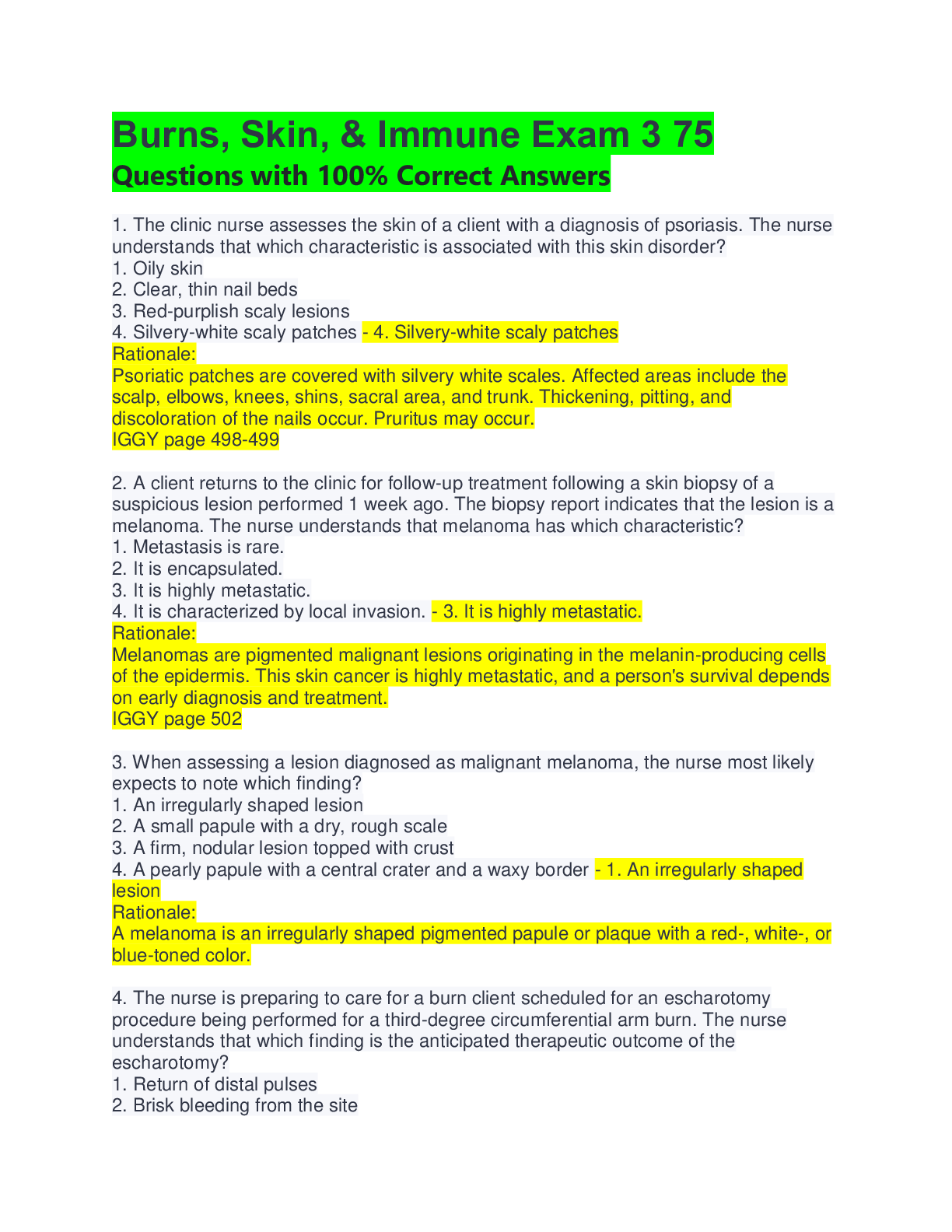
Burns, Skin, & Immune Exam 3 75 Questions with 100% Correct Answers
1. The clinic nurse assesses the skin of a client with a diagnosis of psoriasis. The nurse understands that which characteristic is associated with thi
...
Burns, Skin, & Immune Exam 3 75 Questions with 100% Correct Answers
1. The clinic nurse assesses the skin of a client with a diagnosis of psoriasis. The nurse understands that which characteristic is associated with this skin disorder?
1. Oily skin
2. Clear, thin nail beds
3. Red-purplish scaly lesions
4. Silvery-white scaly patches - 4. Silvery-white scaly patches
Rationale:
Psoriatic patches are covered with silvery white scales. Affected areas include the scalp, elbows, knees, shins, sacral area, and trunk. Thickening, pitting, and discoloration of the nails occur. Pruritus may occur.
IGGY page 498-499
2. A client returns to the clinic for follow-up treatment following a skin biopsy of a suspicious lesion performed 1 week ago. The biopsy report indicates that the lesion is a melanoma. The nurse understands that melanoma has which characteristic?
1. Metastasis is rare.
2. It is encapsulated.
3. It is highly metastatic.
4. It is characterized by local invasion. - 3. It is highly metastatic.
Rationale:
Melanomas are pigmented malignant lesions originating in the melanin-producing cells of the epidermis. This skin cancer is highly metastatic, and a person's survival depends on early diagnosis and treatment.
IGGY page 502
3. When assessing a lesion diagnosed as malignant melanoma, the nurse most likely expects to note which finding?
1. An irregularly shaped lesion
2. A small papule with a dry, rough scale
3. A firm, nodular lesion topped with crust
4. A pearly papule with a central crater and a waxy border - 1. An irregularly shaped lesion
Rationale:
A melanoma is an irregularly shaped pigmented papule or plaque with a red-, white-, or blue-toned color.
4. The nurse is preparing to care for a burn client scheduled for an escharotomy procedure being performed for a third-degree circumferential arm burn. The nurse understands that which finding is the anticipated therapeutic outcome of the escharotomy?
1. Return of distal pulses
2. Brisk bleeding from the site
3. Decreasing edema formation
4. Formation of granulation tissue - 1. Return of distal pulses
Rationale:
Escharotomies are performed to relieve the compartment syndrome that can occur when edema forms under nondistensible eschar in a circumferential third-degree burn. Escharotomies are performed through avascular eschar to subcutaneous fat. Although bleeding may occur from the site, it is considered a complication rather than an anticipated therapeutic outcome. Usually, direct pressure with a bulky dressing and elevation control the bleeding, but occasionally an artery is damaged and may require ligation
5. A client is undergoing fluid replacement after being burned on 20% of her body 12 hours ago. The nursing assessment reveals a blood pressure of 90/50 mm Hg, a pulse rate of 110 beats/minute, and a urine output of 20 mL over the past hour. The nurse reports the findings to the health care provider (HCP) and anticipates which prescription?
1. Transfusing 1 unit of packed red blood cells
2. Administering a diuretic to increase urine output
3. Increasing the amount of intravenous (IV) lactated Ringer's solution administered per hour
4. Changing the IV lactated Ringer's solution to one that contains dextrose in water - 3. Increasing the amount of intravenous (IV) lactated Ringer's solution administered per hour
Rationale:
Fluid management during the first 24 hours following a burn injury generally includes the infusion of (usually) lactated Ringer's solution. Fluid resuscitation is determined by urine output and hourly urine output should be at least 30 mL/hour. The client's urine output is indicative of insufficient fluid resuscitation, which places the client at risk for inadequate perfusion of the brain, heart, kidneys, and other body organs. Therefore the HCP would prescribe an increase in the amount of IV lactated Ringer's solution administered per hour.
IGGY page 526 & 257
5. The nurse is caring for a client who sustained superficial partial-thickness burns on the anterior lower legs and anterior thorax. Which finding does the nurse expect to note during the resuscitation/emergent phase of the burn injury?
1. Decreased heart rate
2. Increased urinary output
3. Increased blood pressure
4. Elevated hematocrit levels - 4. Elevated hematocrit levels
Rationale:
The resuscitation/emergent phase begins at the time of injury and ends with the restoration of capillary permeability, usually at 48 to 72 hours following the injury. During the resuscitation/emergent phase, the hematocrit level increases to above normal because of hemoconcentration from the large fluid shifts. Hematocrit levels of 50% to 55% are expected during the first 24 hours after injury, with return to normal by 36 hours after injury. Initially, blood is shunted away from the kidneys, and renal perfusion and glomerular filtration are decreased, resulting in low urine output. Pulse rates are typically higher than normal, and the blood pressure is decreased as a result of the large fluid shifts.
IGGY page 524
6. The health education nurse provides instructions to a group of clients regarding measures that will assist in preventing skin cancer. Which instructions should the nurse provide? Select all that apply.
1. Sunscreen should be applied every 8 hours.
2. Use sunscreen when participating in outdoor activities.
3. Wear a hat, opaque clothing, and sunglasses when in the sun.
4. Avoid sun exposure in the late afternoon and early evening hours.
5. Examine your body monthly for any lesions that may be suspicious. - 2. Use sunscreen when participating in outdoor activities.
3. Wear a hat, opaque clothing, and sunglasses when in the sun.
5. Examine your body monthly for any lesions that may be suspicious.
Rationale:
The client should be instructed to avoid sun exposure between the hours of 10 am and 4 pm. Sunscreen, a hat, opaque clothing, and sunglasses should be worn for outdoor activities. The client should be instructed to examine the body monthly for the appearance of any possible cancerous or any precancerous lesions. Sunscreen should be reapplied every 2 to 3 hours and after swimming or sweating; otherwise, the duration of protection is reduced
IGGY Page 503
7. Mafenide acetate (Sulfamylon) is prescribed for a client with a burn injury. When applying the medication, the client complains of local discomfort and burning. The nurse should take which most appropriate action?
1. Discontinue the medication.
2. Notify the health care provider.
3. Inform the client that this is expected
4. Apply a thinner film than prescribed to the burn site. - 3. Inform the client that this is expected
Rationale:
Mafenide acetate is bacteriostatic for gram-negative and gram-positive organisms and is used to treat burns to reduce bacteria present in avascular tissues. The client should be informed that the medication will cause local discomfort and burning and that this is a normal reaction.
Kee Hayes page 757
8. A burn client is receiving treatments of topical mafenide acetate (Sulfamylon) to the site of injury. The nurse monitors the client, knowing that which finding indicates that a systemic effect has occurred?
1. Hyperventilation
2. Local rash at the burn site
3. Elevated blood pressure
4. Local pain at the burn site - 1. Hyperventilation
Rationale:
Mafenide acetate is a carbonic anhydrase inhibitor and can suppress renal excretion of acid, thereby causing acidosis. Clients receiving this treatment should be monitored for signs of an acid-base imbalance (hyperventilation). If this occurs, the medication will probably be discontinued for 1 to 2 days. Options 2 and 4 describe local rather than systemic effects. An elevated blood pressure may be expected from the pain that occurs with a burn injury.
Kee Hayes page 756 757
9. Silver sulfadiazine (Silvadene, Thermazene, SSD cream) is prescribed for a client with a partial-thickness burn and the nurse provides teaching about the medication. Which statement made by the client indicates a need for further teaching about the treatments?
1. "The medication is an antibacterial."
2. "The medication will help heal the burn."
3. "The medication will permanently stain my skin."
4. "The medication should be applied directly to the wound." - 3. "The medication will permanently stain my skin."
Rationale:
Silver sulfadiazine (Silvadene, Thermazene, SSD cream) is an antibacterial that has a broad spectrum of activity against gram-negative bacteria, gram-positive bacteria, and yeast. It is applied directly to the wound to assist in healing. It does not stain the skin.
An adult client trapped in a burning house has suffered burns to the back of the head, upper half of the posterior trunk, and the back of both arms. Using the rule of nines, what does the nurse determine the extent of the burn injury to be? Fill in the blank. - 22.5%
Rationale:
According to the rule of nines, the posterior side of the head equals 4.5%, the back of both arms equals 9%, and the upper half of the posterior trunk equals 9%, totaling 22.5%
IGGY page 523
A client is diagnosed with a full-thickness burn. The nurse understands that which structural areas of the skin are involved?
1. Epidermis only
2. Epidermis and deeper dermis
3. Epidermis and upper layer of dermis
4. Epidermis, entire dermis, and epithelial portion of subcutaneous fat - 4. Epidermis, entire dermis, and epithelial portion of subcutaneous fat
Rationale:
A full-thickness burn involves the epidermis, entire dermis, and epithelial portion of subcutaneous fat layer. Option 1 describes a superficial burn. Option 2 describes a deep partial-thickness burn. Option 3 describes a partial-thickness burn.
[Show More]