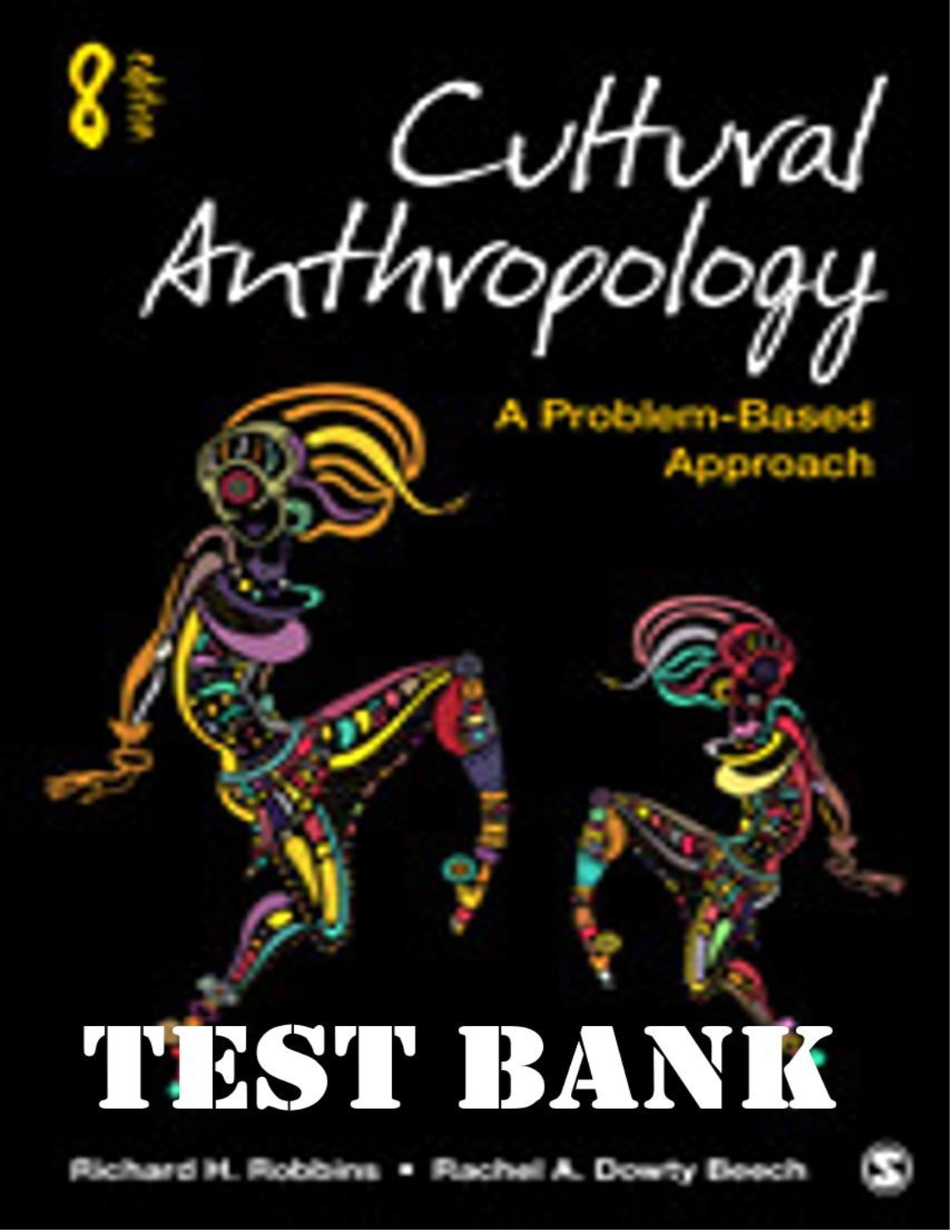
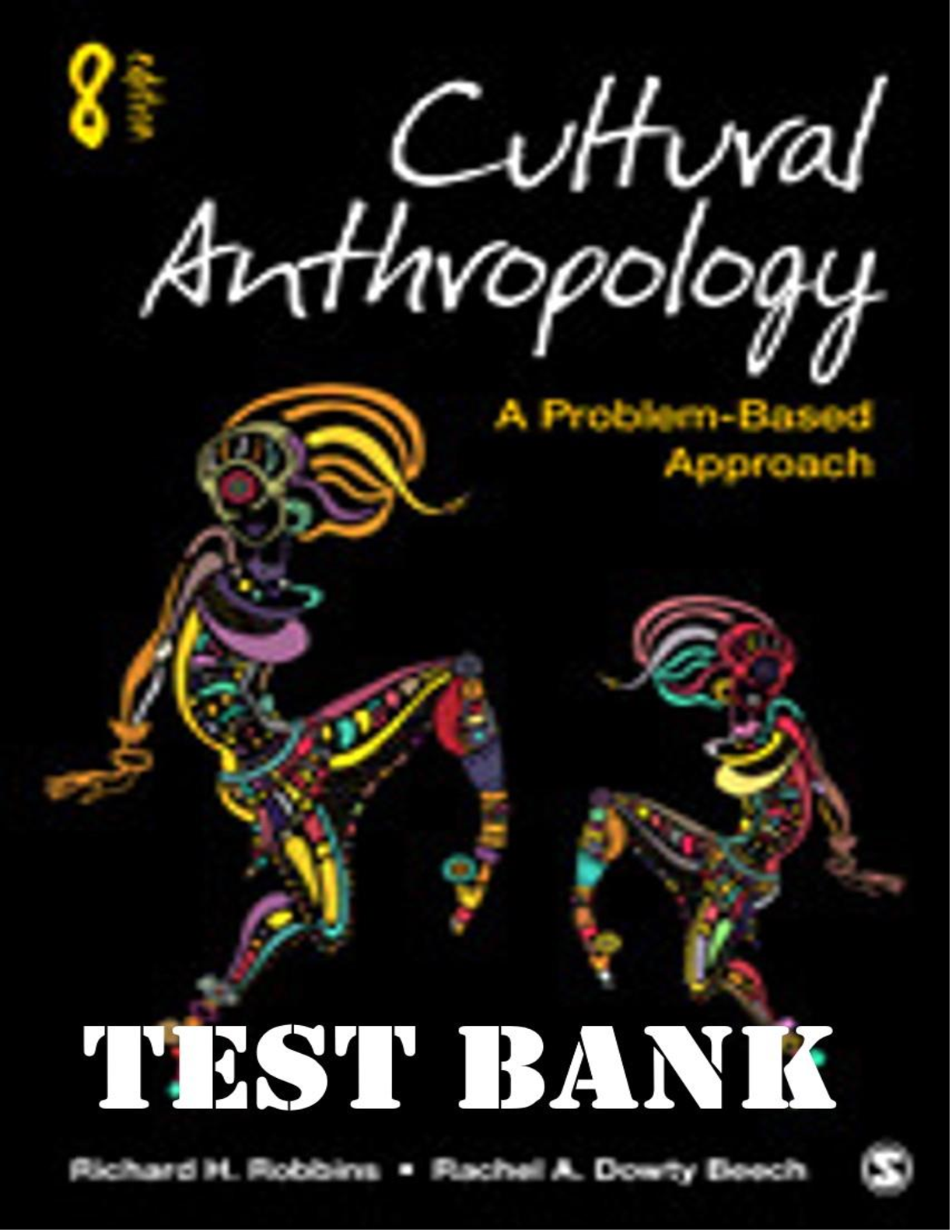
TEST BANK for Cultural Anthropology: A Problem-Based Approach 8th Edition by Richard H. Robbins, Rachel A. Dowty Beech. All Chapters 1-9. (Complete Download)
ISBN-13: 9781544371634
Full chapters included
1 Culture a
...
TEST BANK for Cultural Anthropology: A Problem-Based Approach 8th Edition by Richard H. Robbins, Rachel A. Dowty Beech. All Chapters 1-9. (Complete Download)
ISBN-13: 9781544371634
Full chapters included
1 Culture and Meaning
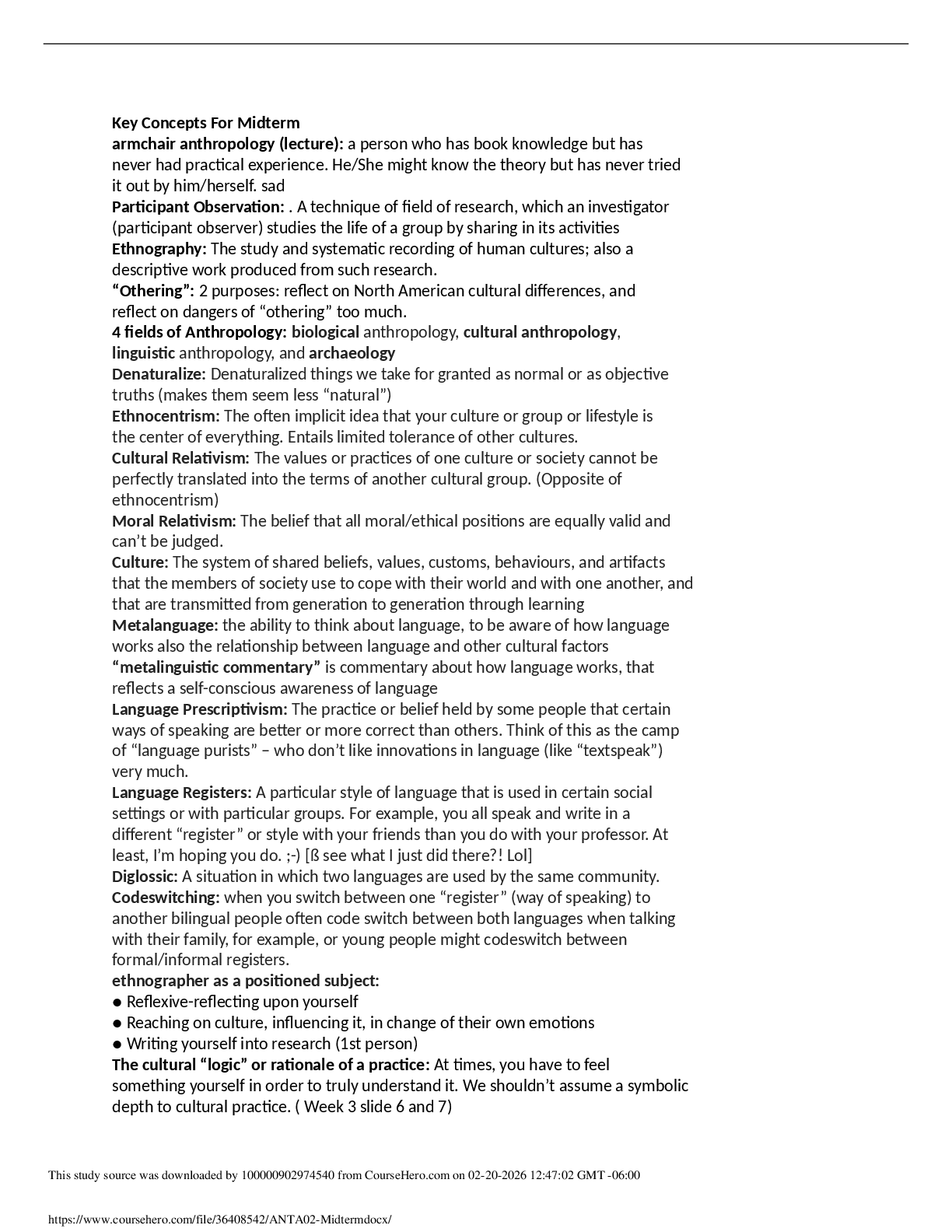
Problem 1: How Can People Begin to Understand Beliefs and Behaviors That Are Different From Their Own?
Introduction: The World Behind Everyday Appearances
Question 1.1: Why Do Human Beings Differ in Their Beliefs and Behaviors?
Question 1.2: How Do People Judge the Beliefs and Behaviors of Others?
The Ethnocentric Fallacy and the Relativist Fallacy
Virginity Testing in Turkey and Cannibalism Among the Wari
Objectivity and Morality
Question 1.3: Is It Possible to See the World Through the Eyes of Others?
The Embarrassed Anthropologist
Confronting Witchcraft in Mexico
The Endangered Anthropologist
Question 1.4: How Can the Meanings That Others Find in Experience Be Interpreted and Described?
Deciphering the Balinese Cockfight
Question 1.5: What Can Learning About Other Peoples Tell Americans About Themselves?
A Balinese Anthropologist Studies Football
An Anthropologist Looks at a “Happy Meal”
Case Study in Doing Anthropology #1: Why We Post
Conclusions
References and Suggested Readings
2 The Meaning of Progress and Development
Problem 2: How Do We Explain the Transformation of Human Societies Over the Past 10,000 Years From Small-Scale Nomadic Bands of Hunters and Gatherers to Large-Scale Urban-Industrial States?
Introduction: The Death of a Way of Life
Question 2.1: Why Did Hunter-Gatherer Societies Switch to Sedentary Agriculture?
Life Among Hunter-Gatherers: The Hadza and the Bushman
The Transition to Agriculture
Producing Potato Calories
Question 2.2: Why Are Some Societies More Industrially Advanced Than Others?
The British in India
Cotton, Slavery, and the Cherokee Removal
Question 2.3: Why Do Poor Countries Not Modernize and Develop in the Same Way as Wealthier Countries?
Debt, SAPs, and Vultures
Question 2.4: How Do Modern Standards of Health and Medical Treatment Compare With Those of Traditional Societies?
Illness and Inequality
The Meaning of Illness
Question 2.5: Why Are Simpler Societies Disappearing?
Cultural Devastation and Radical Hope
Case Study in Doing Anthropology #2: Searching for the Perfect Diet and Doing Development
What We Eat
Women in Development
Conclusions
References and Suggested Readings
3 Debt, Globalization, and the Nation-State
Problem 3: How Does Our Economy Affect Our Way of Life?
Introduction: Debt
Question 3.1: How Is Money Created and Why Must Modern Economies Perpetually Grow?
Money, Wealth, and Well-Being
A Brief History of Money
The Society of Perpetual Growth
Question 3.2: Where Does the Wealth Needed to Sustain Growth Come From?
Capital Conversion
Question 3.3: What Kind of Economic System Is Necessary to Sustain Growth?
“The Great Transformation”
The Emergence of Neoliberalism
Market Externalization
Question 3.4: What Is the Role of the Nation-State in Sustaining Growth?
T-Shirt Travels
Free Trade
Avoiding Democratic Decision Making
The Use of Force
Question 3.5: Why Do Economies Collapse?
Tulip Bulbs and Bubbles
Case Study in Doing Anthropology #3: Anthropology and Public Policy
The Market Externalities of “Hog Hotels”
Conclusions
References and Suggested Readings
4 The Cultural Construction of Social Hierarchy
Problem 4: Why Are Modern Societies Characterized by Growing Economic Inequalities?
Introduction: Plutocracy
Question 4.1: How Unequal Are We?
Income and Wealth Inequality
Stratification and Youth
Question 4.2: Why Is Social and Economic Inequality Increasing?
Question 4.3: How Do People Come to Accept Social Hierarchies as Natural?
Constructing the Ideology of Racism
The Social Construction of “Intelligence”
Constructing Stratification by Gender
Question 4.4: How Do People Living in Poverty Adapt to Their Condition?
Kinship as an Adaptation to Poverty
In Search of Respect: Selling Crack in El Barrio
Question 4.5: What Are the Effects of Inequality on Society?
The Health Effects of Inequality
Case Study in Doing Anthropology #4: Health and Human Rights
Anthropology and Human Rights
Anthropology and Medical Rights: The Work of Paul Farmer
Health as a Human Right
Conclusions
References and Suggested Readings
5 The Social and Cultural Construction of Reality
Problem 5: Why Do People Believe Different Things, and Why Are They So Certain Their View of the World Is Correct and Other Views Are Wrong?
Introduction: The Central Question
Question 5.1: How Does Language Affect the Meanings People Assign to Experience?
Borrowing Meaning With Metaphors
Kwakwaka’wakw Metaphors of Hunger
The Metaphors of Contemporary Witchcraft and Magic
Question 5.2: How Does Symbolic Action Reinforce a Particular View of the World?
The Kwakwaka’wakw Cannibal Dance
The Ritual of Contemporary Witchcraft and Magic
Dorothy Gale Meets Luke Skywalker
Question 5.3: How Do People Come to Believe What They Do, and How Do They Continue to Hold to Their Beliefs Even If They Seem Contradictory or Ambiguous?
The Process of Interpretive Drift
Explaining Why the Sun Moves Around Earth
Question 5.4: How Can We Account for the Different Meanings People Assign to Experiences?
What Kinds of Worldviews Are Associated With Each Cultural Type?
Question 5.5: How Can People Reorder Their View of the World If It Becomes Unsatisfactory?
Wovoka and the Ghost Dance
Mother Ann Lee and the Shakers
Case Study in Doing Anthropology #5: Political Consulting and the Power of Metaphor
Moral Politics: The Nation as a Family
Policy Views: Same-Sex Marriage
Translating Theory Into Action
Conclusions
References and Suggested Readings
6 Patterns of Family Relations
Problem 6: What Do We Need to Know Before We Can Understand the Dynamics of Family Life in Other Societies?
Introduction: Soap Operas and Family Relations
Question 6.1: What Is the Composition of the Typical Family Group?
The Family Composition of the Bushman
The Family Composition of the Trobriand Islanders
The Family Composition of the Chinese
Question 6.2: How Are Families Formed and Ideal Family Types Maintained?
The Family Cycle of the Bushman
The Family Cycle of the Trobriand Islanders
The Family Cycle of the Chinese
Question 6.3: What Are the Roles of Sexuality, Love, and Wealth?
Sex, Love, and Wealth Among the Bushman
Sex, Love, and Wealth Among the Trobriand Islanders
Sex, Love, and Wealth Among the Chinese
Question 6.4: What Threatens to Disrupt the Family Unit?
Threats to the Bushman Family
Threats to the Trobriand Island Family
Threats to the Chinese Family
Case Study in Doing Anthropology #6: Combating HIV/AIDS
AIDS Prevention in Mexico
Sexual Silence
Power Relations
Trust and Fidelity
Sex and Love
Why Is the Message of Traditional AIDS Prevention Programs Sometimes Ignored?
Designing AIDS Prevention Programs
Conclusions
References and Suggested Readings
7 The Cultural Construction of Identity
Problem 7: How Do People Determine Who They Are, and How Do They Communicate Who They Think They Are to Others?
Introduction: The Importance of Self
Question 7.1: How Does the Concept of Personhood Vary From Society to Society?
The Egocentric and Sociocentric Self
Personhood in Japan and America
Question 7.2: How Do Societies Distinguish Individuals From One Another?
Constructing Male and Female
Language, Gender, and Race
Question 7.3: How Do Individuals Learn Who They Are?
The Transition to Adulthood
Work and Career
Question 7.4: How Do Individuals Communicate Their Identities to One Another?
Gifts and Commodities
Gift Giving and Christmas in America
Question 7.5: How Do Individuals Defend Their Identities When They Are Threatened?
Making Moka in Papua New Guinea
Migrants and Refugees
Case Study in Doing Anthropology #7: Fat Talk
Body Image and Identity
Fat Talk
The Problem
Addressing the Problem
Conclusions
References and Suggested Readings
8 The Cultural Construction of Violent Conflict
Problem 8: How Do Societies Give Meaning to and Justify Collective Violence?
Introduction: The Justification of Violent Conflict
Question 8.1: How Do Societies Create a Bias in Favor of Collective Violence?
Horses, Rank, and Warfare Among the Kiowa
Good Hosts Among the Yanomamö
Defending Honor in Kohistan
Constructing Religious Justifications for Violence
Question 8.2: How Do Societies Create a Bias Against Violent Conflict?
Characteristics of Peaceful Societies
Question 8.3: What Are the Economic, Political, or Social Differences Between Peaceful and Violent Societies?
The Need to Protect Resources and Honor
Creating the Conditions for Violence
Sexism and Violent Conflict
Question 8.4: What Are the Effects of War on Societies?
The Impact of War on Population
The Evolution of the Nation-State
Violence and Male Solidarity
Question 8.5: How Is It Possible to Justify the Creation of Weapons of Mass Destruction?
The Anthropology of a Nuclear Weapons Laboratory
The Language of Nuclear Destruction
Case Study in Doing Anthropology #8: The Uses (and Misuses?) of Anthropology for Peace and War
Anthropology and the Outcomes of War
Anthropology and Peace Studies
The Human Terrain Concept and Anthropologists in the Military
The Anthropological Reaction to Human Terrain Systems
The End of Human Terrain Systems
Conclusions
References and Suggested Readings
Glossary
References
Index
[Show More]








.png)