ILE2 Exam 1 Study Guide 193 Questions
with Correct Answers
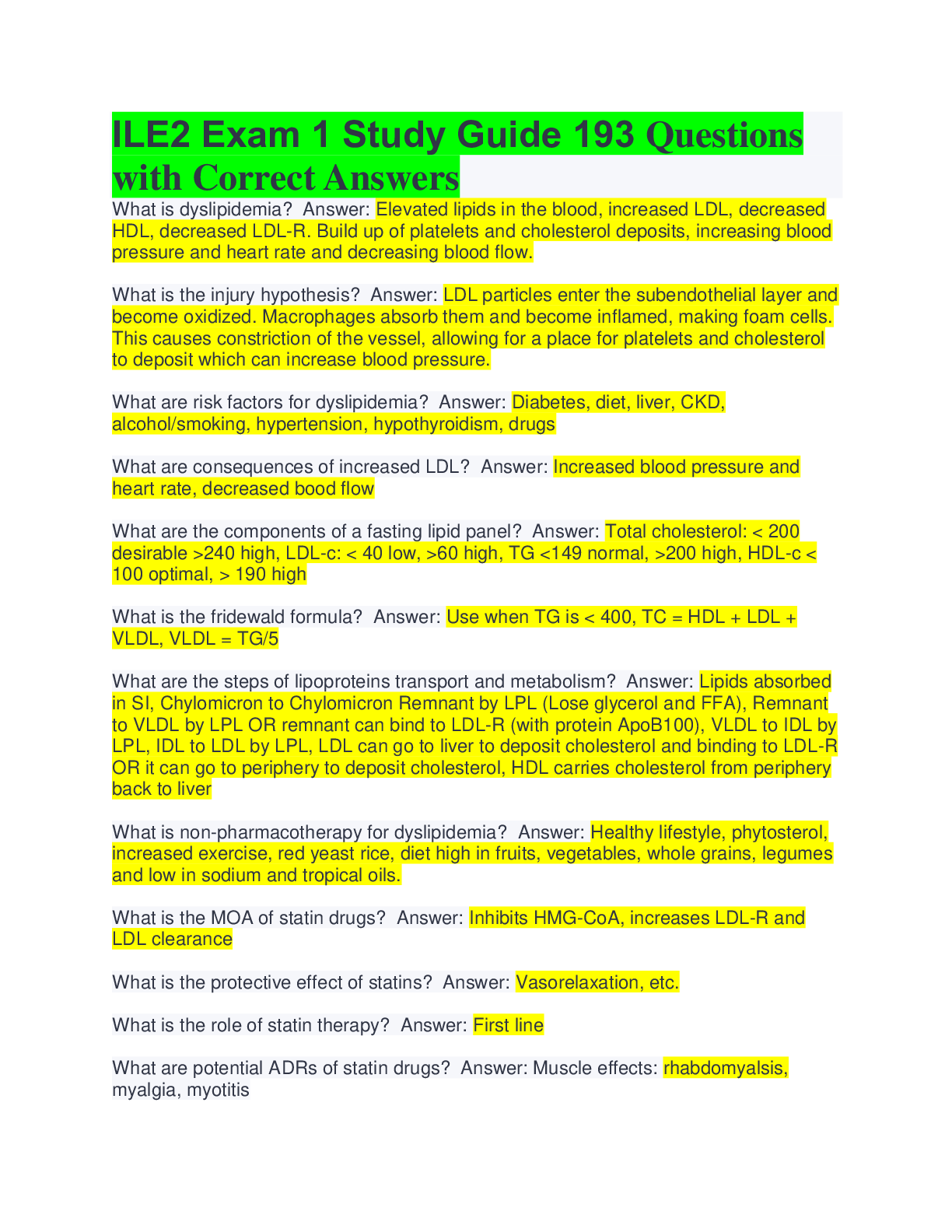
What is dyslipidemia? Answer: Elevated lipids in the blood, increased LDL, decreased
HDL, decreased LDL-R. Build up of platelets and cholesterol deposits, inc
...
ILE2 Exam 1 Study Guide 193 Questions
with Correct Answers
What is dyslipidemia? Answer: Elevated lipids in the blood, increased LDL, decreased
HDL, decreased LDL-R. Build up of platelets and cholesterol deposits, increasing blood
pressure and heart rate and decreasing blood flow.
What is the injury hypothesis? Answer: LDL particles enter the subendothelial layer and
become oxidized. Macrophages absorb them and become inflamed, making foam cells.
This causes constriction of the vessel, allowing for a place for platelets and cholesterol
to deposit which can increase blood pressure.
What are risk factors for dyslipidemia? Answer: Diabetes, diet, liver, CKD,
alcohol/smoking, hypertension, hypothyroidism, drugs
What are consequences of increased LDL? Answer: Increased blood pressure and
heart rate, decreased bood flow
What are the components of a fasting lipid panel? Answer: Total cholesterol: < 200
desirable >240 high, LDL-c: < 40 low, >60 high, TG <149 normal, >200 high, HDL-c <
100 optimal, > 190 high
What is the fridewald formula? Answer: Use when TG is < 400, TC = HDL + LDL +
VLDL, VLDL = TG/5
What are the steps of lipoproteins transport and metabolism? Answer: Lipids absorbed
in SI, Chylomicron to Chylomicron Remnant by LPL (Lose glycerol and FFA), Remnant
to VLDL by LPL OR remnant can bind to LDL-R (with protein ApoB100), VLDL to IDL by
LPL, IDL to LDL by LPL, LDL can go to liver to deposit cholesterol and binding to LDL-R
OR it can go to periphery to deposit cholesterol, HDL carries cholesterol from periphery
back to liver
What is non-pharmacotherapy for dyslipidemia? Answer: Healthy lifestyle, phytosterol,
increased exercise, red yeast rice, diet high in fruits, vegetables, whole grains, legumes
and low in sodium and tropical oils.
What is the MOA of statin drugs? Answer: Inhibits HMG-CoA, increases LDL-R and
LDL clearance
What is the protective effect of statins? Answer: Vasorelaxation, etc.
What is the role of statin therapy? Answer: First line
What are potential ADRs of statin drugs? Answer: Muscle effects: rhabdomyalsis,
myalgia, myotitisWhat are the three classes of statin drugs? Answer: High (atorvastatin 40 and
rosuvastatin 20), Moderate, Low (simvastatin 10, pravastatin 10-20, lovastatin 20,
fluvastatin 20-40)
What are the goals of therapy of each statin drug? Answer: High = decrease LDL by
>/= 50%, Moderate = decrease LDL by 30-49.9%, Low = decrease LDL by < 30%
What is the MOA of PCSK9 inhibitors? Answer: Inhibits degradation of PCSK9
receptors, aiding in LDL clearance
What is the role of PCSK9-I? Answer: Last line
[Show More]