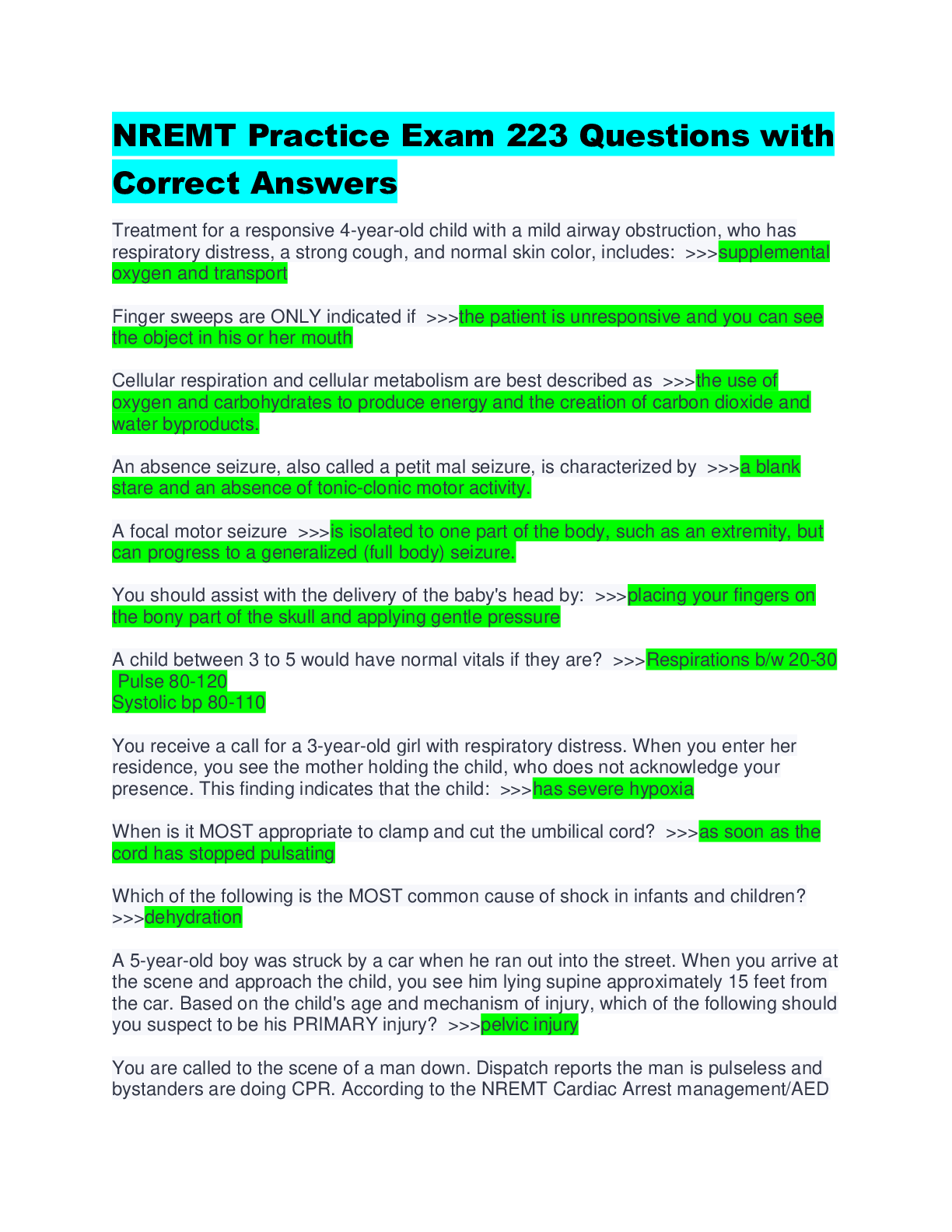
NREMT Practice Exam 223 Questions with
Correct Answers
Treatment for a responsive 4-year-old child with a mild airway obstruction, who has
respiratory distress, a strong cough, and normal skin color, includes: >>>supp
...
NREMT Practice Exam 223 Questions with
Correct Answers
Treatment for a responsive 4-year-old child with a mild airway obstruction, who has
respiratory distress, a strong cough, and normal skin color, includes: >>>supplemental
oxygen and transport
Finger sweeps are ONLY indicated if >>>the patient is unresponsive and you can see
the object in his or her mouth
Cellular respiration and cellular metabolism are best described as >>>the use of
oxygen and carbohydrates to produce energy and the creation of carbon dioxide and
water byproducts.
An absence seizure, also called a petit mal seizure, is characterized by >>>a blank
stare and an absence of tonic-clonic motor activity.
A focal motor seizure >>>is isolated to one part of the body, such as an extremity, but
can progress to a generalized (full body) seizure.
You should assist with the delivery of the baby's head by: >>>placing your fingers on
the bony part of the skull and applying gentle pressure
A child between 3 to 5 would have normal vitals if they are? >>>Respirations b/w 20-30
Pulse 80-120
Systolic bp 80-110
You receive a call for a 3-year-old girl with respiratory distress. When you enter her
residence, you see the mother holding the child, who does not acknowledge your
presence. This finding indicates that the child: >>>has severe hypoxia
When is it MOST appropriate to clamp and cut the umbilical cord? >>>as soon as the
cord has stopped pulsating
Which of the following is the MOST common cause of shock in infants and children?
>>>dehydration
A 5-year-old boy was struck by a car when he ran out into the street. When you arrive at
the scene and approach the child, you see him lying supine approximately 15 feet from
the car. Based on the child's age and mechanism of injury, which of the following should
you suspect to be his PRIMARY injury? >>>pelvic injury
You are called to the scene of a man down. Dispatch reports the man is pulseless and
bystanders are doing CPR. According to the NREMT Cardiac Arrest management/AEDskill sheet, which of the following sequences is appropriate? >>>Complete 1 cycle of
CPR, attach AED, have everyone stand clear during rhythm check.
Your patient is a 41 year old female who was found lying prone in the kitchen. She does
not appear to be conscious andthere is a pool of saliva next to her head. You and your
partner log roll her into a supine position while maintaining c-spine stabilization. Just as
you get the woman rolled over her husband tells you that she has a previous history of
heart attacks. What would be the most appropriate course of action to take next?
>>>Do a jaw thrust to open her airway.
Which position is MOST appropriate for a mother in labor with a prolapsed umbilical
cord? >>>supine with hips elevated
You are treating a 5-year-old child who has had severe diarrhea and vomiting for 3 days
and is now showing signs of shock. Supplemental oxygen has been given and you have
elevated his lower extremities. En route to the hospital, you note that his work of
breathing has increased. You should: >>>lower the extremities and reassess the child
After an advanced airway device (eg, ET tube, multilumen airway, supraglottic airway)
has been inserted during cardiac arrest, ventilate the patient at a rate of_____________
breaths per minute (one breath every __________ seconds). This ventilation rate
applies to all age groups, except the newborn. >>>8 to 10, 6 to 8
[Show More]