139 Final NREMT EXAM Questions and Answers
COPD hypoxic oxygen >>>Patients who retain CO2 all the time, such as those with ____, lose their ability to sense that gas. They end up depending upon ____ drive, using ____
...
139 Final NREMT EXAM Questions and Answers
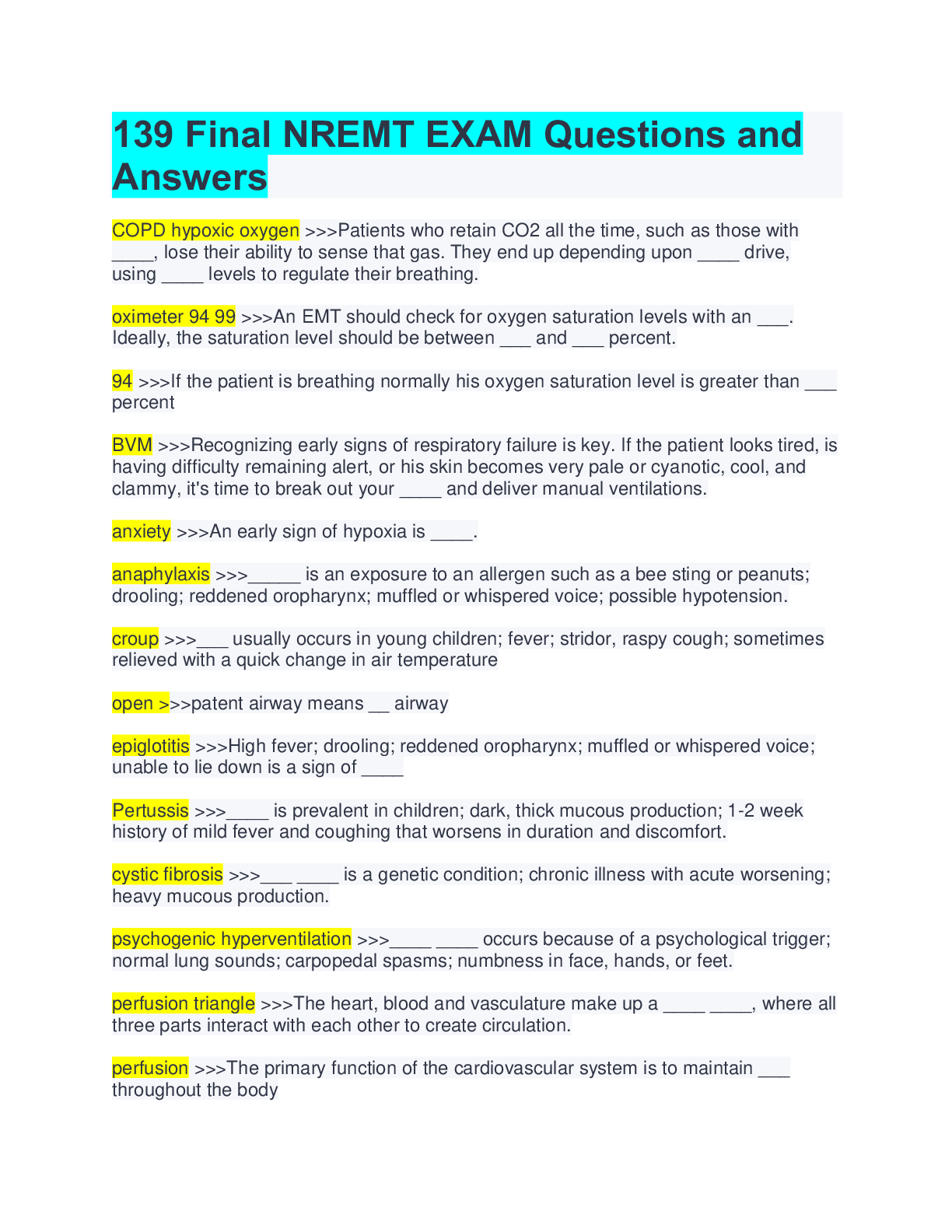
COPD hypoxic oxygen >>>Patients who retain CO2 all the time, such as those with ____, lose their ability to sense that gas. They end up depending upon ____ drive, using ____ levels to regulate their breathing.
oximeter 94 99 >>>An EMT should check for oxygen saturation levels with an ___. Ideally, the saturation level should be between ___ and ___ percent.
94 >>>If the patient is breathing normally his oxygen saturation level is greater than ___ percent
BVM >>>Recognizing early signs of respiratory failure is key. If the patient looks tired, is having difficulty remaining alert, or his skin becomes very pale or cyanotic, cool, and clammy, it's time to break out your ____ and deliver manual ventilations.
anxiety >>>An early sign of hypoxia is ____.
anaphylaxis >>>_____ is an exposure to an allergen such as a bee sting or peanuts; drooling; reddened oropharynx; muffled or whispered voice; possible hypotension.
croup >>>___ usually occurs in young children; fever; stridor, raspy cough; sometimes relieved with a quick change in air temperature
open >>>patent airway means __ airway
epiglotitis >>>High fever; drooling; reddened oropharynx; muffled or whispered voice; unable to lie down is a sign of ____
Pertussis >>>____ is prevalent in children; dark, thick mucous production; 1-2 week history of mild fever and coughing that worsens in duration and discomfort.
cystic fibrosis >>>___ ____ is a genetic condition; chronic illness with acute worsening; heavy mucous production.
psychogenic hyperventilation >>>____ ____ occurs because of a psychological trigger; normal lung sounds; carpopedal spasms; numbness in face, hands, or feet.
perfusion triangle >>>The heart, blood and vasculature make up a ____ ____, where all three parts interact with each other to create circulation.
perfusion >>>The primary function of the cardiovascular system is to maintain ___ throughout the body
Baroreceptors bloodstream >>>____ in the carotid arteries sense a drop in BP, they send signals to the brain that, in turn, sends signals to the body to do such things as increase heart rate, increase the strength of ventricular contractions, constrict appropriate arteries, and even decrease the amount of water being filtered by the kidneys so that more fluid stays within the ___.
60 100 >>>Your normal resting pulse should be strong, regular, and pumping at about ____ to ___ beats per minute while at rest.
120 80 >>>Your blood pressure should be roughly around ___ mm Hg or less systolic and about ___ mm Hg or less diastolic when measured at the distal bicep region of the arm.
lower high >>>Having a ___-than-normal BP is much better than having ___ BP.
respiratory >>>Tightly connected to the cardiovascular system is the ___ system; what happens in one is often reflected in the other.
[Show More]


.png)

![Preview of [FOR ELDY] Telehealth for Mental Health Services Post Pandemic](https://browseimages.nyc3.digitaloceanspaces.com/paper-images/2026/04/19/efrRqveL2026-04-19-12-0969e3f3031469a.png)