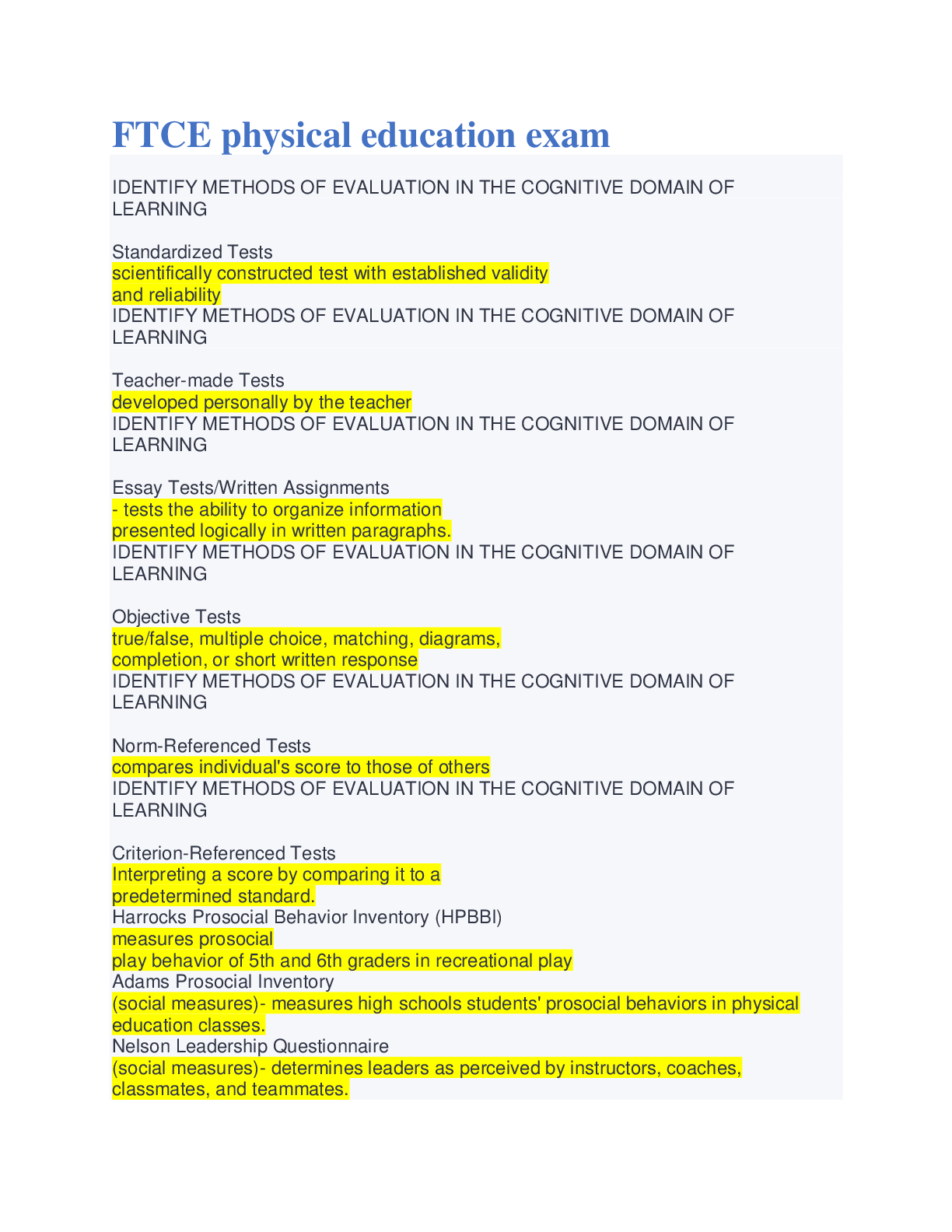
Which of the following behaviors reflects an infants development of an understanding of
object permanence?
a. sucking on part of a handheld toy
b. switching a toy from hand to hand
c. watching a toy roll across a flo
...
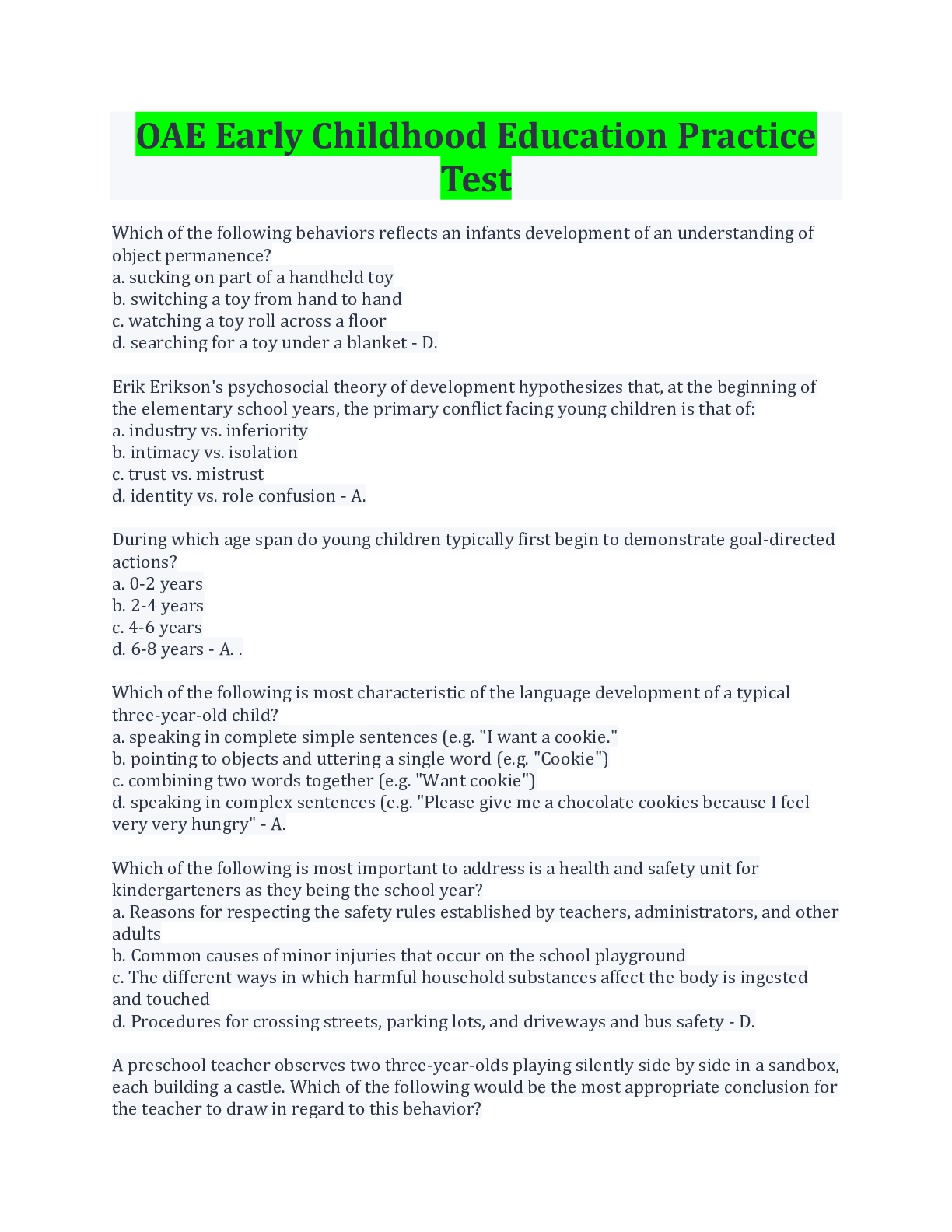
Which of the following behaviors reflects an infants development of an understanding of
object permanence?
a. sucking on part of a handheld toy
b. switching a toy from hand to hand
c. watching a toy roll across a floor
d. searching for a toy under a blanket - ✔✔D.
Erik Erikson's psychosocial theory of development hypothesizes that, at the beginning
of the elementary school years, the primary conflict facing young children is that of:
a. industry vs. inferiority
b. intimacy vs. isolation
c. trust vs. mistrust
d. identity vs. role confusion - ✔✔A.
During which age span do young children typically first begin to demonstrate goaldirected actions?
a. 0-2 years
b. 2-4 years
c. 4-6 years
d. 6-8 years - ✔✔A. .
Which of the following is most characteristic of the language development of a typical
three-year-old child?
a. speaking in complete simple sentences (e.g. "I want a cookie."
b. pointing to objects and uttering a single word (e.g. "Cookie")
c. combining two words together (e.g. "Want cookie")
d. speaking in complex sentences (e.g. "Please give me a chocolate cookies because I
feel very very hungry" - ✔✔A.
Which of the following is most important to address is a health and safety unit for
kindergarteners as they being the school year?
a. Reasons for respecting the safety rules established by teachers, administrators, and
other adults
b. Common causes of minor injuries that occur on the school playground
c. The different ways in which harmful household substances affect the body is ingested
and touched
d. Procedures for crossing streets, parking lots, and driveways and bus safety - ✔✔D.
A preschool teacher observes two three-year-olds playing silently side by side in a
sandbox, each building a castle. Which of the following would be the most appropriate
conclusion for the teacher to draw in regard to this behavior?a. The children's play is advanced for their age and suggests that they may be gifted
learners
b. The children's play falls within the developmentally appropriate range for
preschoolers.
c. The children's play seems overly static and in need of intervention to stimulate
greater creativity
d. The children's play is typical of much younger children and suggests significant
developmental delays - ✔✔B.
Which of the following types of peer relationships is most characteristic of second-grade
students?
a. A single-exclusive friendship
b. Small, same-gender groups
c. Popularity-based cliques
d. Fluid, heterogeneous gangs - ✔✔B.
The curriculum in an early childhood program encourages young children to become
engaged in challenging activities that involve both planning and problem solving. This
aspect of the curriculum is most likely to promote the children's ability to:
a. Adjust easily to unexpected changes in the daily schedule
b. Perform in the highest percentile on mandated tests
c. Approach new learning experiences with confidence
d. Maintain focus and concentration during academic instruction - ✔✔C.
Which of the following would be the most effective method to use for monitoring the
progress of second-grade students in mathematics?
a. Administering a norm-referenced assessment midway through the school year
b. Conducting frequent curriculum-based assessments
c. Administering a dynamic skills assessment at the beginning of each instructional unit
d. Conducting a portfolio assessment at the end of the school year - ✔✔B.
Which of the following reflects the best use of a developmental screening checklist with
preschool children?
a. To create a profile of children's individual learning styles
b. To determine whether individual children are eligible for special education services
c. To identify children who are in need of more in-depth assessment in specific areas
d. To modify instructional strategies for children with developmental delays - ✔✔C.
Which of the following assessment adaptations would be the most appropriate to use
with a first-grade English language learner?
a. Using a standardize test with multiple subtests
b. Presenting material nonverbally
c. Beginning the test at a lower age level
d. Using culturally relevant materials
[Show More]



![Recommended document preview for Early Childhood Education Today 15th Edition By George S Morrison, Mary Jean Woika, Lorraine Breffni, Mary Jean Woika [SOLUTIONS MANUAL]](https://scholarfriends.com/storage/Solutions Manual for Early Childhood Education Today, 15th edition By George S Morrison, Mary Jean Woika, Lorraine Breffni, Mary Jean Woika.png)

![Recommended document preview for eBook [PDF] Early Childhood Education for Marginalized Children in India By Monimalika Day, Venita Kaul, Swati Bawa Sawhne](https://browseimages.nyc3.digitaloceanspaces.com/paper-images/2025/Oct/14/8zHOmr3A2025-10-14-07-1468ee76ef05f03.png)
![Recommended document preview for eBook [PDF] Applied Behavior Analysis in Early Childhood Education 2nd Edition By Casey, Laura Baylot, Carter](https://browseimages.nyc3.digitaloceanspaces.com/paper-images/2026/03/18/Dt6oe9C12026-03-18-10-5469ba5a4c2f27a.png)