OAE Early Childhood Education Practice
Test
Which of the following behaviors reflects an infants development of an understanding of
object permanence?
a. sucking on part of a handheld toy
b. switching a toy from han
...
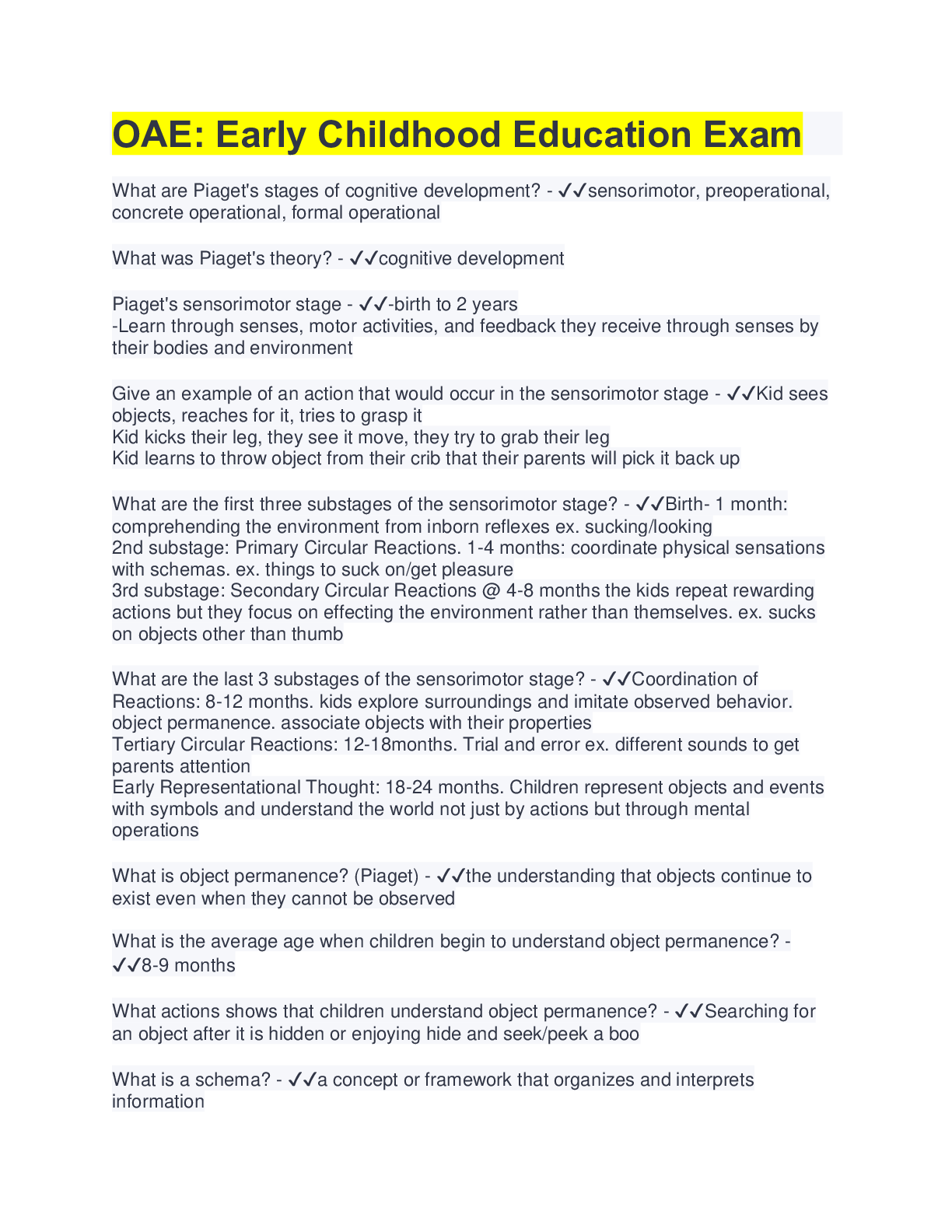
OAE Early Childhood Education Practice
Test
Which of the following behaviors reflects an infants development of an understanding of
object permanence?
a. sucking on part of a handheld toy
b. switching a toy from hand to hand
c. watching a toy roll across a floor
d. searching for a toy under a blanket - ✔✔D.
Erik Erikson's psychosocial theory of development hypothesizes that, at the beginning
of the elementary school years, the primary conflict facing young children is that of:
a. industry vs. inferiority
b. intimacy vs. isolation
c. trust vs. mistrust
d. identity vs. role confusion - ✔✔A.
During which age span do young children typically first begin to demonstrate goaldirected actions?
a. 0-2 years
b. 2-4 years
c. 4-6 years
d. 6-8 years - ✔✔A. .
Which of the following is most characteristic of the language development of a typical
three-year-old child?
a. speaking in complete simple sentences (e.g. "I want a cookie."
b. pointing to objects and uttering a single word (e.g. "Cookie")
c. combining two words together (e.g. "Want cookie")
d. speaking in complex sentences (e.g. "Please give me a chocolate cookies because I
feel very very hungry" - ✔✔A.
Which of the following is most important to address is a health and safety unit for
kindergarteners as they being the school year?
a. Reasons for respecting the safety rules established by teachers, administrators, and
other adults
b. Common causes of minor injuries that occur on the school playground
c. The different ways in which harmful household substances affect the body is ingested
and touched
d. Procedures for crossing streets, parking lots, and driveways and bus safety - ✔✔D.
A preschool teacher observes two three-year-olds playing silently side by side in a
sandbox, each building a castle. Which of the following would be the most appropriate
conclusion for the teacher to draw in regard to this behavior?
a. The children's play is advanced for their age and suggests that they may be gifted
learners
b. The children's play falls within the developmentally appropriate range for
preschoolers.
c. The children's play seems overly static and in need of intervention to stimulate
greater creativity
d. The children's play is typical of much younger children and suggests significant
developmental delays - ✔✔B.
Which of the following types of peer relationships is most characteristic of second-grade
students?
a. A single-exclusive friendship
b. Small, same-gender groups
c. Popularity-based cliques
d. Fluid, heterogeneous gangs - ✔✔B.
The curriculum in an early childhood program encourages young children to become
engaged in challenging activities that involve both planning and problem solving. This
aspect of the curriculum is most likely to promote the children's ability to:
a. Adjust easily to unexpected changes in the daily schedule
b. Perform in the highest percentile on mandated tests
c. Approach new learning experiences with confidence
d. Maintain focus and concentration during academic instruction - ✔✔C.
Which of the following would be the most effective method to use for monitoring the
progress of second-grade students in mathematics?
a. Administering a norm-referenced assessment midway through the school year
b. Conducting frequent curriculum-based assessments
c. Administering a dynamic skills assessment at the beginning of each instructional unit
d. Conducting a portfolio assessment at the end of the school year - ✔✔B.
Which of the following reflects the best use of a developmental screening checklist with
preschool children?
a. To create a profile of children's individual learning styles
b. To determine whether individual children are eligible for special education services
c. To identify children who are in need of more in-depth assessment in specific areas
d. To modify instructional strategies for children with developmental delays - ✔✔C.
Which of the following assessment adaptations would be the most appropriate to use
with a first-grade English language learner?
a. Using a standardize test with multiple subtests
b. Presenting material nonverbally
c. Beginning the test at a lower age level
d. Using culturally relevant materials - ✔✔D.
Which of the following assessment strategies would provide a kindergarten teacher with
the most comprehensive information about a student's oral language development?
a. Observing the student during conversations with peers
b. Asking the student several questions that require yes or no responses
c. Listening to the student recite the alphabet
d. Having the student read a list of sight words aloud - ✔✔A.
Which of the following is the most appropriate rationale for a team approach when
assessing young children?
a. Coordination of assessment results from a variety of disciplines increased the
effectiveness of instruction
b. Collaboration is an effective time-management strategy to complete evaluations
quickly
c. Coordination of evaluations helps eliminate the need to recommend more in-depth
assessment
d. Collaboration among professional helps parents feel confident about the reliability of
the assessment results - ✔✔A.
A first-grade teacher is participating in an initial special education evaluation of a
student in the teacher's class. In addition to documenting the student's current level of
academic performance, the teacher would typically provide which of the following
information to the evaluation team?
a. Plans to involve the family in the student's instructional program at home
b. Documentation of the student's complete developmental and medical history
c. Plans to implement a new instructional strategy with the student
d. Documentation of the strategies and modifications to instruction that have been tried
with the student - ✔✔D.
Which of the following is an ethical responsibility of a preschool teacher regarding the
assessment of young children?
a. Conducting testing in the same environment consistently
b. Respecting the privacy of the data that are collected
c. Inviting the family to participate in each session
D. Making the results available in a central location to school personnel - ✔✔B.
Toward the end of a unit on animals, a second-grade class goes on a field trip to the
zoo. Upon returning, the teacher engages the students in a discussion of what they saw
and experiences at the zoo. Then, as an evaluation exercise, the teacher asks that each
student draw a picture with a written description. This activity is characteristic of which
of the following assessment methods?
a. Criterion-referenced
b. Portfolio review
c. Task analysis
D. Performance based - ✔✔D.
In general, children of preschool age feel most secure in educational settings that:
a. Combine a large number of activity choices with frequent changes of activity
b. Stress whole-class activities in which students perform specific tasks under close
teacher direction
c. Emphasize student-directed learning and a minimum of external structure
d. Offer a balance of calm and active learning experiences in a predictable and orderly
environment - ✔✔D.
A child in a preschool class continually tests the rules and disobeys the teacher. The
teacher decides that she can best meet the child's needs by establishing clear limits and
being consistent in imposing consequences for misbehavior. Whenever disciplinary
measures are necessary, the teacher should ensure that the child understands that:
a. The consequences are a sign of the teacher's disappointment in the child.
b. The child's misbehavior sets him or her apart from the other children
c. The consequences are a direct result of the child's misbehavior
d. The misbehavior represents a breach of trust the teacher - ✔✔C.
A kindergarten teacher is arranging the classroom for the first day of school. The
teacher has planned a variety of whole-class and small-group activities for the day. In
the area of the room where whole-class meetings will be held, the teacher lays out a
carpet square for each child. The best rationale for this practice is that it:
a. Provides an environmental cue that helps students understand what they are
expected to do
b. Encourages students to assemble quickly in order to obtain seats beside their
preferred classmates
c. Facilitates the teacher's performance of routine chores such as calling roll
d. Communicates to each student that the teacher has confidence in his o her ability to
make good decisions - ✔✔A.
Which of the following would be a third-grade teacher's best strategy for ensuring that
transitions in the classroom are accomplished with a minimum of disruption and wasted
time?
a. Offering rewards to the first few students to be seated at their desks and prepared for
a new activity
b. Teaching students a sequence of steps to follow when it is time to move from one
activity to the next
c. Imposing a consequence on the class if not everyone is ready for a new activity after
a given period of time
d. Choosing a few responsible students to circulate during transitions and offer
assistance as necessary - ✔✔B.
A first-grade student with disabilities leaves his general education classroom frequently
to work with specialists in a resource room. The first-grade teacher wants to ensure that
the general education classroom represents a positive and secure environment for this
student. Which of the following actions by the first-grade teacher would best foster the
achievement of this objective?
a. Asking the specialists in the resource room to emphasize to the student that the
general education classroom is his primary placement
b. Designing instruction that supports the student's development of friendships and
sense of belonging in the classroom community
c. Encouraging the student's parents to create ongoing opportunities for the student to
interact with the classmates outside of school
d. Providing an explanation to the class about the nature of the student's disability and
the services he receives in the resource room - ✔✔B
A kindergarten teacher often uses blocks as learning tools in various areas of the
curriculum. The teacher is currently planning activities to promote the children's
problem-solving skills. Which of the following activities with blocks would best support
this objective?
a. Having children work in small groups to build a block structure that will support a
heavy book
b. Showing children assorted blocks on a tray, then removing one block secretly and
asking the children to identify which one was removed
c. Distributing a variety of blocks to pairs of
[Show More]