PMHNP Role 6670N week 7 Assignment 1 Captain of the
Ship: OCD with Complete Solution
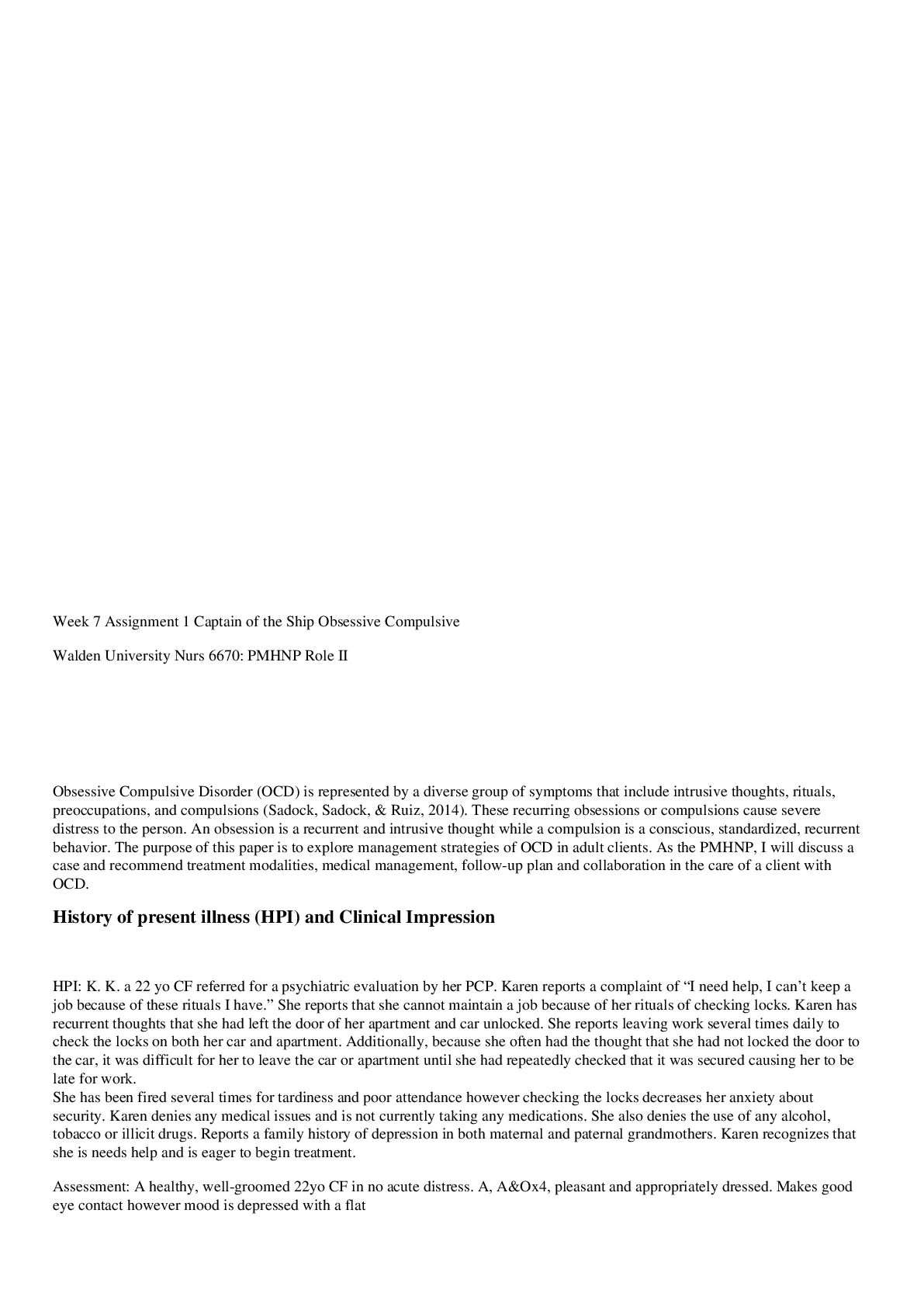
Week 7 Assignment 1 Captain of the Ship
Obsessive Compulsive
Walden University
Nurs 6670: PMHNP Role II
This study source was d
...
PMHNP Role 6670N week 7 Assignment 1 Captain of the
Ship: OCD with Complete Solution
Week 7 Assignment 1 Captain of the Ship
Obsessive Compulsive
Walden University
Nurs 6670: PMHNP Role II
This study source was downloaded by 100000831988016 from CourseHero.com on 08-12-2022 10:21:28 GMT -05:00
https://www.coursehero.com/file/30136423/captain-of-the-ship-exampledocx/
Obsessive Compulsive Disorder (OCD) is represented by a diverse group of symptoms
that include intrusive thoughts, rituals, preoccupations, and compulsions (Sadock, Sadock, &
Ruiz, 2014). These recurring obsessions or compulsions cause severe distress to the person. An
obsession is a recurrent and intrusive thought while a compulsion is a conscious, standardized,
recurrent behavior. The purpose of this paper is to explore management strategies of OCD in
adult clients. As the PMHNP, I will discuss a case and recommend treatment modalities, medical
management, follow-up plan and collaboration in the care of a client with OCD.
History of present illness (HPI) and Clinical Impression
HPI: K. K. a 22 yo CF referred for a psychiatric evaluation by her PCP. Karen reports a
complaint of “I need help, I can’t keep a job because of these rituals I have.” She reports that she
cannot maintain a job because of her rituals of checking locks. Karen has recurrent thoughts that
she had left the door of her apartment and car unlocked. She reports leaving work several times
daily to check the locks on both her car and apartment. Additionally, because she often had the
thought that she had not locked the door to the car, it was difficult for her to leave the car or
apartment until she had repeatedly checked that it was secured causing her to be late for work.
She has been fired several times for tardiness and poor attendance however checking the locks
decreases her anxiety about security. Karen denies any medical issues and is not currently taking
any medications. She also denies the use of any alcohol, tobacco or illicit drugs. Reports a
family history of depression in both maternal and paternal grandmothers. Karen recognizes that
she is needs help and is eager to begin treatment.
Assessment: A healthy, well-groomed 22yo CF in no acute distress. A, A&Ox4, pleasant
and appropriately dressed. Makes good eye contact however mood is depressed with a flat
This study source was downloaded by 100000831988016 from CourseHero.com on 08-12-2022 10:21:28 GMT -05:00
https://www.coursehero.com/file/30136423/captain-of-the-ship-exampledocx/
affect; recent and remoter memory are intact. Karen’s thoughts are circumstantial and
preoccupied with obsessions and compulsions. Her insight and judgment are fair. Denies
SI/HI/AVH.
Clinical Impression: Based on the diagnostic criteria in APA (2013), a diagnosis of OCD
is made.
Psychopharmacology
If the patient’s symptoms cause a significant impairment in function or distress, treatment is
recommended (Fenske and Petersen, 2015). Based on Karen’s report of losing several jobs
because of tardiness and attendance, there is a significant impairment in social and home
functionality. Karen also reports that her rituals cause her significant distress. The standard
approach is to start treatment with an SSRI or clomipramine and then move to other
pharmacological strategies if the SSRI is not effective (Sadock, Sadock, & Ruiz, 2014). I will
initiate Prozac 40mg oral daily as it is Food and Drug Administration (FDA) approved for
treatment of OCD (Stahl, 2014). I will have the patient return to clinic in week to assess for
tolerability and increase to the suggested 80mg oral daily. Higher dosages have often been
necessary for a beneficial effect (Stahl, 2014). I prefer to initiate with an SSRI (Prozac) as
opposed to tricyclic (Clomipramine) for the less troubling adverse effects associated with
Clomipramine. Karen will be informed that she might experience sleep disturbances, nausea,
diarrhea, headache and anxiety which are all adverse effects of SSRIs. The desired outcome of
pharmacotherapy is to reduce the patient’s intrusive thoughts that cause the compulsions that
interfere with her home and work life. Well controlled studies have found that pharmacotherapy,
behavior therapy, or combination of both is effective in significantly reducing the symptoms of
patients with OCD (Fenske and Petersen, 2015).
This study source was downloaded by 100000831988016 from CourseHero.com on 08-12-2022 10:21:28 GMT -05:00
https://www.coursehero.com/file/30136423/captain-of-the-ship-exampledocx/
Psychotherapy
Some studies indicate that behavior therapy is as effective as pharmacotherapies in OCD and
some indicate that the beneficial effects are longer lasting with behavior therapy (Sadock,
Sadock, & Ruiz, 2014). Many clinicians consider behavior therapy the treatment of choice for
OCD and also because it can be conducted in both outpatient and inpatient settings. With the
prinicpal behavioral approaches being exposure and response prevention, patients must be
committed to improvement as Karen is. Behavior therapy will be initiated the same week as
pharmacotherapy. The goal of therapy is to change the client’s behavior to reduce dysfunction
and to improve her quality of life. A psychotherapist will be consulted to intiate and manage
therapy sessions.
Medical Manag
[Show More]
 (1).png)
.png)