FCCS (Fundamentals of Critical Care Support) Exam Solution latest.
What is the single most important indicator in critical illness? >>>>tachypnea
Beck's Triad >>>>hypotension, JVD, muffled heart sounds
- a/w car
...
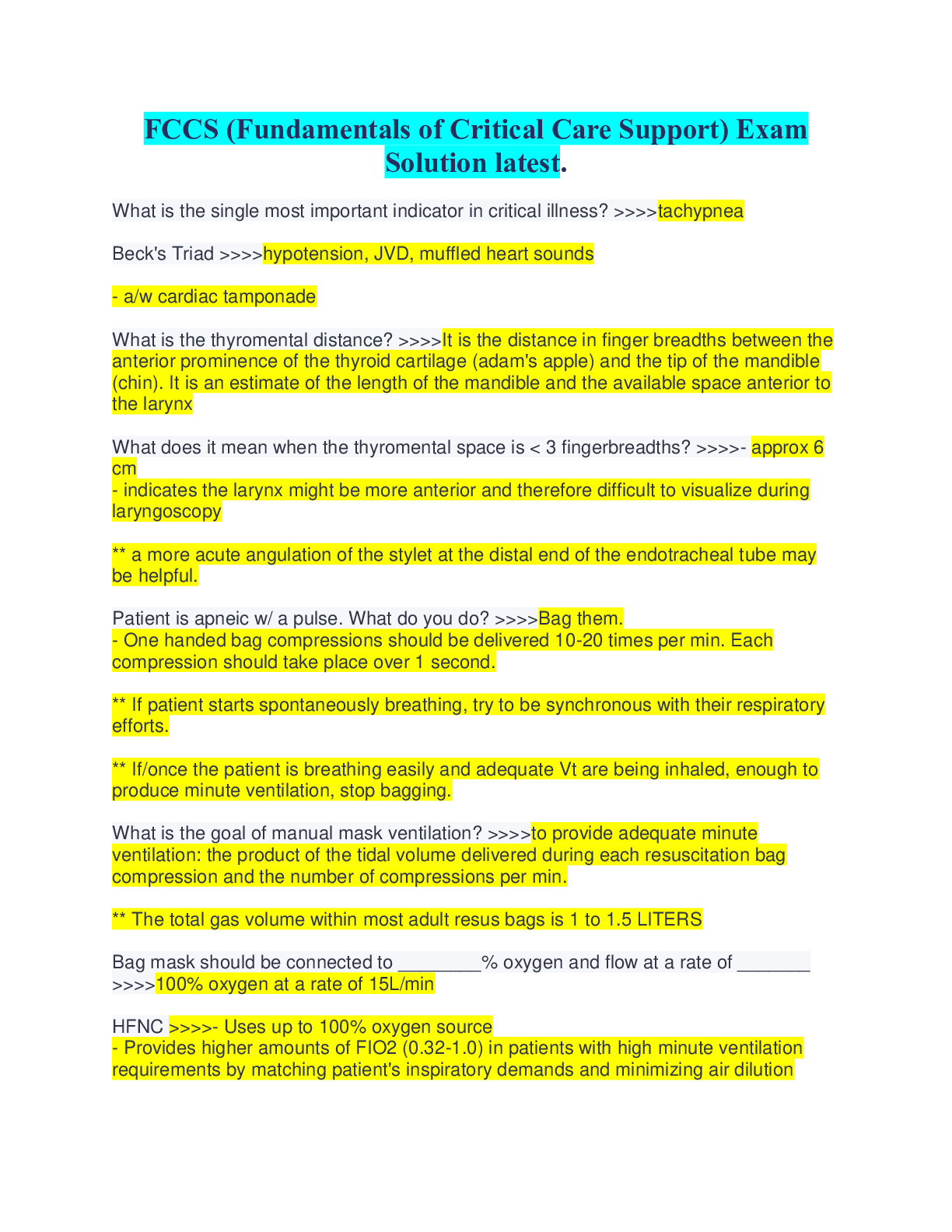
FCCS (Fundamentals of Critical Care Support) Exam Solution latest.
What is the single most important indicator in critical illness? >>>>tachypnea
Beck's Triad >>>>hypotension, JVD, muffled heart sounds
- a/w cardiac tamponade
What is the thyromental distance? >>>>It is the distance in finger breadths between the anterior prominence of the thyroid cartilage (adam's apple) and the tip of the mandible (chin). It is an estimate of the length of the mandible and the available space anterior to the larynx
What does it mean when the thyromental space is < 3 fingerbreadths? >>>>- approx 6 cm
- indicates the larynx might be more anterior and therefore difficult to visualize during laryngoscopy
** a more acute angulation of the stylet at the distal end of the endotracheal tube may be helpful.
Patient is apneic w/ a pulse. What do you do? >>>>Bag them.
- One handed bag compressions should be delivered 10-20 times per min. Each compression should take place over 1 second.
** If patient starts spontaneously breathing, try to be synchronous with their respiratory efforts.
** If/once the patient is breathing easily and adequate Vt are being inhaled, enough to produce minute ventilation, stop bagging.
What is the goal of manual mask ventilation? >>>>to provide adequate minute ventilation: the product of the tidal volume delivered during each resuscitation bag compression and the number of compressions per min.
** The total gas volume within most adult resus bags is 1 to 1.5 LITERS
Bag mask should be connected to ________% oxygen and flow at a rate of _______ >>>>100% oxygen at a rate of 15L/min
HFNC >>>>- Uses up to 100% oxygen source
- Provides higher amounts of FIO2 (0.32-1.0) in patients with high minute ventilation requirements by matching patient's inspiratory demands and minimizing air dilution
- These devices also can generate PEEP (that is difficult to measure; can cause barotrauma in theory)
- Flow rates up to 60L/min
- heated and humidified oxygen
NRB >>>>- AKA Reservoir Face Mask
- Bag is filled with 100% oxygen from a supply source (tank)
- The flow rate must be adjusted so that the bag remains completely or partially distended throughout the respiratory cycle
- When the mask is properly applied, oxygen delivery can be maximized but rarely exceeds a FIO2 of 0.6 to 0.9
- One way flap valves minimize entrapment of room air which dilutes FiO2
- NRB is a high oxygen high, flow device.
- non humidified oxygen
** commonly used to improve oxygenation in patients with severe hypoxemia until further eval and treatments are accomplished.
Aerosol Face Mask >>>>- This mask has large side holes, the mask itself is attached to large bore tubing to a nebulize that blends 100% oxygen and room air to deliver a PRESET FIO2 level (done by dial on oxygen adapter)
- If the entire aerosol mist disappears from the mask during. inhalation, the patient's inspiratory flow demands are probably exceeding the capacity of the nebulizer and room air is being entrained.
- minimum flow rate = 8L/min
- Max FIO2 = 40-60%
- This is a variable oxygen, moderate-flow device.
Simple Face Mask >>>>- minimum flow rate: 6L/min (to clear CO2 from mask)
- humidified O2
- Approx. concentrations L to FIO2 ratios:
6L = 40%
7L = 50%
8L = 60%
Venturi Face Mask >>>>- aka air entrainment face mask
- delivers O2 through a jet mixing device that increases the velocity of oxygen and causes a controlled entrainment
- the FiO2 can be more precisely controlled from .24 to .5 (24% to 50%) at high flow rates simply my selecting the interchangeable nozzle and adjusting the O2 flow rate
- this is a high flow, controlled oxygen device.
[Show More]