NR509 Midterm Review -Bates Guide to Physical Examination 13th edition Chapters 1-17
Patient and clinician-centered >>>The approach to a clinical encounter
Echolalia >>>repetition of the words and phrases of others
...
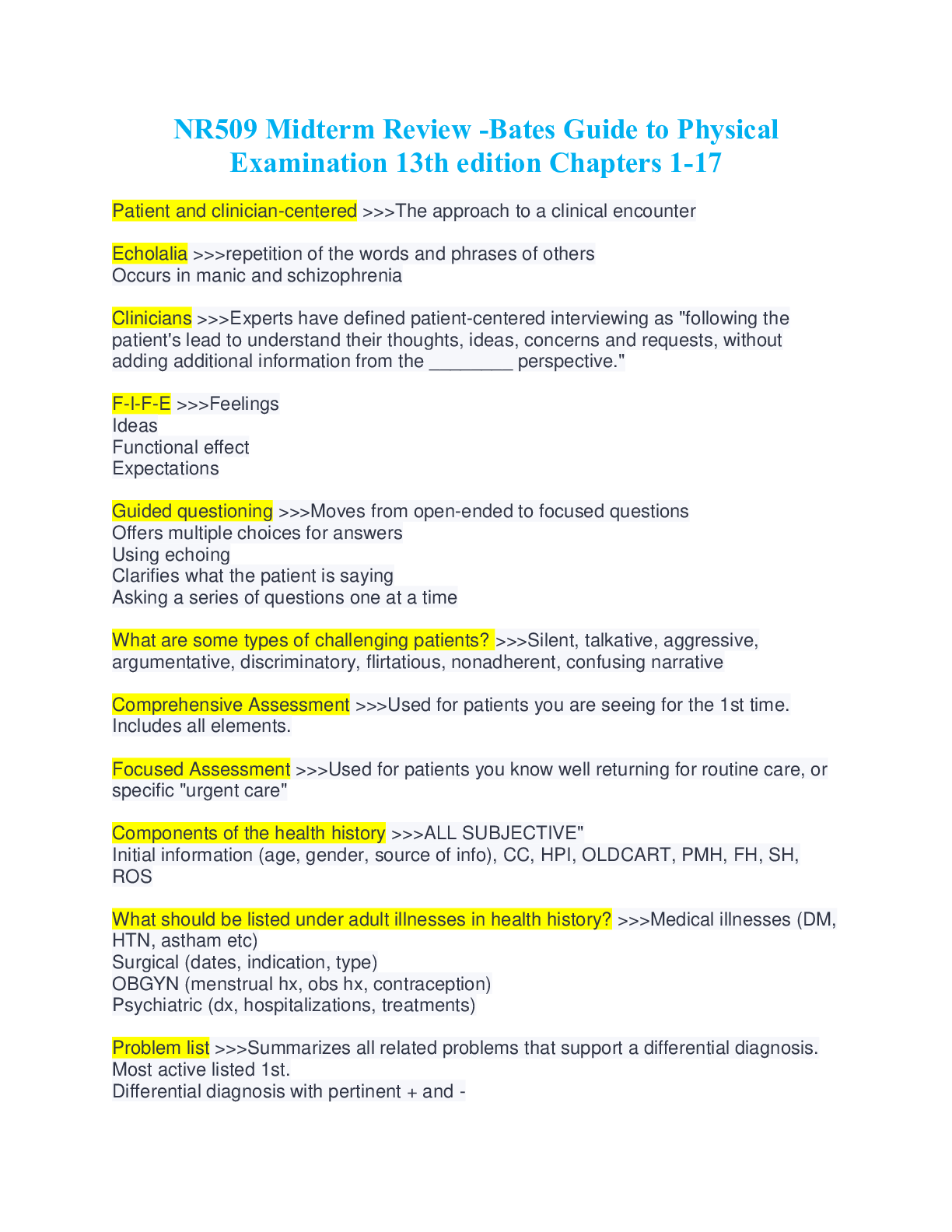
NR509 Midterm Review -Bates Guide to Physical Examination 13th edition Chapters 1-17
Patient and clinician-centered >>>The approach to a clinical encounter
Echolalia >>>repetition of the words and phrases of others
Occurs in manic and schizophrenia
Clinicians >>>Experts have defined patient-centered interviewing as "following the patient's lead to understand their thoughts, ideas, concerns and requests, without adding additional information from the ________ perspective."
F-I-F-E >>>Feelings
Ideas
Functional effect
Expectations
Guided questioning >>>Moves from open-ended to focused questions
Offers multiple choices for answers
Using echoing
Clarifies what the patient is saying
Asking a series of questions one at a time
What are some types of challenging patients? >>>Silent, talkative, aggressive, argumentative, discriminatory, flirtatious, nonadherent, confusing narrative
Comprehensive Assessment >>>Used for patients you are seeing for the 1st time. Includes all elements.
Focused Assessment >>>Used for patients you know well returning for routine care, or specific "urgent care"
Components of the health history >>>ALL SUBJECTIVE"
Initial information (age, gender, source of info), CC, HPI, OLDCART, PMH, FH, SH, ROS
What should be listed under adult illnesses in health history? >>>Medical illnesses (DM, HTN, astham etc)
Surgical (dates, indication, type)
OBGYN (menstrual hx, obs hx, contraception)
Psychiatric (dx, hospitalizations, treatments)
Problem list >>>Summarizes all related problems that support a differential diagnosis.
Most active listed 1st.
Differential diagnosis with pertinent + and -
social determinants of health >>>economic stability, education, neighborhood and built environment, health and health care, social and community context.
Explain how the examination will proceed. >>>A 23-year-old physician assistant (PA) student found that she felt nervous when called upon to examine men in her age group. On one occasion, she encountered a young male patient who appeared embarrassed to see her walk into the room. What should the PA do to minimize their mutual discomfort?
Follow the patient's lead to understand their thoughts, feeling, and ideas. >>>A 34-year-old male with a history of complex social and medical needs (including current substance abuse) presents to a PC clinic. The patient has experienced a number of adversarial relationships with prior clinicians, including voluntarily leaving two practices within the previous year and being asked to leave care at a third clinic due to misbehavior. The attending physician desires to utilize the approaches to this patient that are most likely lead to comprehensive care and patient compliance. Which of the following is the most appropriate interview style for the attending physician to use?
Using nonverbal communication to encourage the patient to expand their narrative >>>A 17-year-old male presents to a sexually transmitted disease clinic at the behest of his brother, who convinced the patient to attend the clinic after he disclosed that he prefers homosexual partners but is afraid that his last partner may have given him an infection. The patient expresses to the intake nurse that he is unashamed of his sexual orientation and will not stay through the visit if he feels that he is dismissed or discriminated against because of it. The nurse practitioner receives this communication prior to entering the examination room and decides to employ active listening to best connect with the patient at this critical juncture in his care with the clinic. Which of the following is an example of an active listening technique?
Feelings, ideas, function, expectations >>>A 42-year-old female mathematician presents for follow-up care regarding a new diagnosis of systemic lupus erythematosus 6 months ago after a lengthy diagnostic process during which she was debilitated with fatigue and joint pain. Since her diagnosis, she has been minimally compliant with medications and has switched her rheumatology provider twice. She continues to feel ill, and, in explanation for her lack of adherence to the prescribed treatment, she simply says, "I don't like it." At this initial visit with her third rheumatology provider, the clinician elects to explore the issues behind her noncompliance before engaging in diagnostics and treatment using the FIFE model. Which of the following best defines the elements of the FIFE model?
[Show More]