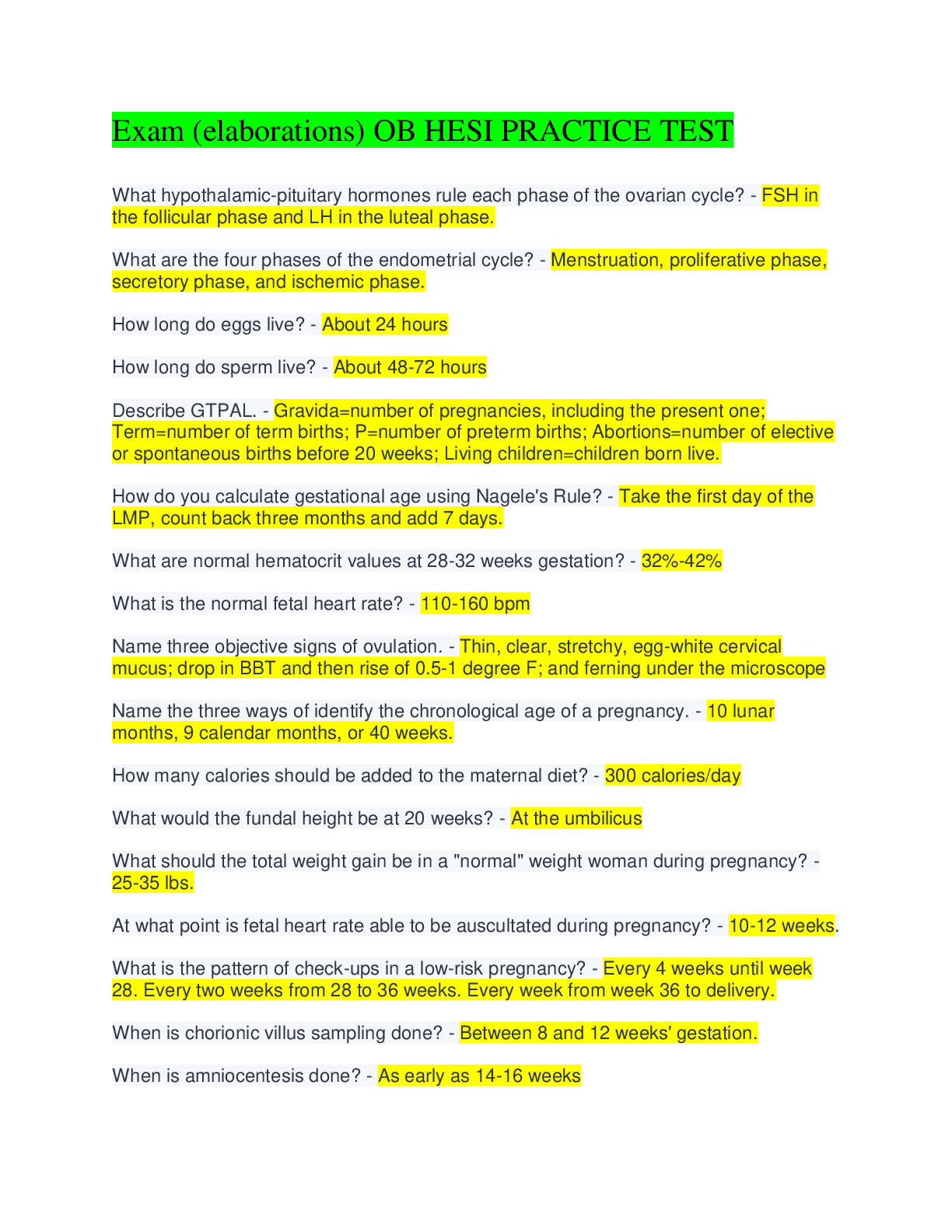
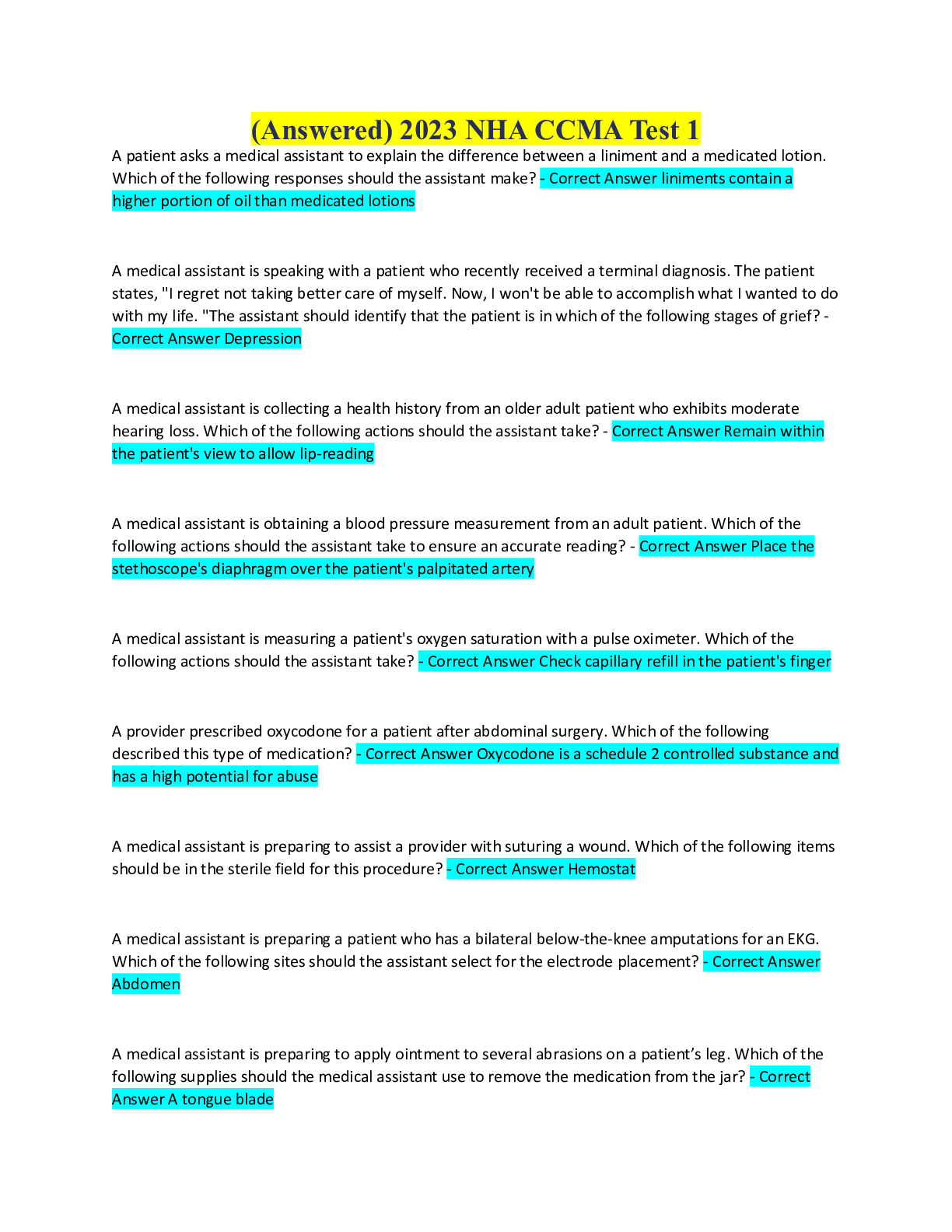
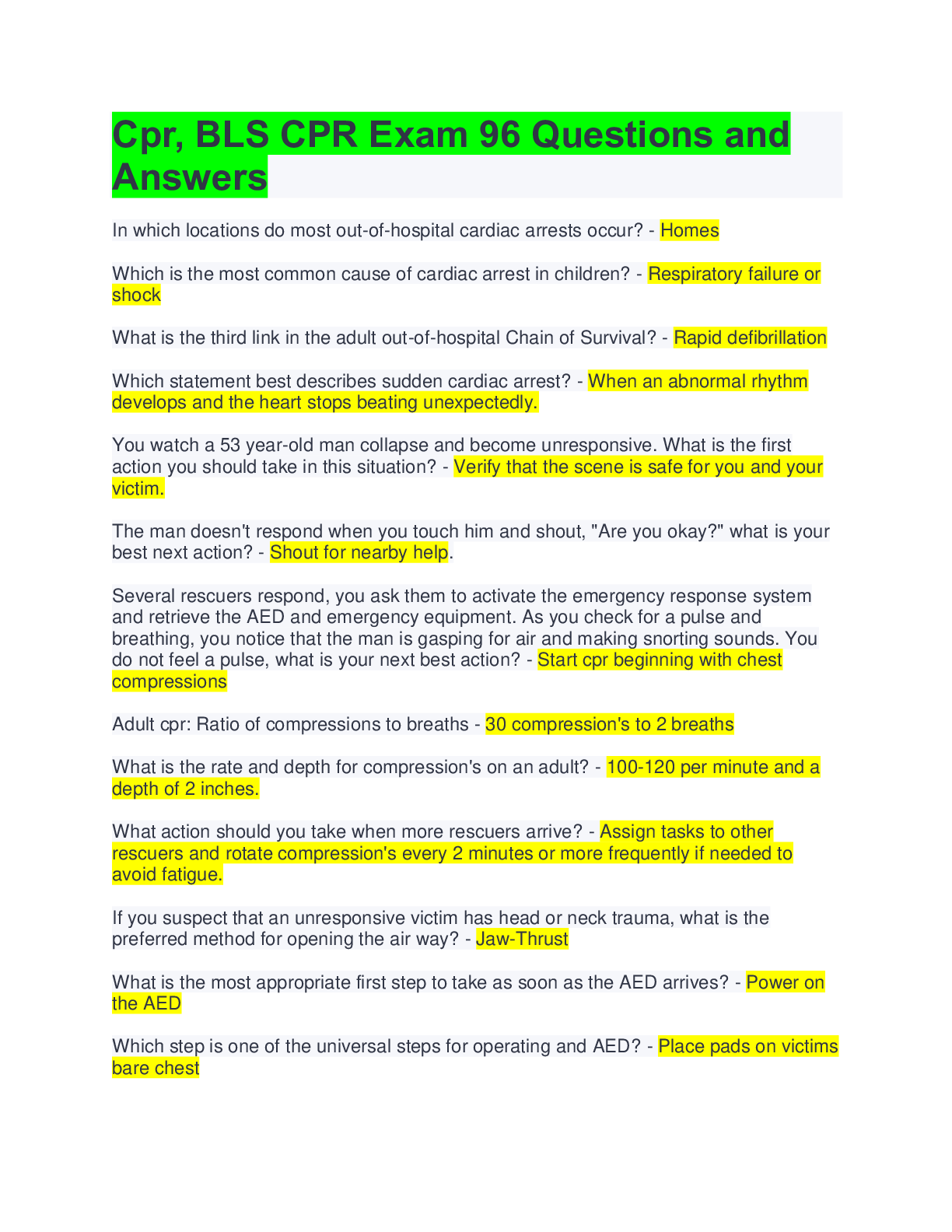
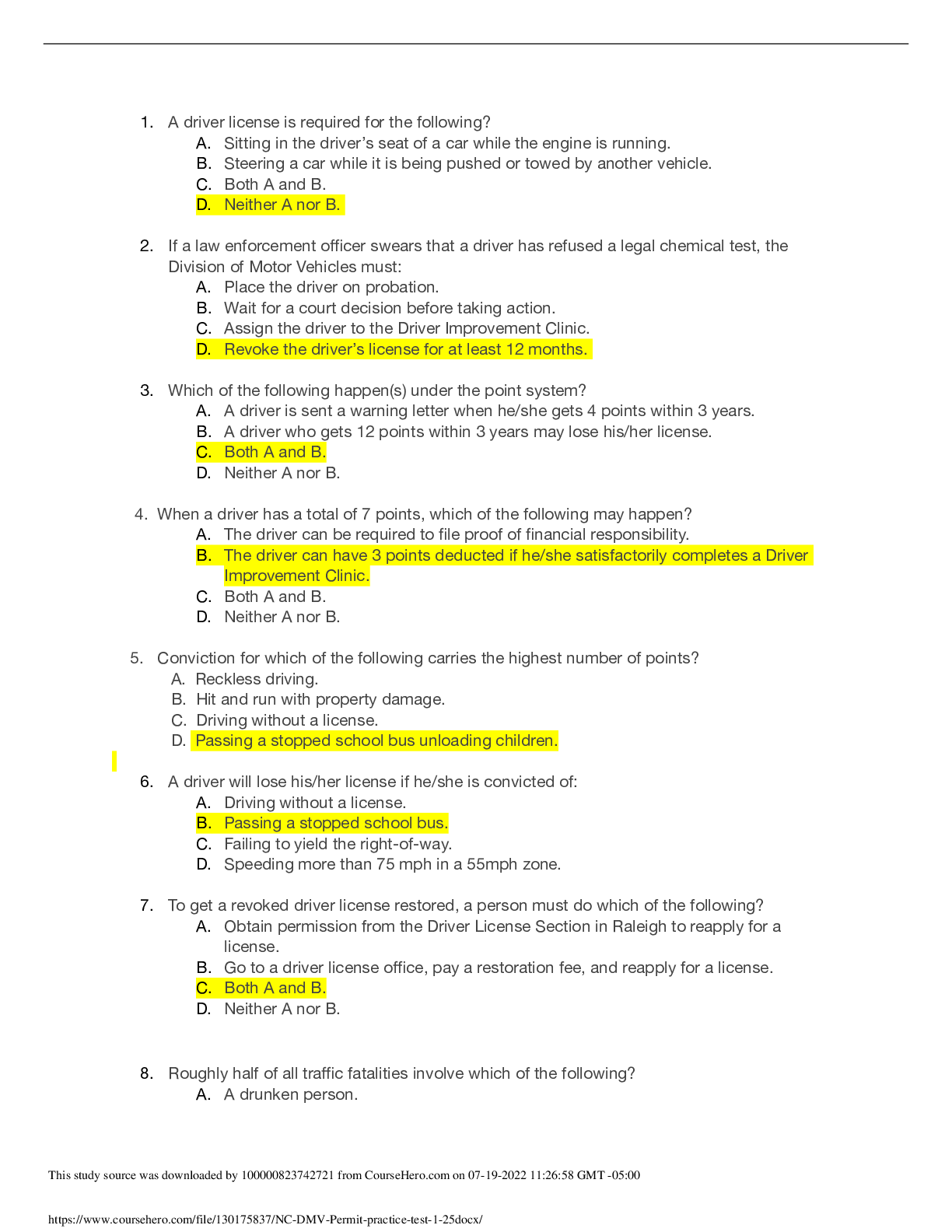
Exam (elaborations) OB HESI PRACTICE TEST
What hypothalamic-pituitary hormones rule each phase of the ovarian cycle? - FSH in
the follicular phase and LH in the luteal phase.
What are the four phases of the endometria
...
Exam (elaborations) OB HESI PRACTICE TEST
What hypothalamic-pituitary hormones rule each phase of the ovarian cycle? - FSH in
the follicular phase and LH in the luteal phase.
What are the four phases of the endometrial cycle? - Menstruation, proliferative phase,
secretory phase, and ischemic phase.
How long do eggs live? - About 24 hours
How long do sperm live? - About 48-72 hours
Describe GTPAL. - Gravida=number of pregnancies, including the present one;
Term=number of term births; P=number of preterm births; Abortions=number of elective
or spontaneous births before 20 weeks; Living children=children born live.
How do you calculate gestational age using Nagele's Rule? - Take the first day of the
LMP, count back three months and add 7 days.
What are normal hematocrit values at 28-32 weeks gestation? - 32%-42%
What is the normal fetal heart rate? - 110-160 bpm
Name three objective signs of ovulation. - Thin, clear, stretchy, egg-white cervical
mucus; drop in BBT and then rise of 0.5-1 degree F; and ferning under the microscope
Name the three ways of identify the chronological age of a pregnancy. - 10 lunar
months, 9 calendar months, or 40 weeks.
How many calories should be added to the maternal diet? - 300 calories/day
What would the fundal height be at 20 weeks? - At the umbilicus
What should the total weight gain be in a "normal" weight woman during pregnancy? -
25-35 lbs.
At what point is fetal heart rate able to be auscultated during pregnancy? - 10-12 weeks.
What is the pattern of check-ups in a low-risk pregnancy? - Every 4 weeks until week
28. Every two weeks from 28 to 36 weeks. Every week from week 36 to delivery.
When is chorionic villus sampling done? - Between 8 and 12 weeks' gestation.
When is amniocentesis done? - As early as 14-16 weeksWhat is the peak of a contraction on fetal monitoring called? - The "acme"
How do you calculate the frequency of contractions? - From the beginning of one
contraction to the beginning of the next
What is measured in intraunterine monitoring that cannot be measured externally? - The
intensity of contractions, measured by the increased IUP in mmHg (30-70 mmHg)
What is the baseline FHR? - The heart rate between contractions, monitored over a 10-
minute period.
What is variability? - The normal irregularity of the cardiac rhythm.
Name the four categories of variability and what they mean. - Absent-undetectable;
minimal- amplitude detectable up to and including 5beats/min; moderate- 6-25
beats/min; and marked=>25 beats/min
What are FHR accelerations? - An increase in FHR in response to stimulus
(contractions, etc.). Indicates a healthy fetus.
What are FHR decelerations? - A decrease in FHR that can be early or late when
compared to uterine contractions.
What are early decelerations? - Decelerations that begin with the beginning of
contractions or with contractions that symbolize a benign pattern caused by head
compression. Slowly decelerates and returns to baseline.
What are variable decelerations? - Common pattern with rapid decelerations that is
variable in duration, depth, and fall, and timing relative to the contraction cycle.
What are the nursing actions associated with variable decelerations? - Change position,
stimulate fetus if indicated, d/c oxytocin, give O2 at 10L by tight face mask, SVE for cord
prolapse, and the report findings to physician and document.
What are late decelerations? - An ominous and potentially disastrous non-reassuring
sign. Indicates uteroplacental insufficiency. Uniform shape of deceleration that occurs
toward the end of contractions and recovery occurs after end of contraction. Decel's
don't go past 100 bpm
What are nursing actions for late decelerations? - Turn client to left side, d/c oxytocin,
give O2 10L by tight face mask, assist with fetal blood sampling if indicated, maintain IV,
elevate legs to increase venous return (if possible), correct any hypotension by
increasing IV or with meds, assess FHR variability, notify MD, and document pattern
and response to each nursing action.What are the possible causes of absent or minimal variability? - Hypoxia, acidosis,
maternal drug ingestion, or fetal sleep.
How is fetal bradycardia defined? - A FHR below 110 bpm for 10 minutes.
What are causes of fetal bradycardia? - fetal hypoxia (late manifestation), medications,
maternal hypotension, fetal heart block, prolonged umbilical cord compression.
How is fetal tachycardia defined? - Baseline of greater than 160 bpm for 10 minutes.
What are the causes of fetal tachycardia? - Early sign of fetal hypoxia, fetal anemia,
dehydration, maternal infection/fever, maternal hyperthyroid disease, and medicationinduced tachycardia.
[Show More]