Medical Physics ABR Part 1 Clinical
Rate the body systems in order of decreasing radio-sensitivity. - ✔✔1. Hematopoietic,
Reproductive (2-5 Gy)
2. Skin, cornea, lens of eyes, GI organs (10 Gy)
3. Bone and cartilage
...
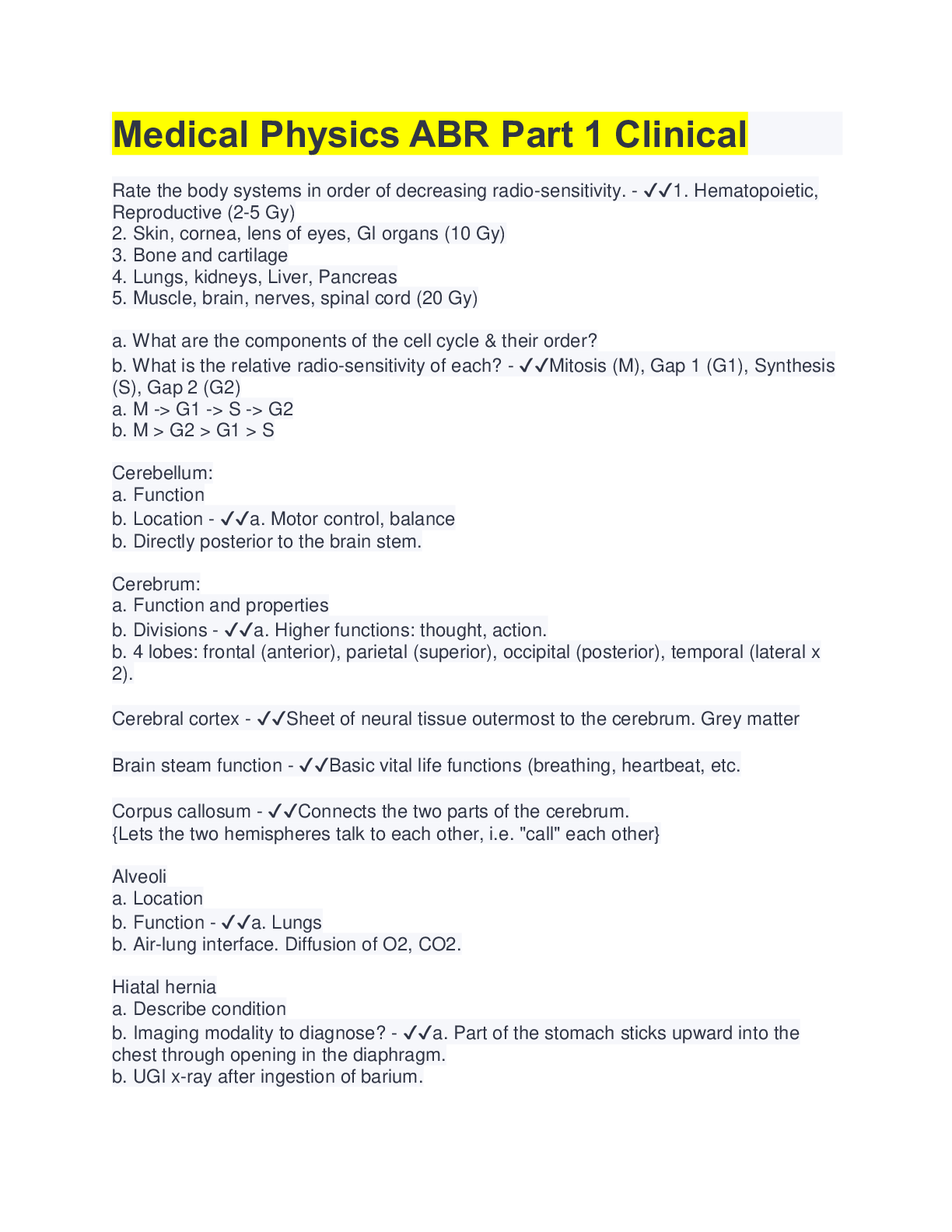
Medical Physics ABR Part 1 Clinical
Rate the body systems in order of decreasing radio-sensitivity. - ✔✔1. Hematopoietic,
Reproductive (2-5 Gy)
2. Skin, cornea, lens of eyes, GI organs (10 Gy)
3. Bone and cartilage
4. Lungs, kidneys, Liver, Pancreas
5. Muscle, brain, nerves, spinal cord (20 Gy)
a. What are the components of the cell cycle & their order?
b. What is the relative radio-sensitivity of each? - ✔✔Mitosis (M), Gap 1 (G1), Synthesis
(S), Gap 2 (G2)
a. M -> G1 -> S -> G2
b. M > G2 > G1 > S
Cerebellum:
a. Function
b. Location - ✔✔a. Motor control, balance
b. Directly posterior to the brain stem.
Cerebrum:
a. Function and properties
b. Divisions - ✔✔a. Higher functions: thought, action.
b. 4 lobes: frontal (anterior), parietal (superior), occipital (posterior), temporal (lateral x
2).
Cerebral cortex - ✔✔Sheet of neural tissue outermost to the cerebrum. Grey matter
Brain steam function - ✔✔Basic vital life functions (breathing, heartbeat, etc.
Corpus callosum - ✔✔Connects the two parts of the cerebrum.
{Lets the two hemispheres talk to each other, i.e. "call" each other}
Alveoli
a. Location
b. Function - ✔✔a. Lungs
b. Air-lung interface. Diffusion of O2, CO2.
Hiatal hernia
a. Describe condition
b. Imaging modality to diagnose? - ✔✔a. Part of the stomach sticks upward into the
chest through opening in the diaphragm.
b. UGI x-ray after ingestion of barium.
Upper gastrointestinal. - ✔✔UGI. Esophagus, stomach, and duodenum
Lower gastrointestinal - ✔✔LGI. Small and Large intestine. Stool.
US transducers:
a. What is the angle of orientation of the two surfaces?
b. How thick are the transducers in terms of the wavelength?
c. Are the pressure waves and voltage in phase or out of phase? - ✔✔a. 180 degrees.
b. lambda/2
c. pressure: in phase. Voltage: out of phase.
Stroke
a. Describe
b. Effects - ✔✔a. sudden loss of consciousness resulting when the rupture or occlusion
of a blood vessel leads to oxygen lack in the brain
b. Loss of brain function, ischemia, hemorrhage
Ischemia - ✔✔Insufficient blood flow to an area
Hemorrhage - ✔✔Flow of blood from a ruptured blood vessels.
Transurethral resection - ✔✔Small pieces of tissue from a nearby structure (typically
prostate) are removed through the wall of the urethra.
Foramen magnum - ✔✔A large hole in the occipital bone (base of skull) for the passage
of nerves into the spinal cord.
Liver cirrhosis
a. Describe
b. Causes
c. Effects - ✔✔a. Cells are progressively destroyed and replaced by fatty and fibrous
tissue that surrounds the intrahepatic blood vessels and biliary radicles, impeding the
circulation of blood through the liver.
b. Caused by chronic alcohol abuse (alcoholism); hepatitis B, C, and D (causes liver
inflammation and injury leading to cirrhosis); and ingestion of poisons.
c. Hypertension, intestine bleeding.
Sarcoidosis - ✔✔Chronic inflammatory disease in which small nodules (granulomas)
develop in lungs, lymph nodes, and other organs
Meiosis
a. Describe
b. Result - ✔✔a. Cell division that produces reproductive cells in sexually reproducing
organisms
b. 4 haploid cells
Haploid cells - ✔✔A cell containing only one set of chromosomes.
Diploid - ✔✔Cell having two sets of chromosomes or twice the haploid number.
How many essential minerals to human health. List them. - ✔✔17.
7 major: Calcium, Sodium, Chloride, Magnesium...
Phosphorus, Sulfur, Potassium.
10 trace: Manganese, Chromium, Copper, Selenium...
Zinc, Iodine, Fluoride, Molybdenum.
{Sing Mexican Hat Dance. Iodine = "Ey
[Show More]

.png)

.png)
.png)