NASM Personal Training Certification Exam Questions and answers, Graded A+
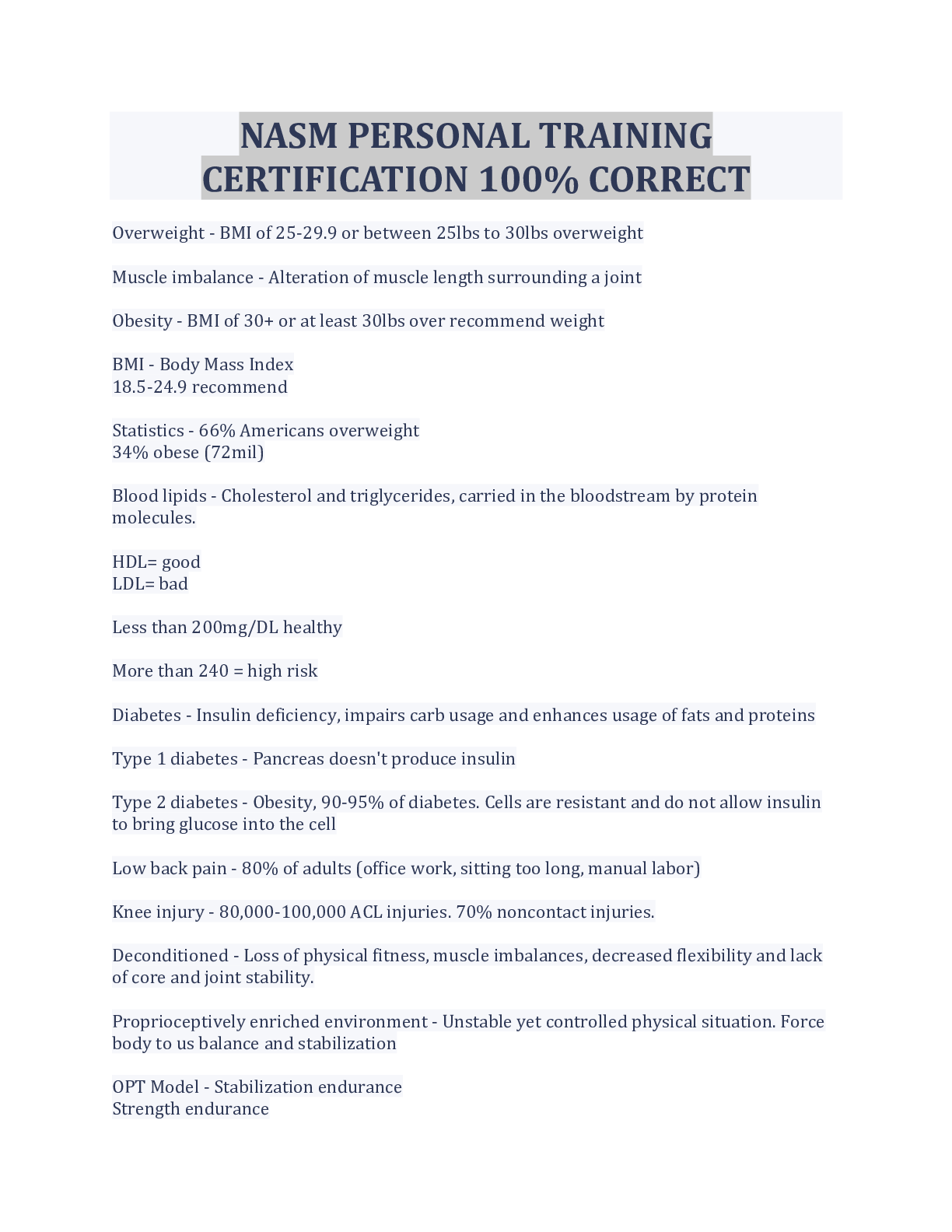
Muscle imbalances - ✔✔alteration of muscle length surrounding a joint
Obesity - ✔✔The condition of being considerably overweight, and ref
...
NASM Personal Training Certification Exam Questions and answers, Graded A+
Muscle imbalances - ✔✔alteration of muscle length surrounding a joint
Obesity - ✔✔The condition of being considerably overweight, and refers to a person with a body mass index of 30 or greater, or who is at least 30 pounds over his or her recommended weight
What is the BMI of a typical obese individual? - ✔✔30 or greater
Refers to a person with a body mass index of 25-29.9 or who is between 25-30 pounds over the recommended weight - ✔✔overweight
These are also known as cholesterol and triglycerides and are carried in the bloodstream by protein molecules known as HDL and LDL - ✔✔blood lipids
chronic metabolic disorder caused by insulin deficiency, which impairs carbohydrate usage and enhances usage of fats and proteins - ✔✔diabetes mellitus
a state of lost physical fitness, which may include muscle imbalances, decreased flexibility, and a lack of core and joint stability - ✔✔deconditioned
the cumulative sensory input to the central nervous system from all mechanoreceptors that sense body positions and limb movement - ✔✔proprioception
an unstable physical situation in which exercises are performed that cause the body to use its internal balance and stabilization mechanisms (Examples include using stability balls and single-leg squats versus traditional) - ✔✔proprioceptively enriched movement
smaller divisions of training progressions that fall within the three building blocks of training - ✔✔phases of training
a muscle's ability to contract for an extended period - ✔✔muscular endurance
the ability of the neuromuscular system to enable all muscles to efficiently work together in all planes of motion - ✔✔neuromuscular efficiency
What is the first phase of training that should be completed before anything else to prevent injury and/or tension at the joints? - ✔✔stabilization training
the muscle that acts as the initial and main source of motive power - ✔✔prime mover
set of two exercises that are performed back-to-back without any rest time between them - ✔✔superset
What type of training should done by individuals with a goal of maximal muscle growth? - ✔✔Hypertrophy training
ability of muscles to exert maximal force output in a minimal amount of time - ✔✔rate of force production
the combination and interrelation of the nervous, muscular, and skeletal systems - ✔✔human movement systems
a conglomeration of billions of cells specifically designed to provide a communication network within the human body - ✔✔nervous system
the ability of the nervous system to sense changes in either the internal or external environment - ✔✔sensory function
the ability of the nervous system to analyze and interpret sensory information to allow proper decision making, which produces the appropriate response - ✔✔integrative function
the neuromuscular response to the sensory information - ✔✔motor function
the functional unit of the nervous system - ✔✔neuron
These neurons transmit nerve impulses from effector sites via receptors to the brain and spinal cord -- respond to touch, sound, light and other stimuli - ✔✔sensory neurons
transmit nerve impulses from one neuron to another - ✔✔interneurons
transmit nerve impulses from the brain and spinal cord to effector sites - ✔✔motor neurons
the portion of the nervous system the consists of the brain and spinal cord - ✔✔central nervous system
cranial and spinal nerves that spread throughout the body - ✔✔peripheral nervous system
sensory receptors responsible for sensing distortion and pressure in body tissues - ✔✔mechanoreceptors
receptors sensitive to change in length of the muscle and the rate of that change - ✔✔muscle spindles
receptors sensitive to change in tension of the muscle and the rate of that change - ✔✔golgi tendon organs
receptors surrounding a joint that respond to pressure, acceleration, and declaration of the joint - ✔✔joint receptors
the body's framework, composed of bones and joints - ✔✔skeletal system
provide a resting ground for muscles and protection of vital organs - ✔✔bones
junctions of bones, muscles, and connective tissue at which movement occurs - ✔✔joints
portion of the skeletal system that consists of the skull, rib cage, and vertebral column - ✔✔axial skeleton
portion of the skeletal system that includes the upper and lower extremities - ✔✔appendicular skeleton
The "link" between the axial and appendicular skeletons - ✔✔pelvic girdle
the process of resorption and formation of bone - ✔✔remodeling
a type of bone cell that removes bone tissue - ✔✔osteoclasts
a type of cell that is responsible for bone formation - ✔✔osteoblasts
the end of long bones, which is mainly composed of cancellous bone, and house much of the red marrow involved in red blood cell production - ✔✔epiphysis
the shaft portion of a long bone - ✔✔diaphysis
the region of a long bone connecting the diaphysis to the epiphysis -- a layer of cartilaginous cells in which growth in length of the diaphysis occurs - ✔✔epiphyseal plate
a dense membrane composed of fibrous connective tissue that closely wraps all bone - ✔✔periosteum
the central cavity of bone shafts where marrow is stored - ✔✔medullar cavity
cartilage that covers the articular surfaces of bone - ✔✔articular cartilage
flattened or indented portions of bone, which can be muscle attachment sites - ✔✔depressions
projections protruding from the bone where muscles, tendons, and ligaments can attach - ✔✔processes
a series of irregularly shaped bones called vertebrae that houses the spinal cord - ✔✔vertebral column
1st seven vertebrae starting at the top of the spinal column - ✔✔cervical spine
twelve vertebrae located in the upper/middle back behind the ribs - ✔✔thoracic spine
five vertebrae of the low back below the thoracic spine - ✔✔lumbar spine
triangular bone located below the lumbar spine - ✔✔sacrum
located below the sacrum, more commonly known as the tailbone - ✔✔coccyx
more specific term for joint motion - ✔✔anthrokinematics
joints that are held together by a joint capsule and ligaments and are most associated with movement in the body - ✔✔synovial joints
this joint is a non-axial joint and is the simplest moving of all joints - ✔✔gliding joint
these joints because the condyle of one bone fits into the cavity of another bone to form the joint - ✔✔condyloid joints
uniaxial joint allowing movement predominantly in only the sagittal plane - ✔✔hinge joint
this joint is only found in the carpometacarpal joint in the thumb, allowing movement in two planes of motion - ✔✔saddle joint
these joints are found in the atlantoaxiao joint at the base of the skull and the radioulnar joint of the elbow, allowing movement in one plane of motion - ✔✔pivot joints
these are the most mobile of all joints, allowing movement in all three planes - ✔✔ball-and-socket joints
joints that do not have a joint cavity, connective tissue, or cartilage - ✔✔Nonsynovial joint
primary connective tissue that connects bones together and provides stability, input to the nervous system, guidance, and the limitation of improper joint movement - ✔✔ligament
What is the best type of exercise for bone strength and health? - ✔✔weight-bearing exercise
series of muscles that moves the skeleton - ✔✔muscular system
a layer of connective tissue that surrounds the muscle - ✔✔epimysium
the connective tissue that surrounds fascicles - ✔✔perimysium
the deepest layer of connective tissue that surrounds individual muscle fibers - ✔✔endomysium
connective tissue that attach muscle to bone and provide as an anchor for muscles to produce force - ✔✔tendons
the functional unit of a muscle that produces muscular contraction and consists of repeating sections of actin and myosin - ✔✔sarcomere
the contraction of a muscle generated by neural stimulation - ✔✔neural activation
a motor neuron and all of the muscle fibers that it activates - ✔✔motor unit
chemical messengers that cross the neuromuscular junction the transmit impulses from nerve to muscle - ✔✔neurotransmitters
Type 1 muscle fibers, also known as _________________ muscle fibers have a high oxidative capacity and don't fatigue as easily - ✔✔slow-twitch
Type 2 muscle fibers, also known as _________________ muscle fibers have a low oxidative capacity and fatigue easily - ✔✔fast-twitch
these hormones help prepare the body for activity and are participants in the "fight or flight" reflex - ✔✔catecholamines
in both men and women, this hormone plays a major role in the growth and repair of tissue - ✔✔testosterone
this hormone is referred to as a catabolic hormone and is associated with tissue breakdown - ✔✔cortisol
this hormone is primarily an anabolic hormone that is responsible for most growth and development during childhood up until puberty - ✔✔growth hormones
these hormones or responsible for carbohydrate, protein, and fat metabolism - ✔✔thyroid hormones
a hollow muscular organ that pumps blood through the body by means of rhythmic contraction - ✔✔heart
the space in the chest between the lungs that contains all the internal organs of the chest except the lungs - ✔✔mediastinum
a specialized area of cardiac tissue, located in the right atrium of the heart, which initiates the electrical impulses that determine the heart rate; aka the "pacemaker" of the heart - ✔✔SA Node
a small mass of specialized cardiac muscle fibers, located in the wall of the tight atrium of the heart, that receives the heartbeat impulses from the SA node and directs them to the walls of the ventricles - ✔✔AV Node
the superior chamber of the heart that receives blood from the veins and forced it into the ventricles - ✔✔Atrium
The inferior chamber of the heart that receives blood from the corresponding atrium, in turn, forces blood into the arteries - ✔✔Ventricle
The amount of blood pumped out of the heart with each contraction - ✔✔Stroke Volume
the rate at which the heart pumps - ✔✔heart rate
heart rate x stroke volume; the overall performance of the heart - ✔✔cardiac output
network of hollow tubes that circulate blood through the body - ✔✔blood vessels
vessels that transport blood away from the heart - ✔✔arteries
the smallest blood vessels, and the site of exchange of chemicals and water between the blood and tissues - ✔✔capillaries
vessels that transport blood from the capillaries toward the heart - ✔✔veins
small terminal branches of an artery, which end in capillaries - ✔✔arterioles
the very small veins that connect capillaries to the larger veins - ✔✔venules
a system of organs that collects oxygen form the external environment and transports it to the bloodstream - ✔✔respiratory system
skeletal structues and soft tissues that work together to allow proper respiratory mechanics to occur and help pump blood back to the heart during inspiration - ✔✔respiratory pump
the process of actively contracting the inspiratory muscles to move air into the body - ✔✔inspiration
the process of actively or passively relaxing the inspiratory muscles to move air out of the body - ✔✔expiration
the process of getting oxygen from the environment to the tissues of the body - ✔✔diffusion
the highest rate of oxygen transport and utilization achieved at maximal physical exertion - ✔✔Maximal Oxygen Consumption ; VO2 max
the study of energy in the human body - ✔✔bioenergetics
all of the chemical reactions that occur in the body to maintain itself -- process in which nutrients are acquired, transported, used and disposed of the body - ✔✔metabolism
the examination of bioenergetics as it relates to the unique physiologic changes and demands placed on the body during exercise - ✔✔
[Show More]

.png)