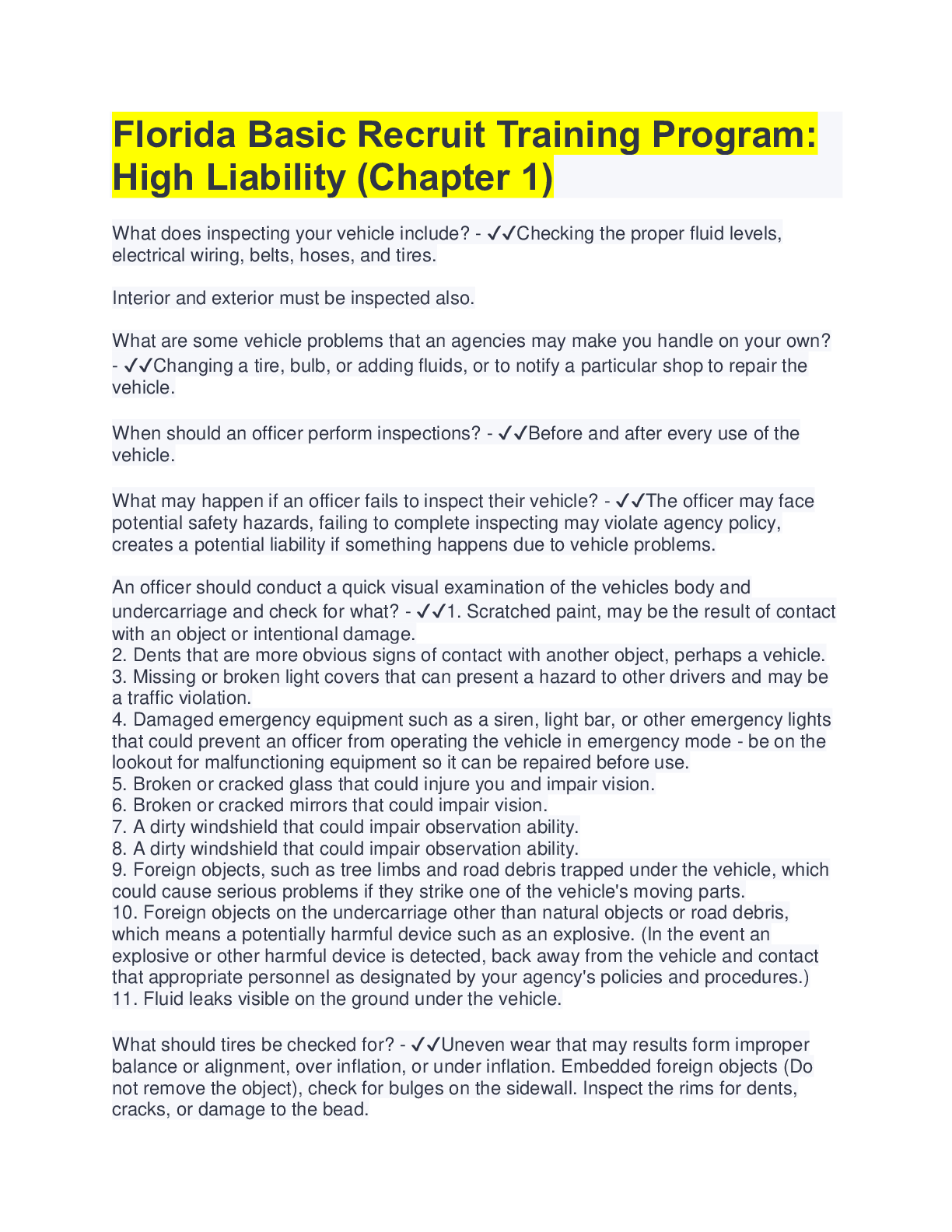
Florida Basic Recruit Training Program:
High Liability (Chapter 1)
What does inspecting your vehicle include? - ✔✔Checking the proper fluid levels,
electrical wiring, belts, hoses, and tires.
Interior and exterior mu
...
Florida Basic Recruit Training Program:
High Liability (Chapter 1)
What does inspecting your vehicle include? - ✔✔Checking the proper fluid levels,
electrical wiring, belts, hoses, and tires.
Interior and exterior must be inspected also.
What are some vehicle problems that an agencies may make you handle on your own?
- ✔✔Changing a tire, bulb, or adding fluids, or to notify a particular shop to repair the
vehicle.
When should an officer perform inspections? - ✔✔Before and after every use of the
vehicle.
What may happen if an officer fails to inspect their vehicle? - ✔✔The officer may face
potential safety hazards, failing to complete inspecting may violate agency policy,
creates a potential liability if something happens due to vehicle problems.
An officer should conduct a quick visual examination of the vehicles body and
undercarriage and check for what? - ✔✔1. Scratched paint, may be the result of contact
with an object or intentional damage.
2. Dents that are more obvious signs of contact with another object, perhaps a vehicle.
3. Missing or broken light covers that can present a hazard to other drivers and may be
a traffic violation.
4. Damaged emergency equipment such as a siren, light bar, or other emergency lights
that could prevent an officer from operating the vehicle in emergency mode - be on the
lookout for malfunctioning equipment so it can be repaired before use.
5. Broken or cracked glass that could injure you and impair vision.
6. Broken or cracked mirrors that could impair vision.
7. A dirty windshield that could impair observation ability.
8. A dirty windshield that could impair observation ability.
9. Foreign objects, such as tree limbs and road debris trapped under the vehicle, which
could cause serious problems if they strike one of the vehicle's moving parts.
10. Foreign objects on the undercarriage other than natural objects or road debris,
which means a potentially harmful device such as an explosive. (In the event an
explosive or other harmful device is detected, back away from the vehicle and contact
that appropriate personnel as designated by your agency's policies and procedures.)
11. Fluid leaks visible on the ground under the vehicle.
What should tires be checked for? - ✔✔Uneven wear that may results form improper
balance or alignment, over inflation, or under inflation. Embedded foreign objects (Do
not remove the object), check for bulges on the sidewall. Inspect the rims for dents,
cracks, or damage to the bead.
PSI - ✔✔Pounds per square inch.
Where can the recommended PSI (Pounds per square inch) be found? - ✔✔On the
doorjamb.
What may happen if a front tire fails? - ✔✔May have difficulty steering, feel vibration in
the steering wheel, and feel the vehicle pulling in the direction of the affected tire.
What may happen if a rear tire fails? - ✔✔May lose traction and may pull in an
unpredictable direction.
What fluid levels should be checked before driving your vehicle? - ✔✔1. Engine Oil
(Measured in Quarts)
2. Brake Fluid
3. Coolant Reservoir
4. Transmission Fluid (Measured in Pints)
5. Power Steering Fluid
6. Windshield washer fluid.
What should you look for when inspecting the vehicles belts, hoses, and wires? -
✔✔Belts should be checked for fraying, cuts, cracking, and gouges. Hoses should be
checked for dry rot, cracking, holes, bulges, and leaks. Wires should be checked for
fraying, corrosion, cracked or missing insulation, and exposure.
What should the vehicle's battery be checked for? - ✔✔Checked for proper operation.
Inspect the terminal connections, water level (if applicable), and signs of damage to the
battery's exterior.
What should you check when inspecting the interior of the vehicle? - ✔✔1. Loose items,
if you stop abruptly they can become severe hazards.
2. Check seats for tears or other damage.
3. Before and after each shift and after every transport, check under the back seat for
potential weapons or contraband left behind by suspects.
4. Seat belts should be observed for fraying and binding and to make sure the clasps
properly work.
5. Headlights, interior lights, turn signals, and hazard flashers should be tested to
ensure that they operate normally.
6. Check the rearview mirror to see if it is securely attached or is cracked or broken.
7. Communication equipment will be tested.
8. Ensure that manual or electric windows and door locks operate properly.
9. Observe gauges for visible damage and react properly. (Gas and battery gauges
should move when the vehicle is turned on.)
10. Emergency equipment must be tested to ensure it works properly.
When you start the vehicle's engine, what should you check for? - ✔✔1. Check windows
and doors for proper operation.
2. Be aware of unusual sounds, smells, or other indicators that may warrant further
inspection.
3. Look under it (standing to the side of the vehicle, not in front) to check for leaks that
may not be apparent when the vehicle is off.
When inspecting the trunk you should check for what? - ✔✔1. Ensure all the trunk's
contents are properly restrained; shifting equipment may damage the vehicle or change
how it handles. (Spare tire, vehicle jack, tire tool, etc.)
2. Long and protruding equipment (e.g, long guns, long-handled tools, and equipment.)
must be stored across the width of the trunk. (Side to side not front to back.)
The Federal Motor Company Administration handbook, Countermeasures, lists what
tips officers should follow to prevent accidents? - ✔✔1. Learn to recognize driving
situations that can be hazardous.
2. Assume other drivers will make errors.
3. Adjust speed, position, direction, and attention to be able to maneuver safely if a
hazard develops.
4. Scan far enough ahead to be able to react safely to approaching situ
[Show More]


.png)
.png)
.png)

.png)

.png)

.png)