350 POLICY EXAM ONE
The mythology of autonomous practice refers to: - ✔✔(C) The assumption by social
work practitioners that their clients are relatively insulated from external policies.
Dependency occurs when - ✔✔(A
...
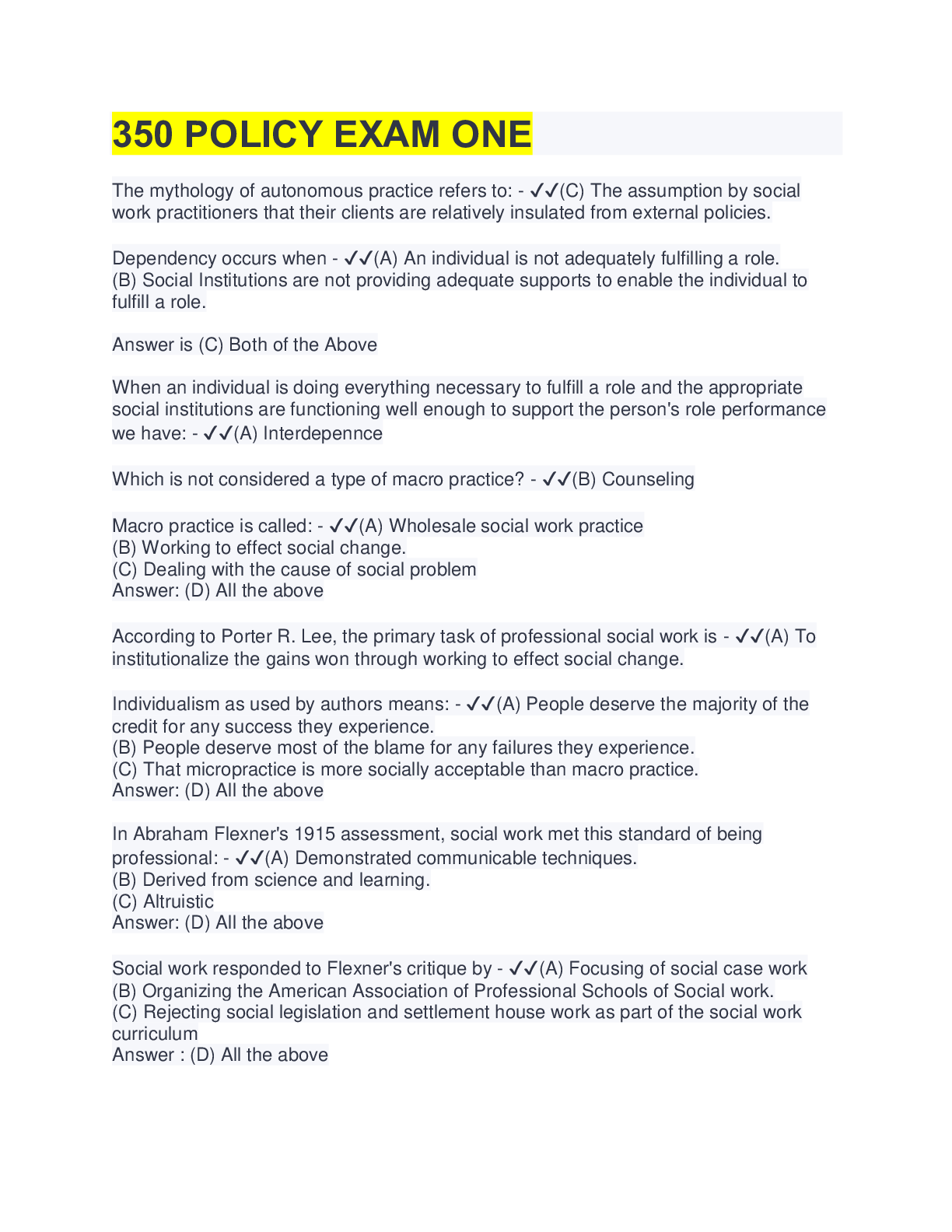
350 POLICY EXAM ONE
The mythology of autonomous practice refers to: - ✔✔(C) The assumption by social
work practitioners that their clients are relatively insulated from external policies.
Dependency occurs when - ✔✔(A) An individual is not adequately fulfilling a role.
(B) Social Institutions are not providing adequate supports to enable the individual to
fulfill a role.
Answer is (C) Both of the Above
When an individual is doing everything necessary to fulfill a role and the appropriate
social institutions are functioning well enough to support the person's role performance
we have: - ✔✔(A) Interdepennce
Which is not considered a type of macro practice? - ✔✔(B) Counseling
Macro practice is called: - ✔✔(A) Wholesale social work practice
(B) Working to effect social change.
(C) Dealing with the cause of social problem
Answer: (D) All the above
According to Porter R. Lee, the primary task of professional social work is - ✔✔(A) To
institutionalize the gains won through working to effect social change.
Individualism as used by authors means: - ✔✔(A) People deserve the majority of the
credit for any success they experience.
(B) People deserve most of the blame for any failures they experience.
(C) That micropractice is more socially acceptable than macro practice.
Answer: (D) All the above
In Abraham Flexner's 1915 assessment, social work met this standard of being
professional: - ✔✔(A) Demonstrated communicable techniques.
(B) Derived from science and learning.
(C) Altruistic
Answer: (D) All the above
Social work responded to Flexner's critique by - ✔✔(A) Focusing of social case work
(B) Organizing the American Association of Professional Schools of Social work.
(C) Rejecting social legislation and settlement house work as part of the social work
curriculum
Answer : (D) All the above
The market-based model of professional practice relies on: - ✔✔(A) A historical
example of private medical practice that is no longer dominant.
(B) An anti-corporate and anti-bureaucratic perspective.
(C) Validation by the attraction of customers in a business model.
Answer: (D) All the above
The three systems that comprise the policy-based professional model are: - ✔✔(A)
Family system
(B) Economic system
(C) Legal system
Answer: (D) None of the above
Social assignment refers to: - ✔✔(C) Societal recognition of a profession as responsible
for a given social problem area.
Proletarianization refers to: - ✔✔(A) An anti-bureautic bias
(B) A Marxist theory of history in which capitalism that strips all workers of control over
their work.
(C) A shift in authority from the professional to the office.
Answer: (D) All the above
Studies of organizations do not support Proletarianization because: - ✔✔(A)
Professionals are recognized under U.S. labor law as a special group.
(B) Professionals are subjected to supervision by other professionals.
Answer: (C) Both of the Above.
(D) Neither of the above.
The strengths of the policy-based professional model include: - ✔✔(A) Acceptance of
difficult-to-define functions as part of social work practice.
(B) Acceptance of social work practice within an organizational context.
(C) Acceptance of systemic influences on human behavior.
Answer: (D) All the above.
Interdependence can be defined as: - ✔✔(B) An individual in doing everything
necessary to fulfill roles and the appropriate social institutions are functioning well
enough to support the person's role performance.
An example of individual role failure is: - ✔✔(A) A woman can't keep a job because she
has problems controlling her temper.
Micropractice is dominant in social work because of all the following except: - ✔✔(A)
The individual is the most immediate target for change.
(B) The conservative nature of U.S. society.
(C) The model of professionalization that the social work profession has pursued.
Answer: (D) All the above
The technique adopted by social work to define itself was known as: - ✔✔(A) Social
casework
The author of the 1915 paper that had a great impact on the direction of the social work
profession was: - ✔✔(C) Abraham Flexner
In this text, the traditional way of defining professions such as medicine is called: -
✔✔(A) Market Based Model
The authors describe the policy based profession as being comprised of the following
except: - ✔✔(A) The practice system`
The thesis that asserts that professionals lose power and control when they work in
organizations is called: - ✔✔(B) Proletarianization
Which of the following is not policy practice role: - ✔✔(A) Therapist
Social policy does not determine the: - ✔✔(B) Goals of clients
What is the best way to understand the relationship between social policy and social
welfare policy: - ✔✔(B) Social welfare policy is a sub-category of social policy
In a philosophical sense, social policy may mean: - ✔✔(A) The opposite of rugged
individualism
The continuing struggle of humanity for equality is best described as an example of: -
✔✔(A) social policy
Libraries, parks and recreation, tax codes, and family law are examples of: - ✔✔(A)
social policy, but not social welfare policy
The educational policy and accreditation standards of the council on social work
education understand the knowledge base of policy practice to include - ✔✔(A) The
History of current structures of social policies and services.
(B) The role of policy and service delivery.
(C) The role of practice and policy development
Answer: (D) All the above
The educational policy and accreditation standards understand the work of policy
practice to include: - ✔✔(A) An analyzing, formulating, and advocating for policies.
(B) Collaborating with colleagues and clients for effective policy action.
(C) Neither the above
Answer: (D) Both the above
The four basic policy basic skills are: - ✔✔(B) Analytic skills, political skills, interactional
skills and value-clarifying skills
What helps explain the significant role of the private sector in American social welfare
policy: - ✔✔(A) Social welfare services grew out of the activities of the private sector.
(B) Government was reluctant to assume responsibility for social welfare
(C) The social work profession resulted from the policies of the private sector
Answer: (D) All the above
Which best describes the contemporary opinion of for-profit organizations and social
welfare service delivery: - ✔✔(C) They are seen as business role models
Which most accurately describes the evolving roles of public and private sectors in the
delivery of social welfare services: - ✔✔(B) The majority of the funds for social services
is public
Which sector provides the most macro level policies: - ✔✔(A) Public and private non-
profit
Which level of policy is most likely to be described as "administrative": - ✔✔(B) Mezzo
level
Which level of policy is most likely to be described as a "basic framework" for the
provision of services: - ✔✔(A) Macro level
Which level of policy is most likely to be described as "actual service" to clients: - ✔✔(B)
Mezzo level
When is social work practitioner exercises a high degree of discretion in the provisions
of social services, this is most likely to be an example of what level of practice: - ✔✔(C)
Macro level
The term "policy" is: - ✔✔(D) A rather loose and imprecise term for which there is no
generally accepted definition of the academic literature
Policy has been defined as: - ✔✔(A) Statements of what ought to happen
(B) A purposive course of action followed by people dealing with a problem
(C) The pattern of action that resolves conflicting claims or provides incentives for
cooperation
Answer: (D) All the above
Activities that would be included under the term social policy, but not social welfare
policy are: - ✔✔(C) Libraries, parks and recreation
[Show More]







.png)