ASNT Study Guide - Industrial
Radiography Radiation Safety
The Symbol R means:
a. rem
b. rad
c. roentgen
d. radiation - ✔✔c. roentgen
The acronym rad means:
a. radiation absorbed dose
b. roentgen absorbed dose
...
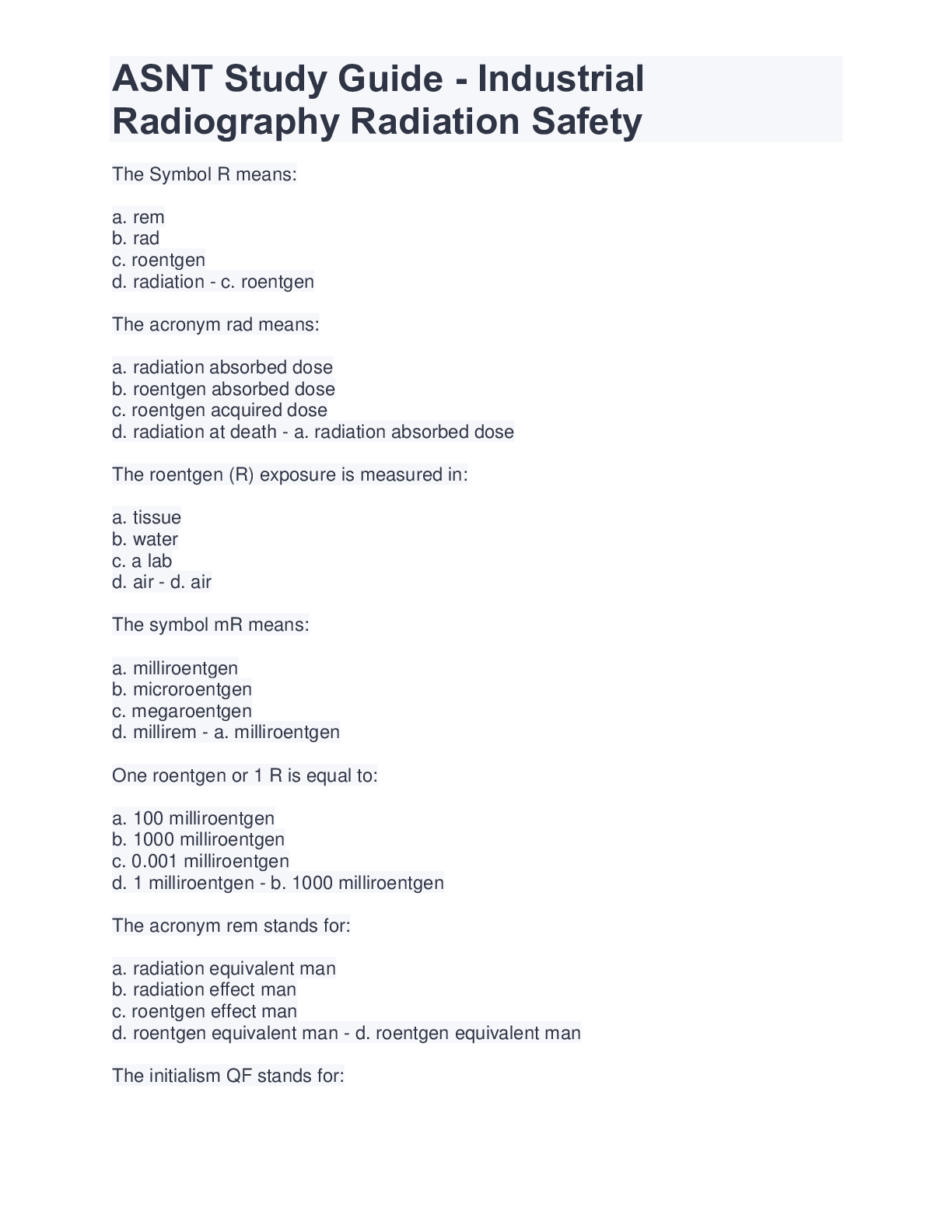
ASNT Study Guide - Industrial
Radiography Radiation Safety
The Symbol R means:
a. rem
b. rad
c. roentgen
d. radiation - ✔✔c. roentgen
The acronym rad means:
a. radiation absorbed dose
b. roentgen absorbed dose
c. roentgen acquired dose
d. radiation at death - ✔✔a. radiation absorbed dose
The roentgen (R) exposure is measured in:
a. tissue
b. water
c. a lab
d. air - ✔✔d. air
The symbol mR means:
a. milliroentgen
b. microroentgen
c. megaroentgen
d. millirem - ✔✔a. milliroentgen
One roentgen or 1 R is equal to:
a. 100 milliroentgen
b. 1000 milliroentgen
c. 0.001 milliroentgen
d. 1 milliroentgen - ✔✔b. 1000 milliroentgen
The acronym rem stands for:
a. radiation equivalent man
b. radiation effect man
c. roentgen effect man
d. roentgen equivalent man - ✔✔d. roentgen equivalent man
The initialism QF stands for:
a. quantity factor
b. quality frequency
c. quality factor
d. quality effective factor - ✔✔c. quality factor
The quality factor for X-rays and gamma rays is:
a. 1
b. 2
c. 10
d. 20 - ✔✔a. 1
The quality factor for alpha (ray) particles is:
a. 1
b. 2
c. 10
d. 20 - ✔✔d. 20
Activity of radioactive material is measured in:
a. curies
b. roentgens
c. sieverts
d. grays - ✔✔a. curies
Becquerels and curies are units of measurement of:
a. physical size of the source
b. gray per hour
c. decay rate
d. roentgen per hour - ✔✔c. decay rate
Atoms that have excess energy and are unstable are known as:
a. radioactive
b. radioactivity
c. balanced
d. weighted - ✔✔a. radioactive
Elementary particles units with a negative electrical charge and a mass approximately
equal to 1/1840 that of a proton are:
a. electrons
b. protons
c. neutrons
d. valence shells - ✔✔a. electrons
Positively charged elementary particles with a mass approximately equal to 1840 times
that of an electron, or 1 AMU, are known as:
a. electrons
b. protons
c. neutrons
d. valence shells - ✔✔b. protons
Uncharged elementary particles with a mass nearly equal to that of a proton are called:
a. electrons
b. protons
c. neutrons
d. valence shells - ✔✔c. neutrons
The area known as the center of an atom is called the:
a. electron
b. nucleus
c. proton
d. neutron - ✔✔b. nucleus
Any byproduct material that is encased in a capsule designed to prevent leakage or
escape of the byproduct material is a:
a. drum
b. pig
c. sealed source
d. container - ✔✔c. sealed source
A tube through which the radioactive source travels when inside a radiographic
exposure device is a/an:
a. port tube
b. guide tube
c. S tube
d. exit tube - ✔✔c. S tube
Survey meters must be calibrated at intervals not to exceed:
a. three months and/or after instrument servicing except for battery changes
b. six months and/or after instrument servicing except for battery changes
c. annually and after instrument servicing except for battery changes
d. daily and after instrument servicing except for battery changes - ✔✔b. six months
and/or after instrument servicing except for battery changes
A survey meter must be capable of measuring a range of:
a. 0 to 1000 mR/h (0 to 10 mSv/h)
b. 2 to 1000 R/h (0.02 to 10 Sv/h)
c. 0 to 1000 R/h (0 to 10 Sv/h)
d. 2 to 1000 mR/h (0.02 to 10 mSv/h) - ✔✔d. 2 to 1000 mR/h (0.02 to 10 mSv/h)
Becquerels and curies are units of measurement of:
a. physical size of the source
b. activity
c. gray per hour
d. roentgen per hour - ✔✔b. activity
An analog survey meter must be calibrated on each scale at two points approximately:
a. 33% and 66% of the scale's potential
b. 25% and 75% of the scale's potential
c. through the full range of the scale's potential
d. at the midpoint of the scale's potential - ✔✔a. 33% and 66% of the scale's potential
The process that results in the removal of orbital electrons from atoms resulting in the
formation of ion pairs is called:
a. excitation
b. radioactivity
c. decay
d. ionization - ✔✔d. ionization
The fact that gases bombarded by ionizing radiation become conductors of electrical
current make them useful in:
a. X-ray transformers
b. cathode tubes
c. detection equipment
d. gasses cannot conduct electrical charges - ✔✔c. detection equipment
A dosimeter must be capable of reading a range of:
a. 0-100 mR (0-1 mSv)
b. 0-200 mR (0-2 mSv)
c. 0-500 mR (0-5 mSv)
d. 0-1 R (0-10 mSv) - ✔✔b. 0-200 mR (0-2 mSv)
Pocket ion chambers must be capable of reading:
a. 100 mR (1 mSv)
b. 500 mR (5 mSv)
c. 200 mR (2 mSv)
d. 999 mR (9.99 mSv) - ✔✔c. 200 mR (2 mSv)
An exposure rate is measured by:
a. survey meter
b. a dosimeter
c. rate alarm
d. TLD/film badge - ✔✔a. survey meter
What dosimeters (dosimetric devices) are least affected by moisture?
a. digital dosimeters
b. film badges
c. TLDs
d. ion chambers - ✔✔c. TLDs
Full deflection of a survey meter while on battery check means:
a. meter is working properly and has good batteries
b. meter may or may not be working properly
c. meter is working properly and battery strength is not an issue
d. meter is unusable - ✔✔b. meter may or may not be working properly
Dosimeters must be calibrated at intervals not to exceed:
a. three months
b. six months
c. biannually
d. annually - ✔✔d. annually
Rate alarms must be calibrated at intervals not to exceed:
a. yearly
b. quarterly
c. monthly
d. biannually - ✔✔a. yearly
A film badge/TLD records what?
a. dose rate
b. exposure rate
c. total dose history for the period worn
d. daily dose - ✔✔c. total dose history for the period worn
When performing radiography in a permanent radiographic installation equipped with an
area monitor, the technician is not required to:
a. use a survey meter
b. wear a film badge or TLD
c. wear a rate alarm
d. wear a dosimeter - ✔✔c. wear a rate alarm
A direct reading ionization chamber, such as a dosimeter, has the advantage of
providing an:
a. accurate dose history for the month
b. immediate dose history since last time charged
c. accurate dose rate
d. immediate dose rate - ✔✔b. immediate dose history since last time charged
A radiographer's survey meter is showing 0 near the source; it can be safely assumed
that:
a. there is no radiation present
b. the meter is inoperable and should be repaired when the shift is over
c. the meter may be inoperable and a replacement should be used immediately
d. the meter is in an inoperable state; the radiographer should retreat form the source
until an operational meter has replaced the suspect meter - ✔✔d. the meter is in an
inoperable state; the radiographer should retreat form the source until an operational
meter has replaced the suspect meter
A radiographer reads 7.5 on the 10x scale of the survey meter. What is the current dose
rate at that position?
a. 7.5 mR/h
b. 75 mR/h
c. 750 mR/h
d. 7.5 R/h - ✔✔b. 75 mR/h
After 6 half-value layers, what percen
[Show More]