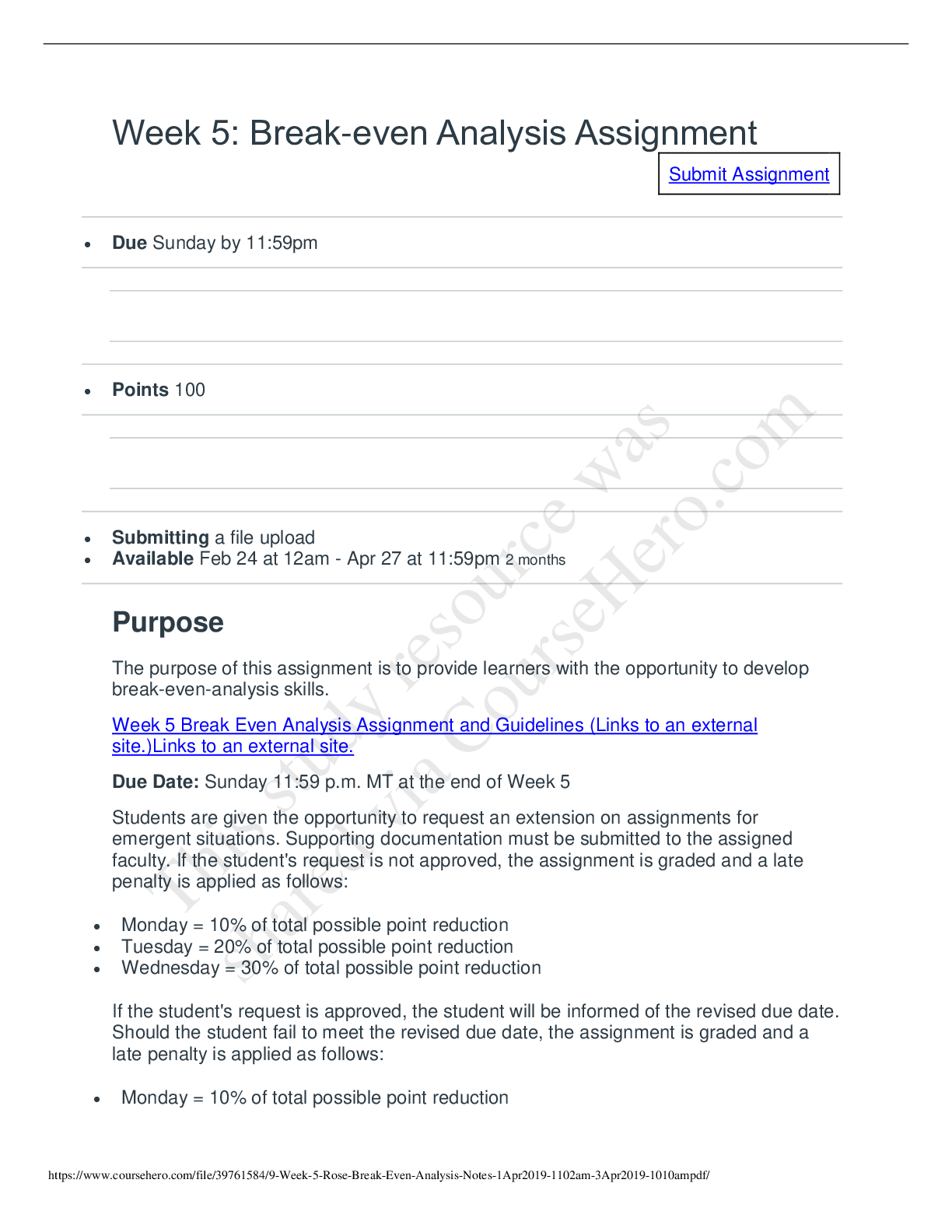
Week 5: Break-even Analysis Assignment Guidelines with Scoring Rubric
Purpose
The purpose of this assignment is to:
To provide learners with the opportunity to develop break-even-analysis skills.
Due Date: Sunday 1
...
Week 5: Break-even Analysis Assignment Guidelines with Scoring Rubric
Purpose
The purpose of this assignment is to:
To provide learners with the opportunity to develop break-even-analysis skills.
Due Date: Sunday 11:59 PM MT at the end of Week 5
Total Points Possible: 100 REQUIREMENTS:
Answer the questions and complete the calculations required for the assignment.
Submit your answers on a Word document, with the heading of Week 5 Assignment. For the questions requiring a written response, please adhere to proper grammar and syntax, and provide references. For the questions requiring calculations, show all your work and follow the format that has been provided for the calculations in the lesson for Week 5.
1. When performing calculations, standard rounding rules apply. If the number to the right of the decimal is less than 5, round down to the nearest whole number, e.g., 33.4 = 33 If the number to the right of the decimal is 5 or greater, round up to the nearest whole number, e.g. 33.5 =34.
2. Read the question carefully. Pay close attention to the units be asked and keep them consistent. For example, hours vs FTEs; days vs months vs years.
3. Provide ALL formulas with references. Designate which formula associates with which source. It is not sufficient to simply list the source at the beginning of the section. Write out the formula used BEFORE filling in the numbers. Formulas used should be taken from one of the required resources for this course.
Example: Total Contribution Margin (CM) = (CM) category 1 + CM cat 2 + CM 3
Leger, J.M. & Dunham-Taylor, J. (2018). Financial management for nurse managers: Merging the heart with the dollar, 4th Ed. Burlington, MA: Jones-Bartlett.
PREPARING THE PAPER
Break-Even Analysis Case Study
You and several of your colleague business partners have decided to establish an outpatient fertility clinic in your service area. All of you are very familiar with this patient population base, have completed an extensive market analysis that demonstrated a great need for the service, and are comfortable with setting up a business and the costs associated with this special group of patients.
As part of the business plan, you and your partners will need to convince stakeholders that this new service endeavor will be viable. They will want to know how many patients visits annually will need to occur and how
long it will take for the service to be at least cost neutral or profitable. To provide them with this information you will perform a break-even analysis. Use the following data, conduct the analysis accounting for the contribution margin of each patient acuity category.
• Fixed Costs: $9,788,000 (start-costs, specialty physicians, anesthesiologists, APNs, staff nurses and other staff salaries, specialty equipment, other miscellaneous)
• Variable costs: $500/patient visit (specialty equipment, oxygen supplies, other miscellaneous)
• Clinic days: Monday-Saturday- 312 days/year
• Projected patient visits per year: 7488
• Patient charges by patient acuity category:
o Simple (15%) $2000/visit
o Moderate (60%) $6500/visit
o Complex (25%) $10,000/visit
Break-even Analysis Data Table
Acuity Category Percentag e % Charge per Visit Visit s per Year Charges per Year Visits per Day Charges per Day Contribution Margin
Simple 15% $2000 1,248 $2,496,000. 00 4 $8000.00 $6000.00
Moderat e 60% $6500 4,368 $28,392,00 0.00 14.4 $91,000.00 $84,000.00
Complex 25% $10,00 0 1,872 $18,720,00 0.00 6 $60,000.00 $57,000.00
Expected Total Daily Charges $159,000
Expected Total Daily Revenue
Break Even point in days
Break Even point in visits
1. Describe your approach to this case study. In addition to the numbers given, what do you need to know before you can calculate the break-even analysis? Contribution margin, fixed cost, variable cost
2. Perform the calculations needed for the break-even analysis. Show your work, formulas used, and reference the formula. When calculating the patient visits per day, round to the nearest whole. After you’ve completed the calculations, record your results in the appropriate place in the table. 7488/312= 24, Simple 24x15%= 3.6/ 4 visit per day, Moderate 24x60%=14 visits per day, Complex 24/25%=6 visits per day.
Simple 4x312= 1248 visits per year, Moderate 14x312=4368 visits per year, Complex 6x312=1872 visits per year.
Simple 1248x$2000.00= $2,496,000.00 charges per year, Moderate 4368x $6500.00=$28,392,000.00 charges per year, Complex 1872x $10,000= $18,720,000.00 charges per year.
Charges per day divide charges per year by clinic days Simple $2,496,000.00/312=$8000.00
Moderate $28,392,000.00/312=$9100.00 Complex $18,720,000.00/312= $60,000.00
Contribution margin is the visits per day multiplied by the number of visits per day subtracted from the charges per day
Simple 4x $500.00=$2000.00 $8000.00-$2000.00= $6000.00 Moderate 14x$500=$7000.00 $91,000.00-$7000.00= $84,000.00 Complex 6x$500= $3000.00 $60,000-$3000.00= $57,000
3. How many patient visits are expected per day?
• Simple 4
• Moderate 14.4-14
• Complex 6
4. What is the contribution margin of each category of patient?
• Simple $6000.00
• Moderate $84,000.00
• Complex $57,000.00
5. Based on the data and your calculations, what is the expected daily revenue?
• $159,000.00
6. How long (in days, months, or years) will it be before the return on investment begins?
7. How many patient visits will be required to reach the break-even point?
8. Discuss your analysis. Is the project viable and profitable service? Does the analysis support moving forward with the business? Cite specific data from your analysis to support your interpretation.
Category Points % Description
Approach to Break-Even Analysis 5 5% Approach to Break-even analysis is clearly articulated and contains elements needed to address the scenario
Calculate the number of patients/categor y served per year and day. 15 15% Number of patients served by the fertility clinic is correctly calculated per year and day for each type/category. Formulas are correctly shown, used, and referenced. Calculations are shown
Calculate the contribution margin for each patient category 30 30% For each of the three patient/categories the contribution margin is correctly calculated. Formulas are correctly shown, used, and referenced. Calculations are shown.
Calculate the number of days to break-even. 10 10% Time to break-even in days is correctly calculated. Formulas are correctly shown, used, and referenced. Calculations are shown
Calculate the break-even quantity (number of visits). 15 15% The break-even quantity (number of visits) is correctly calculated. Formulas are correctly shown, used, and referenced. Calculations are shown.
Analysis of break-even analysis 20 20% Break-even analysis is clearly articulated. Includes elements potential for viability and profitability of service, recommendation for continuing the business. Specific data from the analysis is used to support your interpretation.
Writing conventions, format, and reference
citations 5 5% Writing is clear concise without grammatical and spelling errors. All references are correctly cited (if applicable) and written.
100 100 A quality assignment will meet or exceed all of the above requirements.
GRADING RUBRIC
Assignment Criteria
Outstanding or highest level of performance
Very good or high level of performance
Competent or satisfactory level of performance
Poor or failing level of performance
Unsatisfactory level of performance
Content
Possible Points = 100 Points
Approach to Break-Even Analysis 5 Points 0 Points
Calculate the number of patients per category served at the fertility clinic per year and per day. 15 Points 10 5 0 Points
Number of patients served per year and per day is correctly calculated for each patient category served at the fertility clinic. 2/3 categories correctly calculated 1/3 of categories correctly calculated All categories incorrectly calculated
Calculate the contribution margin for each type of patient served at the fertility clinic. 30 Points 20 10 0 Points
Contribution margin for all category types are correctly calculated Contribution margin for 2/3 category types are correctly calculated Contribution margin for 1/3 category types are correctly calculated Contribution margins for all category types are incorrectly calculated
Calculate the number of days to break-even point. 15 Points 0 Points
Number of days to break-even is Number of days to break even is
correct. incorrect
Calculate the break-even quantity (number of visits) 10 Points 0 Points
Number of visits to break even is correct Number of visits to break even is incorrect.
Analysis of break-even 20 Points 15 Points 10 Points 5 Points 0 Points
analysis
Break-even analysis is clearly articulated. Includes elements potential for viability and profitability of service, recommendation for continuing the business. Specific data from the analysis is used to support your interpretation. 3/4 of all elements of break-even analysis are present and correct. 1/2 of all elements of break-even analysis are present and correct. 1/4 of all elements of break-even analysis is present and correct. All elements of break-even analysis are missing or incorrect.
Writing conventions, format, 5 Points 3 points 1 point 0 points
references
Writing is clear and 2/3 of elements are 1/3 of elements is All elements of
concise, contains no present and correct present and writing conventions
grammatical and correct are missing or
spelling errors. All incorrect.
references are
correctly cited (if
applicable) and
written.
Content Subtotal of 100 points
Total Points
of points
[Show More]




 Budget Development.png)