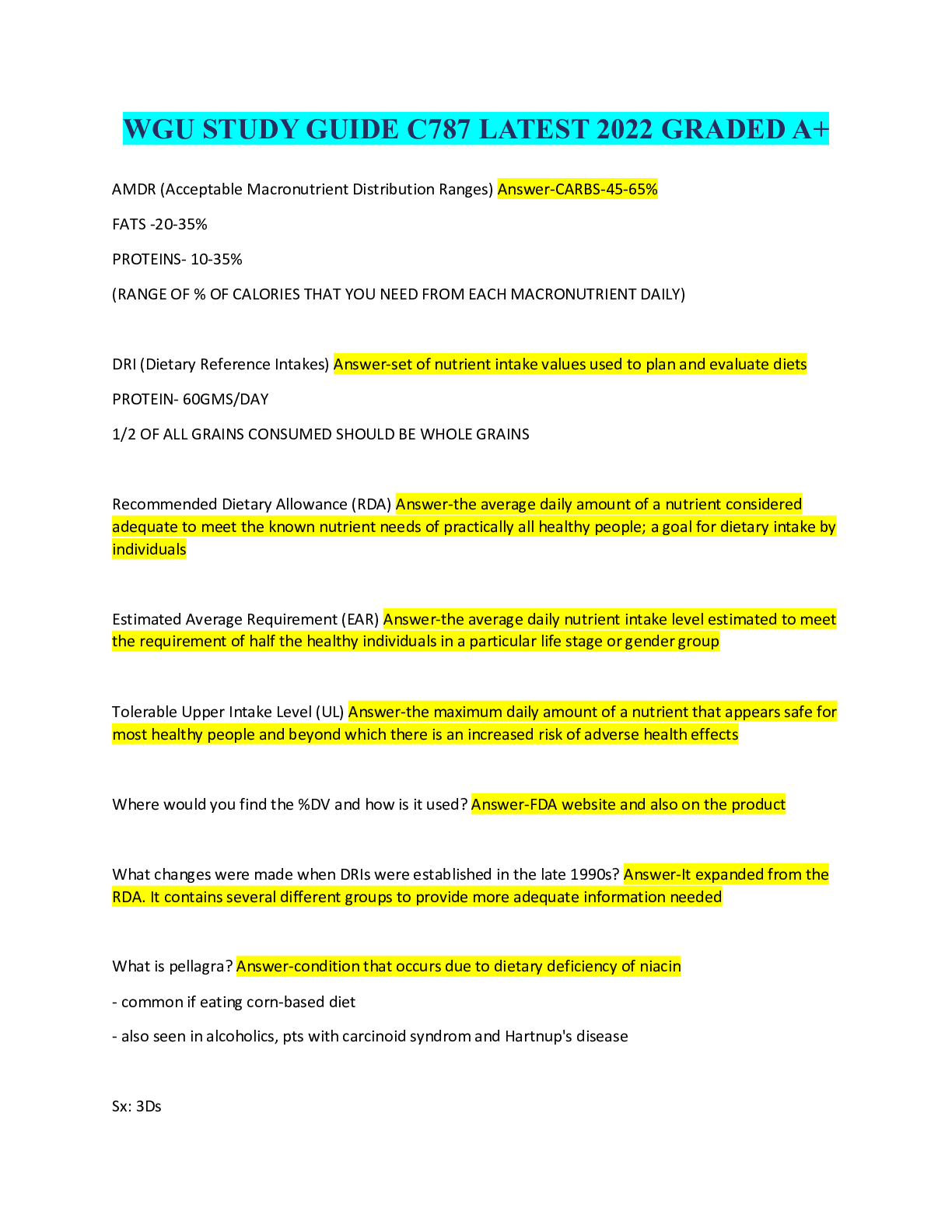
Initial Assessment
● Preparation and Triage
○ Use universal precautions and don PPE
○ Consider any possible patient exposure to hazardous material that puts the trauma team at risk ○ Safe
practice, safe care
○ Ensur
...
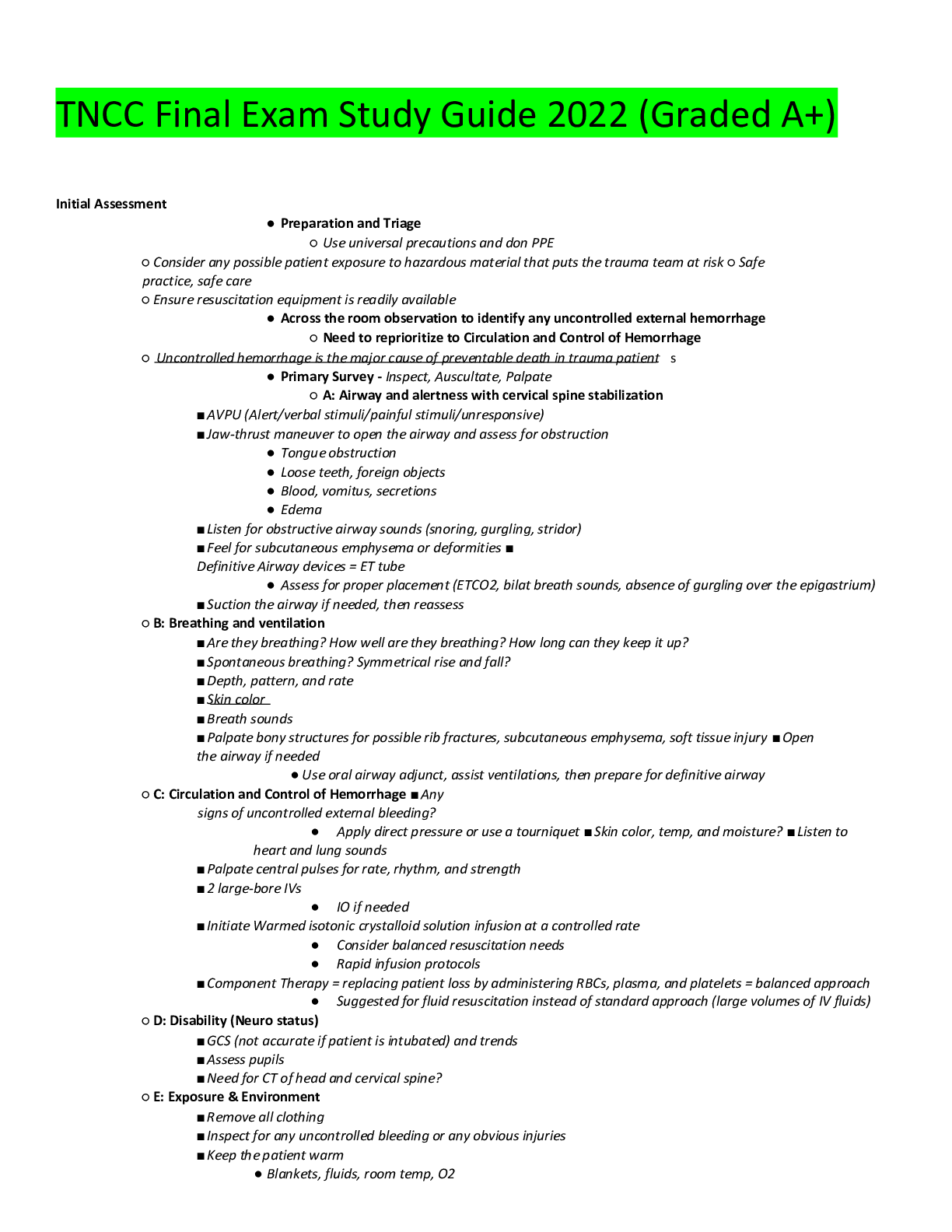
Initial Assessment
● Preparation and Triage
○ Use universal precautions and don PPE
○ Consider any possible patient exposure to hazardous material that puts the trauma team at risk ○ Safe
practice, safe care
○ Ensure resuscitation equipment is readily available
● Across the room observation to identify any uncontrolled external hemorrhage
○ Need to reprioritize to Circulation and Control of Hemorrhage
○ Uncontrolled hemorrhage is the major cause of preventable death in trauma patients
● Primary Survey - Inspect, Auscultate, Palpate
○ A: Airway and alertness with cervical spine stabilization
■ AVPU (Alert/verbal stimuli/painful stimuli/unresponsive)
■ Jaw-thrust maneuver to open the airway and assess for obstruction
● Tongue obstruction
● Loose teeth, foreign objects
● Blood, vomitus, secretions
● Edema
■ Listen for obstructive airway sounds (snoring, gurgling, stridor)
■ Feel for subcutaneous emphysema or deformities
■ Definitive Airway devices = ET tube
● Assess for proper placement (ETCO2, bilat breath sounds, absence of gurgling over the
epigastrium)
■ Suction the airway if needed, then reassess
○ B: Breathing and ventilation
■ Are they breathing? How well are they breathing? How long can they keep it up?
■ Spontaneous breathing? Symmetrical rise and fall?
■ Depth, pattern, and rate
■ Skin color
■ Breath sounds
■ Palpate bony structures for possible rib fractures, subcutaneous emphysema, soft tissue injury ■
Open the airway if needed
● Use oral airway adjunct, assist ventilations, then prepare for definitive airway
○ C: Circulation and Control of Hemorrhage
■ Any signs of uncontrolled external bleeding?
● Apply direct pressure or use a tourniquet
■ Skin color, temp, and moisture?
■ Listen to heart and lung sounds
■ Palpate central pulses for rate, rhythm, and strength
■ 2 large-bore IVs
● IO if needed
■ Initiate Warmed isotonic crystalloid solution infusion at a controlled rate
● Consider balanced resuscitation needs
● Rapid infusion protocols
■ Component Therapy = replacing patient loss by administering RBCs, plasma, and platelets = balanced
approach
● Suggested for fluid resuscitation instead of standard approach (large volumes of IV fluids)
○ D: Disability (Neuro status)
■ GCS (not accurate if patient is intubated) and trends
■ Assess pupils
■ Need for CT of head and cervical spine?
○ E: Exposure & Environment
■ Remove all clothing
■ Inspect for any uncontrolled bleeding or any obvious injuries
■ Keep the patient warm
● Blankets, fluids, room temp, O2
● Aggressive measures are to be taken to prevent loss of body heat
● Hypothermia + hypotension + acidosis = TRAUMA TRIAD OF DEATH
○ F: Full set of VS and Family presence
■ Monitor ef ectiveness of resuscitation ef orts and trend VS
December 2017; TNCC 7th Edition
■ Facilitate family presence as soon as a member of the trauma team is available to act as a liaison to the family
○ G: Get Resuscitation Adjuncts (Get Stuff!)
■ L: Labs (ABGs, Type and Screen, Lactic Acid)
● Lactic acid is an excellent reflection of tissue perfusion● Base deficit of -6 is associated with poor outcomes
■ M: Monitor cardiac Rhythm
■ N: Naso or Orogastric tube
■ O: Oxygenation and Ventilation = Pulse ox and ETCO2
● SpO2 > 95%
● ETCO2 norm = 35-45 mmHg
■ P: Pain
● Assess for pain using appropriate pain scale
● Give nonpharmacologic comfort measures
○ Repositioning, ice therapy, padding, etc.
● Order appropriate analgesic medication
● Reevaluation for signs of internal uncontrolled hemorrhage and consider the need for patient transfer ○
Portable radiograph
○ Initiate steps for transfer to another facility
● Secondary Survey
○ H: History and Head to toe assessment
■ History from EMTs, Patient, Family
■ MIST = MOI, Injuries, S/S, Tx
■ SAMPLE = Symptoms, Allergies, Meds, PMH, Last oral intake, Events/environmental
■ Head
● Eyes, Ears, Nose
■ Neck & cervical spine
● Tracheal deviation = late sign of tension pneumothorax
■ Chest
● Assess heart, lungs, and bones
● Work of breathing
■ Abdomen & FLANKS
● Presence or absence of bowel sounds
■ Pelvis/Perineum
● Palpate instability of pelvis (gentle pressure over the iliac wings downward and medially and over the
symphysis pubis)
● Assess any contraindications for foley catheter
○ Insertion of foley is no longer part of primary assessment due to high risk of CAUTI
■ Inspect and palpate all four Extremities
● Neurological status, color/temp/moisture, sensation, pulses, etc.
○ I: Inspect Posterior surfaces
■ Team assist with log rolling the patient
■ Rectal examination
○ Re Evaluation of adjuncts
■ What injuries were found?
■ What tests were ordered?
■ Abx and Tetanus
■ Wound care
■ Pain meds
■ Splints
● Reevaluation and Post-resuscitation Care
○ Repeat Primary Survey (ABCDE)
○ Vital signs
○ Pain and response to medications
○ Injuries and ef ectiveness of treatment
● Definitive care or Transfer
○ Need for specific subspecialty care
■ Neurosurgery or orthopedics
■ ICU
■ Trauma surgeon
December 2017; TNCC 7th Edition
Chapter 2: Teamwork and Trauma Care
● Vital Roles to the trauma team
○ Patient:
■ The trauma nurse’s highest priority is to ensure the patient remains the focus of the provision of the trauma care
○ Team leader
■ Organizes the team; sets clear goals; makes decisions through input of other team members; empower other
members; model teamwork behaviors
■ Responsible for maintaining situational awareness, clear communication, and encouraging mutual support ○ Core
Team■ Group of care providers works independently to manage a trauma patient from assessment to disposition ○
Contingency and support services
■ Support the core team to facilitate optimal trauma care
● Characteristics of an effective team
○ Effective team members are dynamic, interdependent, and adaptive, moving toward the common goal of optimal trauma
care.
● Key foundations to successful teamwork in the care of the trauma patient
○ Communication
○ Cooperation
○ Coordination
● Strategies for effective communication
○ SBAR
○ DESC (Describe the situation/Express concerns/Suggest alternative/state Consequences)
○ CUS (I’m concerned/uncomfortable/stressed)
○ Callout and Check Back
● Communication Tools
○ Brief
■ A planned teamwork event designed to form the team, designate team roles and responsibilities, establish climate
and goals, and engage the team in goals
■ Done before event
○ Huddle
■ Ideally done before trauma patient’s arrival
■ Purpose of problem solving and regaining situational awareness
○ Debrief
■ Where learning occurs
■ Purpose is process improvement
Chapter 4: Biomechanics, Kinematics, and Mechanisms of Injury
● Kinematics: the study of energy transfer as it applies to identifying actual or potential injuries
● Biomechanics: the general study of forces and their effects
● Mechanism of Injury: how external forces are transferred to the body resulting in injury
● Newton’s Three Laws
○ First Law of Motion: a body at rest will stay at rest unless acted on by an outside force
○ Second Law of Motion: the acceleration of a body is parallel and directly proportional to the net force acting on the body, is
the direction of the net force, and is inversely proportional to the mass of the body (F = m x a) ○ Third Law of Motion: for every action
there is an equal and opposite reaction resulting from the transfer of energy ● Law of Conservation of Energy: energy can neither be
created nor destroyed, but it can change form ● Kinetic Energy = ½ mv^2
○ Mass and velocity contribute to the energy present in a moving object, but it is not a constant ratio ○
When mass is doubled, the net energy is doubled
○ When velocity is doubled, energy is quadrupled
■ High velocity gunshot (rifle) wounds cause more damage than medium-velocity gunshot (handgun) wound even
though the handgun projectile is physically larger or heavier
● Five Forms of Energy
○ Mechanical: energy transfer from one object to another in the form of motion
○ Thermal: energy transfer of heat in the environment of a host
○ Chemical: heat energy transfer from active chemical substances
○ Electrical: energy transfer from light socket, power lines, or lightning
○ Radiant: energy transfer from blast sound waves, radioactivity such as a nuclear facility, or rays of the sun ●
Forces of Energy Transfer
○ External
December 2017; TNCC 7th Edition
■ Deceleration forces: caused by sudden stop of the body’s motion (i.e. falls and collisions)
■ Acceleration forces: result from a sudden and rapid onset of motion (parked car that is hit by a vehicle
traveling at a high rate of speed)
■ Compression force: an external force applied at time of impact
● Stationary objects
● Objects in motion (bullets, bats, balls, fists, feet, etc.)
● Blast forces
○ Internal
■ Forces that resist the applied external force (described as “stress”)
■ How it protects the body from injury
● Compression strength: the ability to resist crush force
● Tensile strength: the ability to resist pulling apart
● Shear strength: the ability to resist a force applied parallel to the tissue
● Types of Traumatic Injury
○ Blunt trauma■ Results from broad energy impacts across large surface areas and involve energy transfer causing
deceleration or acceleration
■ Example: falls, assaults, collisions
○ Penetrating Trauma
■ Results form impalement at a point of impact
■ Example: gunshot
○ Thermal Trauma
■
○ Blast Trauma
■ Rapid release of blast energy results in chemical, physical, and possibly radioactive exposures ●
Deceleration occurs as energy is dispersed from the moving object
○ The more distance involved, the better the outcomes for the patient
● Acceleration = rapid and sudden onset of motion
○ Body hits a tree; internal organs continue to move forward before colliding with internal chest wall (rapid
deceleration).
■ Causes organs to shear off from their vascular supply or anatomic points of attachment
● Environmental and Physiologic Factors considered when the MOI is a fall
○ Point of impact on the boyd
○ Type of surface hit
○ Tissue’s ability to resist effects of potential injuries
○ Acceleration (moving from potential to kinetic energy = Greater acceleration = great impact on deceleration) ●
Motor Vehicle Impact Sequence
○ First Impact = vehicle hits another object
○ Second Impact = passenger collides with the interior of the vehicle
○ Third Impact = internal structures collide with body cavity
● Five Mechanisms of Injury in Blast Trauma
○ Primary = found in patient’s closest to the detonation, with enclosed space detonation resulting in the most lethal impacts
■ Air-filled organs susceptible to rupture
○ Secondary = fragment injuries and generally cause the greatest volume of casualties
○ Tertiary = impacts with larger objects propelled by the blast wind resulting in blunt trauma
○ Quaternary = injuries from heat, flame, gas, and smoke
○ Quinary = injuries from exposure to hazardous materials; the “Dirty Bomb”
● Haddon Matrix
○ Used from injury reduction and prevention
○ Placed emphasis on counterbalances which are more effective than changing human behavior
○ Three phases: Pre-event, The event, post-event
○ Counterbalances can be applied at all three phases
■ Include: the host, the agent, and the physical environment
Chapter 6 Airway and Ventilation
● SaO2 = the percentage of hemoglobin saturated with oxygen as determined by ABG
● SpO2 = pulse oximetry reading of arterial oxygen saturation (SaO2) and is measured as a percentage ● PaO2 = the
partial pressure of oxygen dissolved in the arterial blood and is measured in millimeters of mmHg ○ Reflection of tissue
oxygenation
● PaCO2 = the partial pressure of CO2 dissolved in the blood and is measured in millimeters of mmHg December
2017; TNCC 7th Edition
● FiO2 = inspired concentration of oxygen measure in fraction but more commonly referred to as a percentage in clinical practice
○ Room air FiO2 = 21%
● Ventilation: the movement of air in and out of the lungs
● Diffusion: the passive movement of gases from an area of high concentration to an area of lower concentration ●
Perfusion: the movement of blood to and from the lungs as a delivery medium of oxygen to the entire body ● The tongue
is a common cause of obstruction in the altered patient
● Contributing factors to ineffective ventilation
○ AMS
○ Trauma in high cervical spine with disruption of sympathetic pathways
○ SCI with possible involvement of phrenic nerve resulting in hypoventilation
○ Blunt thoracic trauma - rib fractures and chest wall instability
○ Penetrating thoracic trauma resulting in a hemothorax or pneumothorax
○ Preexisting respiratory disease
○ Increased age with decreased pulmonary reserve
○ Tachypnea as compensation for diminished oxygenation and perfusion
● Airway Adjuncts
○ Nasopharyngeal Airway
■ Can be used in un/responsive patients
■ Contraindicated in patients with facial trauma or suspected basilar skull fracture
■ Measure from tip of the nose to tip of earlobe○ Oropharyngeal Airway
■ Used in the unresponsive patient as a temporary measure to facilitate ventilation with BVM or spontaneous
ventilation until patient can be intubated
■ Use correct size airway be measuring from the corner of the mouth to the tip of the earlobe
● Indications for Definitive Airway Management
○ Failure to maintain or protect own airway
○ Failure to maintain oxygenation or ventilation
○ A specific anticipated clinical course
● Rescue Airways
○ Supraglottic Airway (LMA = laryngeal mask airway)
■ Does not provide protection against aspiration
○ Retroglottic Airways (King airway)
■ Does not have lumen allowing access for gastric tube insertion
● Verifying ET Tube Placement
1. Attach CO2 detection device
2. Watch for symmetric rise and fall of the chest while listening for the presence of gurgling over epigastrium 3.
Listen for the presence of bilateral breath sounds at the midaxillary and midclavicular lines
4. Secure the ETT, note the number at the lip for positioning and document
5. Prepare for mechanical ventilation
6. Note the patient’s color for improvement
7. Obtain chest xray for verification of ETT depth after secondary survey
● Pulse oximetry
○ A non-invasive method of providing oxygenation info and detecting changes in oxygenation that cannot be easily
observed with visual assessment
○ Circumstances that may lead to unreliable readings:
■ Poor peripheral perfusion
■ BP cuff inflated above the sensor
■ CO poisoning
■ Methemoglobinemia
■ Severe dehydration
● Quantitative CO2 monitoring = Capnography monitor
● Qualitative CO2 monitoring = colorimetric CO2 detectors (absences or presence)
● Hyperoxia = too much oxygen
○ High-flow O2 is still indicated initially too all trauma patients
○ Titrate O2 down to maintain SpO2 between 94 - 98% and PaO2 between 100 and 200 mmHg
● Seven P’s of RSI
○ Preparation = gather supplies
○ Preoxygenation = high flow O2
○ Pretreatment = LOAD (lidocaine, opioids, atropine, defasciculating dose of neuromuscular blocking agents) December
2017; TNCC 7th Edition
○ Paralysis with Induction
■ Etomidate, ketamine, versed, propofol, short-acting barbiturates
■ Succinylcholine = use with caution in trauma patient
○ Protection and Positioning
○ Placement with Proof
○ Post intubation management
Chapter 7: Shock
● Hypovolemic Shock
○ Hypovolemic shock from Hemorrhage is the leading cause of preventable deaths in trauma patients. ○
Caused by decrease in the amount of circulating volume
○ Goal-directed therapy is aimed at replacing the type of volume patient has lost
■ Restore physiologic homeostasis
○ Examples:
■ Hemorrhage = whole blood loss
■ Burns = plasma loss
● Obstructive Shock
○ Results from hypoperfusion of the tissue due to an obstruction in either the vasculature or heart
○ Goal-directed therapy is aimed at relieving the obstruction and improving perfusion
○ Examples:
■ Cardiac tamponade = compression of heart → unable to fill atria
■ Tension pneumothorax = mediastinal shift with obstruction to atrial filling
● Cardiogenic Shock
○ Results from pump failure in the presence of adequate intravascular volume
○ Lack of cardiac output and end-organ perfusion
○ Excess volume administration may result in pulmonary edema and increased myocardial ischemia ○Examples:
■ MI = loss of cardiac contractility
■ Dysrhythmias = reduced cardiac output
■ Blunt cardiac trauma = loss of cardiac contractility and dysrhythmias
● Distributive Shock
○ Result of maldistribution of an adequate circulating blood volume with the loss of vascular tone or increased
permeability
○ Examples:
■ Anaphylactic shock: vasodilation of vessels due to immune reaction to allergens
■ Septic shock: mediated by systemic inflammatory response syndrome with hypotension and perfusion
abnormalities
■ Neurogenic shock: loss of vasomotor tone du
[Show More]



.png)




.png)