WGU C236 Compensation and Benefits
Questions and Answers Already Passed
Absolute Level ✔✔The reward can be defined. Paying an employee $50,000 salary per year, for
example, is a defining absolute level.
Administrativ
...
WGU C236 Compensation and Benefits
Questions and Answers Already Passed
Absolute Level ✔✔The reward can be defined. Paying an employee $50,000 salary per year, for
example, is a defining absolute level.
Administrative ✔✔Pertaining to the activities of running an organization or a business.
Anchored Rating Scale ✔✔Uses examples or definitions of typical behaviors to define each point
along the scale.
Autonomy ✔✔Giving employees discretion in choosing what to do and how to do it.
Bad Data Challenge ✔✔Exists because the data a company obtains about market rates may not be
an accurate representation of the market. It is often difficult to fully understand the quality of the
data obtained from various sources, or how best to integrate this information, which adds error to
any reward system based on that data.
Base Pay ✔✔Salary or hourly wages
Benchmark Competitors ✔✔A selection of primary organizations that exemplify the labor and
product/service markets in which the organization competes.
Benchmark Jobs ✔✔Jobs that are representative of the type, content, and level of jobs in the
organization.
Benefit Benchmark Survey ✔✔A tool that helps organizations better understand how employee
benefits may impact their ability to attract and retain qualified employees.
Benefit Level Strategy ✔✔Refers to the level of each benefit type provided as well as the overall
company expenditure.
Benefit Mix Strategy ✔✔Refers to the particular combination of benefit types that an organization
offers.
Broad Input ✔✔Help, advice and thoughts from employees of all levels of the organization.
Broadbanding ✔✔Entails the use of a few broad bands (or grades) to organize work for pay
purposes.
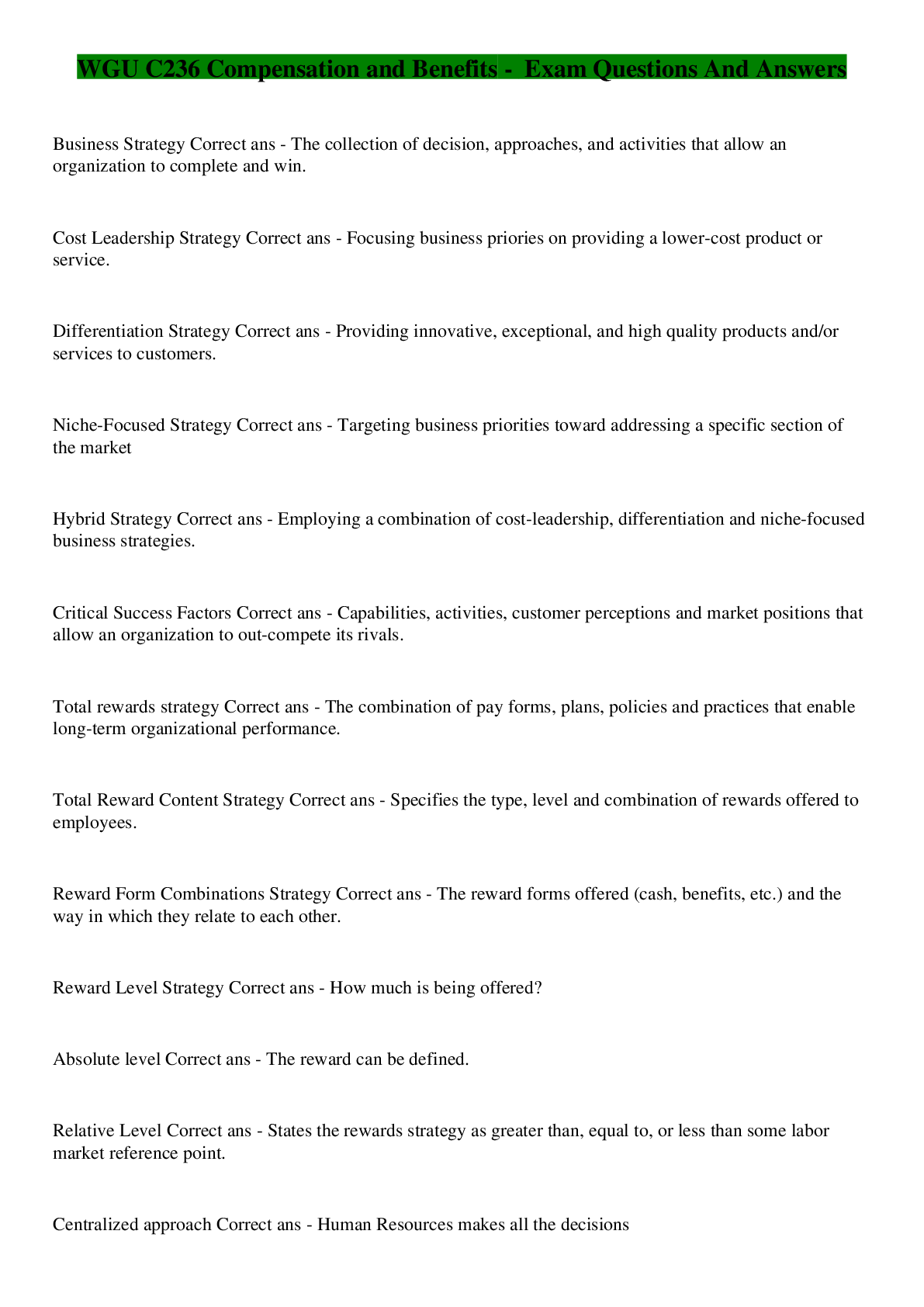
Business Strategy ✔✔The collection of decisions, approaches, and activities that allow an
organization to compete and win
Business Strategy Support ✔✔Supporting a business' approach to adapting to changes in its
environment in order to compete and win.
Capability-based Pay ✔✔When a reward system explicitly attempts to vary rewards based upon
capabilities of the employees. Types include Skill-based pay, Competency-based pay, and
Seniority-based pay.
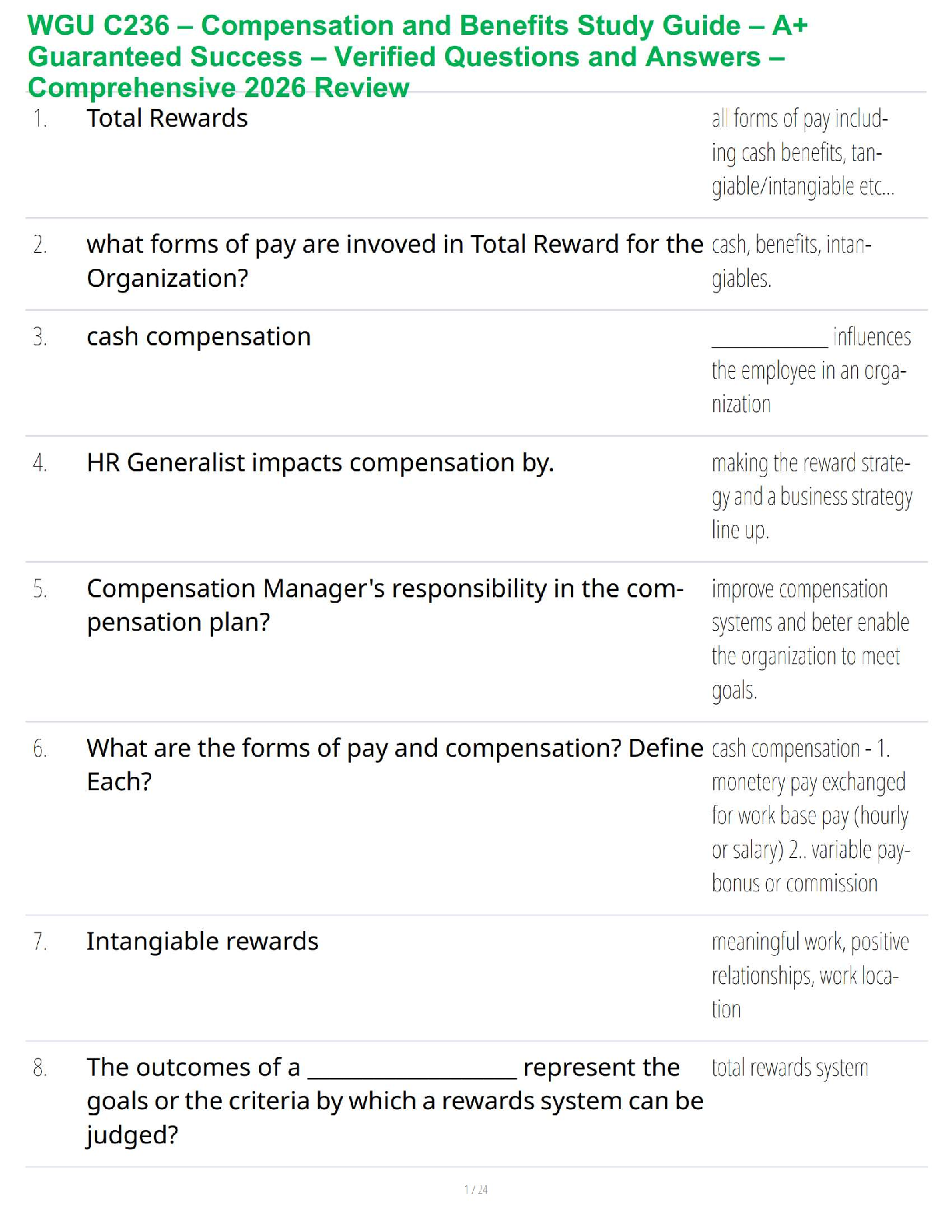
Cash Compensation ✔✔Monetary pay that employees receive in exchange for their work
Central Tendency ✔✔Describes what's typical for a set of data, usually measured by the arithmetic
mean, median, or mode.
Centralized Approach ✔✔The Human Resources department makes all decisions relating to pay
strategy, as well as specific reward decisions.
Centralized Global Rewards Strategy ✔✔Organizations attempt to have a single set of policies
that are determined by the organization and utilized at all locations.
Child Labor ✔✔Defines the type of work appropriate for children and the ages at which children
can work.
Co-pay Policy ✔✔A policy that requires employees to pay a set amount for each time any service
is used.
Collaborative Environment ✔✔Teams of employees work in concert to be creative, solve
problems, and produce results.
Commission-based ✔✔Commission-based reward systems are most often used for jobs with a
sales component and provide employees a set percentage of the sales that they make. They are
used to provide a strong incentive to create sales and also to maximize the size of those sales. In a
pure Commission system, the full risk of low performance is borne by the employees. For this
reason many organizations pair a commission-based system with some other form of base pay
(such as salary) to more evenly distribute that risk.
Communication Strategy ✔✔A plan for creating, sharing, and receiving information relating to its
Total Rewards Systems.
Compa-ratio ✔✔A ratio frequently used to measure the conformity of pay rates to the pay plan.
Compensable Factor ✔✔Job elements or criteria that identify what the organization values for
purposes of job evaluation. Identifying compensable factors is step one in the Point factor
Approach.
Compensatory Time ✔✔Paid time off instead of overtime pay.
Competencies ✔✔Configurations of knowledge, skills, and traits that enable employee
performance.
Computer ✔✔Programming, network administration
Consolidate Information Into Job Description Draft ✔✔Review the information gathered from the
interviews to create the draft of the job description. This draft should note any points of uncertainty
or disagreement among information sources.
Consolidated Omnibus Budget Reconciliation Act (COBRA) ✔✔An Act which established that
employees have a right to continue their employer-sponsored health care plan, at the employees'
expense, for up to 18 months.
Control Costs ✔✔Without a variable pay component, labor costs remain the same even when
revenues, sales, or profits drop. Performance-based pay helps ensure that when performance is
low, the company's cost structure is also reduced.
Correcting Mechanism ✔✔In place to fix any mistake made by the system.
Cost Leadership Strategy ✔✔Focusing business priorities on providing a lower-cost product or
service
Cost of Living Adjustment (COLA) ✔✔A periodic salary or wage increase to compensate for
inflation.
Cost-sharing ✔✔An approach in which the insurance only pays for a portion of medical expenses.
Creative Professionals ✔✔People who are employed for the extraction of their skills concerning
creativity.
Critical Success Factors ✔✔Capabilities, activities, customer perceptions, and market positions
that allow an organization to outcompete its rivals
Custom Questionnaires ✔✔A series of questions that job incumbents complete on their own.
Data ✔✔Facts and statistics collected for reasoning or calculation.
Decentralized Approach ✔✔Decisions can be made by the employee's immediate supervisor or
manager.
Decentralized Global Rewards Strategy ✔✔Rewards policies are established and monitored at the
country level with each location having discretion to adapt to their unique situations and contexts.
Deductible ✔✔The full amount of medical expenses up to a set amount, that must be paid by the
employee.
Defined Benefit ✔✔A plan in which an organization uses a time-based formula to calculate how
much pension an employee has earned, and upon retirement the organization pays the employee a
guaranteed amount per year throughout retirement.
Design Strategy ✔✔The process used to design the rewards system.
Differential Piece Rate ✔✔A system in which a lower rate is paid for the first 10 units assembled,
and then a higher rate is paid for each un
[Show More]
.png)
.png)

.png)
.png)



.png)
.png)