ISTQB Foundation Level Questions and Answers 2022
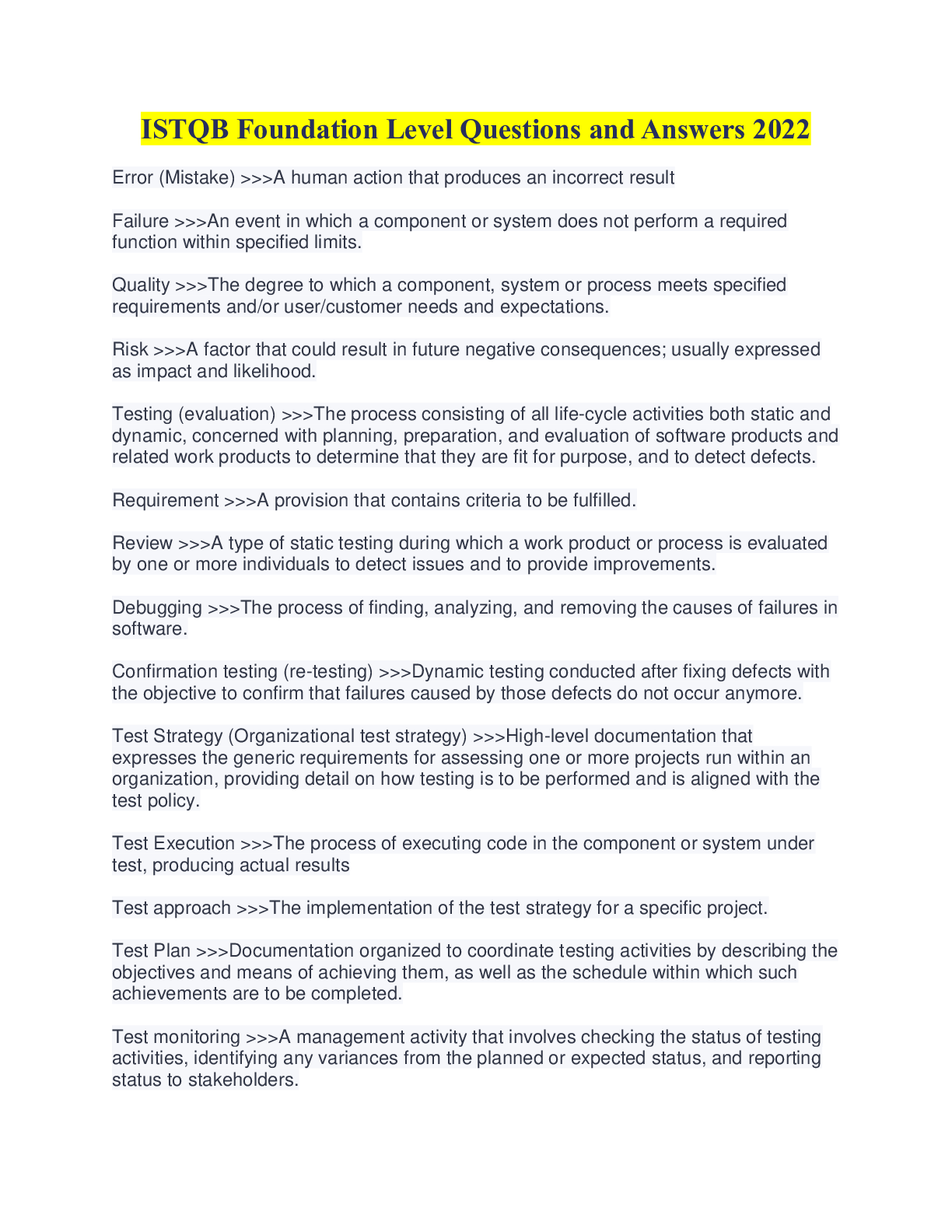
Error (Mistake) >>>A human action that produces an incorrect result
Failure >>>An event in which a component or system does not perform a required function within s
...
ISTQB Foundation Level Questions and Answers 2022
Error (Mistake) >>>A human action that produces an incorrect result
Failure >>>An event in which a component or system does not perform a required function within specified limits.
Quality >>>The degree to which a component, system or process meets specified requirements and/or user/customer needs and expectations.
Risk >>>A factor that could result in future negative consequences; usually expressed as impact and likelihood.
Testing (evaluation) >>>The process consisting of all life-cycle activities both static and dynamic, concerned with planning, preparation, and evaluation of software products and related work products to determine that they are fit for purpose, and to detect defects.
Requirement >>>A provision that contains criteria to be fulfilled.
Review >>>A type of static testing during which a work product or process is evaluated by one or more individuals to detect issues and to provide improvements.
Debugging >>>The process of finding, analyzing, and removing the causes of failures in software.
Confirmation testing (re-testing) >>>Dynamic testing conducted after fixing defects with the objective to confirm that failures caused by those defects do not occur anymore.
Test Strategy (Organizational test strategy) >>>High-level documentation that expresses the generic requirements for assessing one or more projects run within an organization, providing detail on how testing is to be performed and is aligned with the test policy.
Test Execution >>>The process of executing code in the component or system under test, producing actual results
Test approach >>>The implementation of the test strategy for a specific project.
Test Plan >>>Documentation organized to coordinate testing activities by describing the objectives and means of achieving them, as well as the schedule within which such achievements are to be completed.
Test monitoring >>>A management activity that involves checking the status of testing activities, identifying any variances from the planned or expected status, and reporting status to stakeholders.
Test condition (test requirement, test situation) >>>An aspect of the test basis that is relevant in order to achieve specific test objectives.
Test basis >>>The body of knowledge on which assessment analysis and design are based.
Test Data >>>Inputs created or selected to satisfy the execution preconditions and to execute one or more test cases.
Coverage (test coverage) >>>The degree, expressed as a percentage, to which specified items have been exercised by a test suite.
Test procedure >>>A sequence of test cases in execution order, and any associated actions that may be required to set up the initial preconditions and any wrap-up activities post execution.
Test Suite (Test case suite, test set) >>>A set of test cases or test procedures to be executed in a specific test cycle.
Incident* (deviation) >>>Any event occurring that requires investigation.
Testware >>>Work products produced during the test process for use in planning, designing, executing, evaluating and reporting on testing.
Regression testing >>>Assessment of a previously tested program following modification to ensure that defects have not been introduced or uncovered in unchanged areas of the software, as a result of the changes made.
Test log* >>>A chronological record of relevant details about the execution of assessments.
Independence of testing >>>Separation of responsibilities, which encourages the accomplishment of objective testing
Test policy (Organizational test policy) >>>A high-level document describing an organization's principles, approach, and major objectives regarding assessment.
Verification >>>Confirmation by examination of software specifications and through the provision of objective evidence that specified requirements have been fulfilled.
Validation >>>Confirmation by examination and through the provision of objective evidence that the requirements for a specific intended use or application have been fulfilled.
V-model >>>A sequential development lifecycle model describing a one-for-one relationship between major phases of software development from business
[Show More]



.png)
.png)