Chapter 47--Assessment of Gastrointestinal Function
MULTIPLE CHOICE
1. A client asks the nurse what will happen to her digestion if she needs to have her appendix removed.
The nurse should respond that the purpose of
...
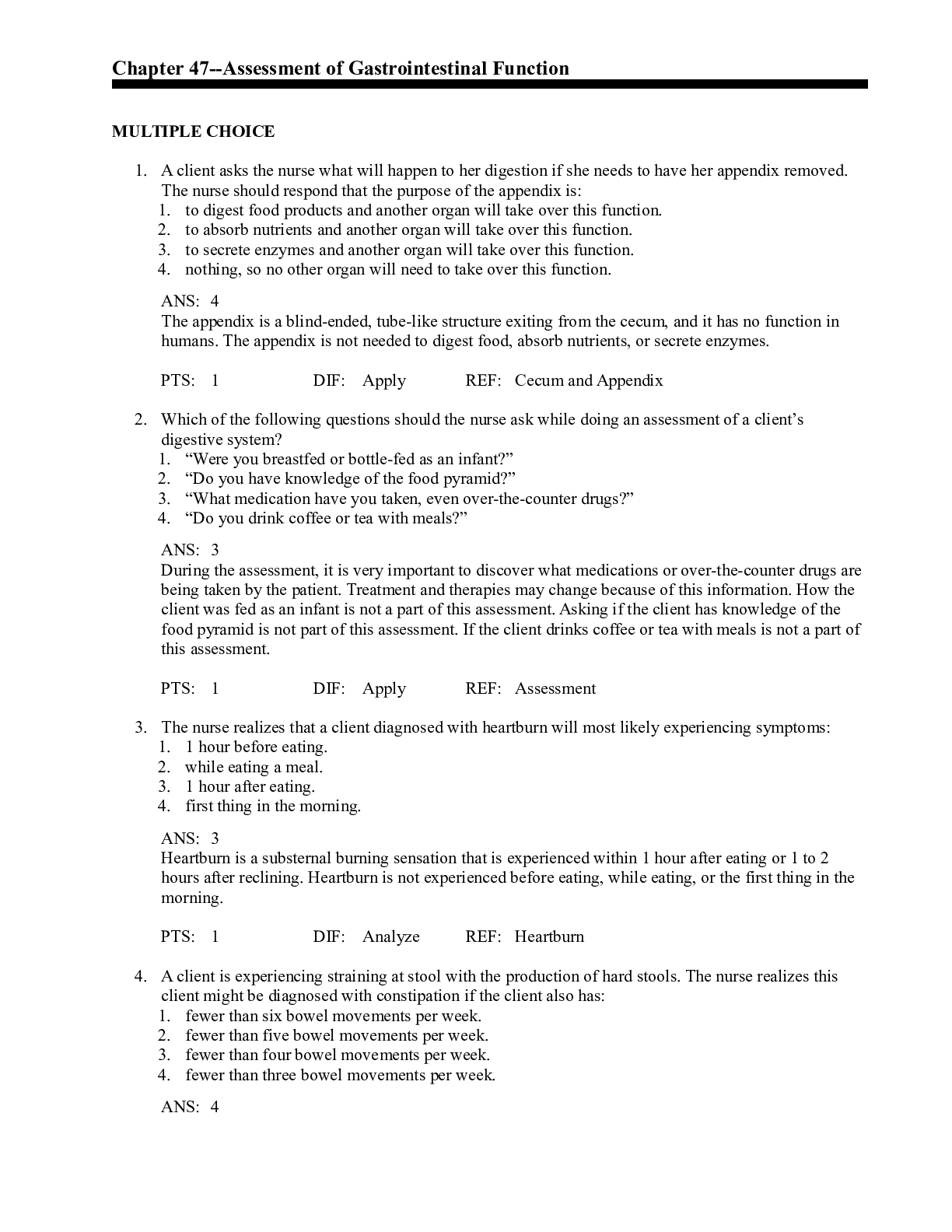
Chapter 47--Assessment of Gastrointestinal Function
MULTIPLE CHOICE
1. A client asks the nurse what will happen to her digestion if she needs to have her appendix removed.
The nurse should respond that the purpose of the appendix is:
1. to digest food products and another organ will take over this function.
2. to absorb nutrients and another organ will take over this function.
3. to secrete enzymes and another organ will take over this function.
4. nothing, so no other organ will need to take over this function.
PTS: 1 DIF: Apply REF: Cecum and Appendix
2. Which of the following questions should the nurse ask while doing an assessment of a client’s
digestive system?
1. “Were you breastfed or bottle-fed as an infant?”
2. “Do you have knowledge of the food pyramid?”
3. “What medication have you taken, even over-the-counter drugs?”
4. “Do you drink coffee or tea with meals?”
PTS: 1 DIF: Apply REF: Assessment
3. The nurse realizes that a client diagnosed with heartburn will most likely experiencing symptoms:
1. 1 hour before eating.
2. while eating a meal.
3. 1 hour after eating.
4. first thing in the morning.
PTS: 1 DIF: Analyze REF: Heartburn
4. A client is experiencing straining at stool with the production of hard stools. The nurse realizes this
client might be diagnosed with constipation if the client also has:
1. fewer than six bowel movements per week.
2. fewer than five bowel movements per week.
3. fewer than four bowel movements per week.
4. fewer than three bowel movements per week.
5. The nurse is preparing to conduct an abdominal assessment on a client and realizes that this
assessment should be performed in the order of:
1. inspection, palpation, auscultation, and percussion.
2. inspection, auscultation, percussion, and palpation.
3. auscultation, palpation, percussion, and inspection.
4. percussion, palpation, inspection, and auscultation.
PTS: 1 DIF: Apply REF: Assessment
6. The nurse has determined a client has absent bowel sounds because no sounds have been heard in all
four quadrants for :
1. 1 minute.
2. 2 minutes.
3. 30 seconds.
4. 5 minutes.
PTS: 1 DIF: Analyze
REF: Table 47-1 Assessment of Abdomen: Normal and Key Findings
7. A client scheduled for a colonoscopy should be instructed regarding the need for:
1. serum blood specimens.
2. a bowel preparation.
3. pain medications prior to the test.
4. eating a full meal prior to the test.
PTS: 1 DIF: Apply REF: Colonoscopy
8. A client, scheduled for a colonoscopy, is provided with a polyethylene glycol solution to ingest the day
before the test. Which of the following should the nurse instruct the client about this solution?
1. Keep the solution at room temperature.
2. Sip the solution throughout the day until bowel movements begin.
3. Drink 8 ounces of the solution every 10 minutes until totally consumed.
4. Drink 8 ounces of the solution every hour until bowel movements begin.
PTS: 1 DIF: Apply REF: Colonoscopy
9. When instructing a client on the three steps of a proctosigmoidoscopy, which of the following would
not be included?
1. Placement of a nasogastric (NG) tube for gastric deflation
2. Digital examination to dilate the anal sphincters to detect obstruction
3. Sigmoidoscope to examine the distal sigmoid colon and rectum
4. Proctoscope to examine the lower rectum and anal canal
PTS: 1 DIF: Apply REF: Proctosigmoidoscopy
10. The nurse, planning care for a client diagnosed with severe facial trauma, realizes that which of the
following will not be used when caring for this client?
1. Blood pressure cuff
2. Nasogastric tube
3. Indwelling urinary catheter
4. Doppler
PTS: 1 DIF: Analyze REF: Nasogastric Tubes
11. A client is prescribed to receive a nasogastric (NG) tube feeding. The nurse realizes that:
1. placement does not need to be checked before the feeding.
2. an NG tube is for long-term uses.
3. the head of the bed must be 30 degrees or greater.
4. feeding the client is not a reason for an NG tube.
12. A client is diagnosed with insufficient hydrochloric acid in the stomach. The nurse realizes this client
will most likely need which of the following vitamin supplements?
1. A
2. B-12
3. C
4. D
PTS: 1 DIF: Analyze REF: Stomach
13. A client is scheduled for an abdominal paracentesis. Which of the following should the nurse instruct
the client to do before the procedure?
1. Empty the bladder.
2. Drink a large glass of water.
3. Eat a full meal.
4. Sleep for several hours.
PTS: 1 DIF: Apply REF: Paracentesis
MULTIPLE RESPONSE
1. A client is being assessed for gastrointestinal system dysfunction. The nurse realizes an impairment of
this function could affect which of the following? (Select all that apply.)
1. Absorption of food
2. Digestion of food
3. Metabolism of food
4. Utilization of oxygen
5. Synthesis of red blood cells
6. Filtering of water
PTS: 1 DIF: Analyze REF: Anatomy and Physiology
2. While palpating the abdominal organs during a physical assessment of a client, which of the following
organs will the nurse most likely not be able to assess? (Select all that apply.)
1. Liver
2. Gallbladder
3. Pancreas
4. Kidney
5. Spleen
6. Colon
PTS: 1 DIF: Apply REF: Assessment
3. During the eating habits portion of an assessment of a client’s gastrointestinal system, the nurse should
assess which of the following? (Select all that apply.)
1. Fluid intake
2. Urine output
3. Blood pressure
4. Bowel habits
5. Food intolerance
6. Appetite
PTS: 1 DIF: Apply REF: Assessment
4. A client is experiencing excessive belching. Which of the following can the nurse instruct this client?
(Select all that apply.)
1. Eat slowly.
2. Do not drink with a straw.
3. Avoid carbonated beverages.
4. Do not smoke.
5. Do not chew gum.
6. Avoid eating onions.
PTS: 1 DIF: Apply REF: Gastrointestinal Gas
5. The nurse is assessing a client for acute appendicitis. Which of the following can be done to help
diagnose this disorder? (Select all that apply.)
1. Assess for Blumberg’s sign.
2. Assess bowel sounds.
3. Perform the iliopsoas muscle test.
4. Auscultate for bowel sounds in the right lower quadrant.
5. Perform the obturator muscle test.
6. Assess for referred pain to the right shoulder.
PTS: 1 DIF: Apply REF: Red Flag: Assessments for Acute Appendicitis
[Show More]

.png)

 Med Surg test Latest Verified Questions and all Correct Answers with Explanations Chapter 47 Management of Patients with Intestinal and Rectal Disorders.png)

 Correct Study Guide, Download to Score A.png)
.png)