NURS 305 Exam 1 QUESTIONS AND ANSWERS A GRADED
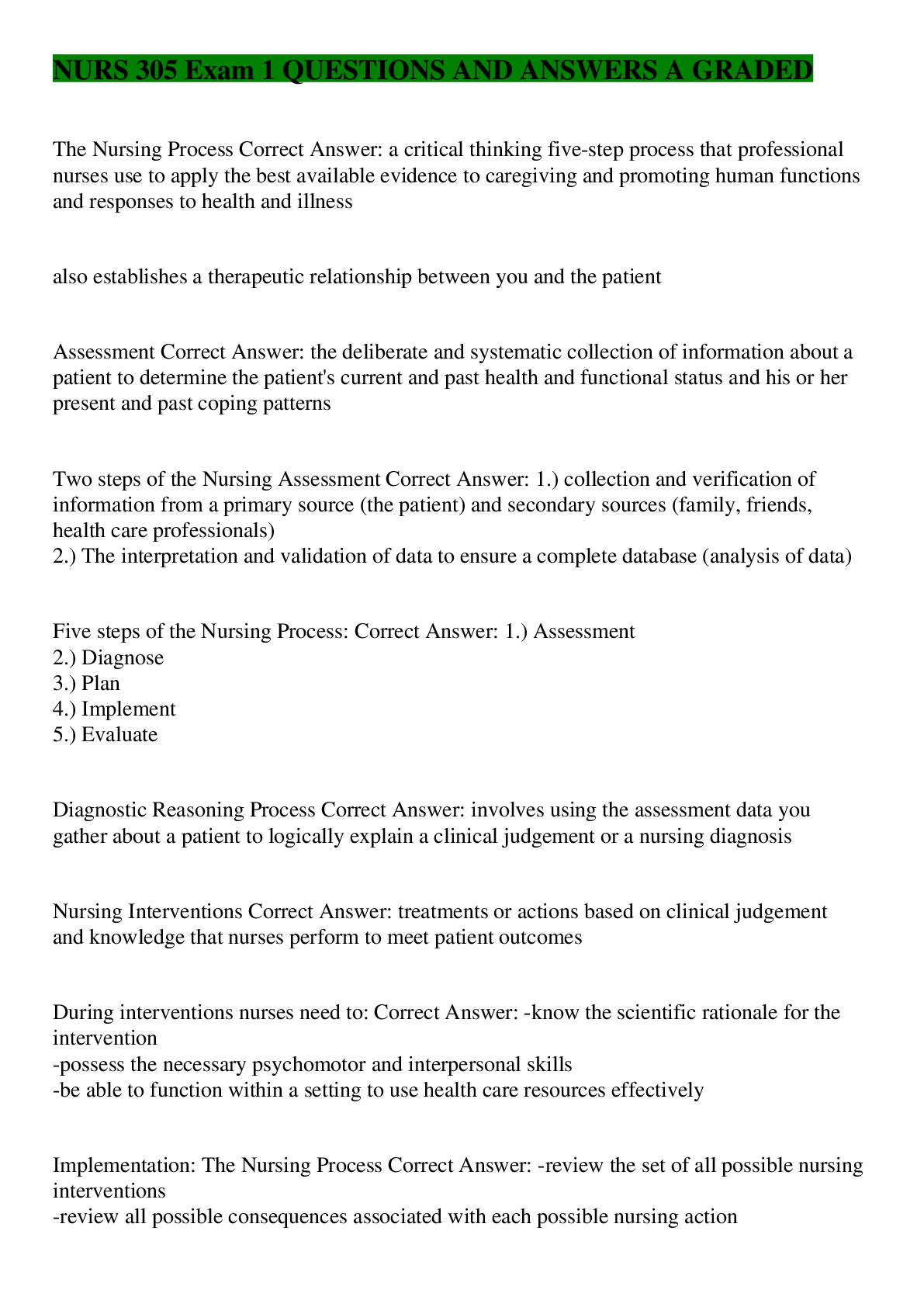
The Nursing Process Correct Answer: a critical thinking five-step process that professional nurses use to apply the best available evidence to caregiving and promoting h
...
NURS 305 Exam 1 QUESTIONS AND ANSWERS A GRADED
The Nursing Process Correct Answer: a critical thinking five-step process that professional nurses use to apply the best available evidence to caregiving and promoting human functions and responses to health and illness
also establishes a therapeutic relationship between you and the patient
Assessment Correct Answer: the deliberate and systematic collection of information about a patient to determine the patient's current and past health and functional status and his or her present and past coping patterns
Two steps of the Nursing Assessment Correct Answer: 1.) collection and verification of information from a primary source (the patient) and secondary sources (family, friends, health care professionals)
2.) The interpretation and validation of data to ensure a complete database (analysis of data)
Five steps of the Nursing Process: Correct Answer: 1.) Assessment
2.) Diagnose
3.) Plan
4.) Implement
5.) Evaluate
Diagnostic Reasoning Process Correct Answer: involves using the assessment data you gather about a patient to logically explain a clinical judgement or a nursing diagnosis
Nursing Interventions Correct Answer: treatments or actions based on clinical judgement and knowledge that nurses perform to meet patient outcomes
During interventions nurses need to: Correct Answer: -know the scientific rationale for the intervention
-possess the necessary psychomotor and interpersonal skills
-be able to function within a setting to use health care resources effectively
Implementation: The Nursing Process Correct Answer: -review the set of all possible nursing interventions
-review all possible consequences associated with each possible nursing action
-determine the probability of all possible consequences
-make a judgement of the value of that consequence to the patient
Assessment (first step) Correct Answer: -purpose is to establish a database about the patient's perceived needs, health problems, and responses to these problems
sources of data - patient, family and significant others, health care team, medical records, scientific literature, nurse's experience
Cue Correct Answer: information that you obtain through use of the senses
Examples of cues: Correct Answer: -lies still with arms along sides; tense
-states had not turned for some time
-reports pain a 7 on a scale of 0 to 10
(patient lying in the bed looks uncomfortable)
Inference Correct Answer: is your judgement or interpretation of these cues
Examples of inferences: Correct Answer: -pain is severe
-pain limits patient's ability to move and reposition self
Structured database format Correct Answer: formed on the basis of an accepted theoretical framework or practice standard created by Gordon known as the 11 Functional Health Patterns
What assessment does for you? Correct Answer: Ultimately your assessment identifies functional (patient strengths) and dysfunctional (nursing diagnosis) patterns that help you develop the nursing care plan
Problem-focused approach Correct Answer: focus on a patient's presenting situation and begin with problematic areas such as incisional pain or limited understanding of postoperative recovery
Subjective Data Correct Answer: your patient's verbal descriptions of their health problems
Examples of subjective data: Correct Answer: include the patients feelings, perceptions, and self-report of symptoms
Objective Data Correct Answer: observations or measurements of a patient's health status
Examples of objective data: Correct Answer: -inspecting the condition of a surgical incision or wound
-describing an observed behavior
-measuring blood pressure
Patient-centered interview Correct Answer: relationship based and is an organized conversation focused on learning about the well and the sick as they seek care
Patient-centered interview structure: Correct Answer: -Set the stage (preparation, environment, greeting)
-Set an agenda/gather information about patient's concerns
-Collect the assessment or nursing health history; assure the patient of confidentiality
-Terminate the interview (cue the end)
Communication skills: patient-centered interview Correct Answer: courtesy
comfort
connection
confirmation
Open-ended questions Correct Answer: prompts patients to describe a situation in more than one or two words
Back channeling Correct Answer: active listening prompts such as "all right," "go on," or "uh-huh."
Closed-ended questions Correct Answer: limit answers to one or two words such as "yes" or "no" or a number or frequency of a symptom
Nursing Health History Correct Answer: Data collected about a patient's present level of wellness, changes in life patterns, sociocultural role, and mental and emotional reactions to illness.
Components of the Nursing Health History: Correct Answer: -biographical data
-chief concern or reason for seeking care
-patient expectations
-present illness or health concerns
[Show More]