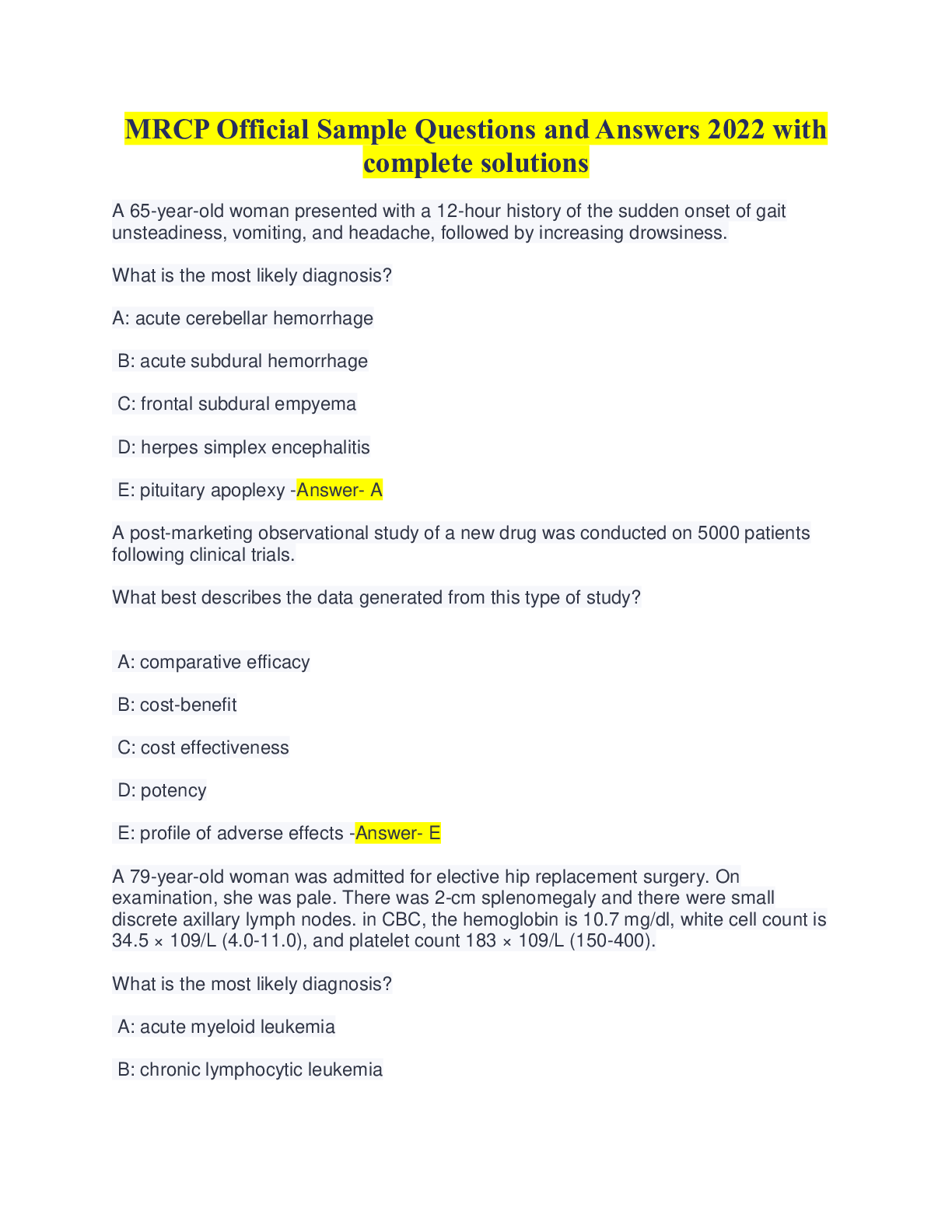
MRCP Official Sample Questions and Answers 2022 with complete solutions
A 65-year-old woman presented with a 12-hour history of the sudden onset of gait unsteadiness, vomiting, and headache, followed by increasing dro
...
MRCP Official Sample Questions and Answers 2022 with complete solutions
A 65-year-old woman presented with a 12-hour history of the sudden onset of gait unsteadiness, vomiting, and headache, followed by increasing drowsiness.
What is the most likely diagnosis?
A: acute cerebellar hemorrhage
B: acute subdural hemorrhage
C: frontal subdural empyema
D: herpes simplex encephalitis
E: pituitary apoplexy -Answer- A
A post-marketing observational study of a new drug was conducted on 5000 patients following clinical trials.
What best describes the data generated from this type of study?
A: comparative efficacy
B: cost-benefit
C: cost effectiveness
D: potency
E: profile of adverse effects -Answer- E
A 79-year-old woman was admitted for elective hip replacement surgery. On examination, she was pale. There was 2-cm splenomegaly and there were small discrete axillary lymph nodes. in CBC, the hemoglobin is 10.7 mg/dl, white cell count is 34.5 × 10⁹/L (4.0-11.0), and platelet count 183 × 109/L (150-400).
What is the most likely diagnosis?
A: acute myeloid leukemia
B: chronic lymphocytic leukemia
C: chronic myeloid leukemia
D: myelodysplasia
E: myelofibrosis -Answer- B
A 17-year-old boy presented with a non-blanching rash over his legs, a swollen knee, and painless, visible haematuria.
Urinalysis showed blood 3+, protein 1+.
serum creatinine 210 µmol/L (60-110) urine culture negative ultrasound scan of kidneys normal
What glomerular abnormality is most likely to be present at renal biopsy?
A: focal segmental sclerosis
B: foot process fusion
C: linear deposition of IgG on the basement membrane
D: mesangial deposition of IgA
E: thickening of basement membranes -Answer- D
A 75-year-old woman developed a spreading cellulitis on her left leg secondary to ulceration.
blood cultures MRSA
In addition to vancomycin, what is the most appropriate antibiotic?
A: amoxicillin
B: azithromycin
C: flucloxacillin
D: metronidazole
E: rifampicin -Answer- E
A 45-year-old woman presented with right flank pain. She had a 4-year history of hypertension and progressive cognitive impairment.
On examination, she had livedo reticularis and tenderness in the right flank. Her BP was 185/105 mmHg. Urinalysis showed blood 3+, protein 1+.
Hb 129 g/L (115-165) WCC 8.7 × 10⁹/L (4.0-11.0) PlTs 83 × 109/L (150-400)
serum creatinine 106 µmol/L (60-110)
What antibody test is most likely to be positive?
A: anticardiolipin
B: anticentromere
C: anti-glomerular basement membrane
D: antimitochondrial
E: anti-neutrophil cytoplasmic
E: anti-neutrophil cytoplasmic -Answer- A
A 37-year-old woman presented with a history of intermittent lightheadedness. Examination was normal.ECG normal
24-hour ambulatory ECG tracing
atrial and ventricular premature beats; nocturnal bradycardia and Mobitz type 1 atrioventricular block, and supraventricular tachycardia
Which abnormality on the 24-hour ambulatory ECG is clinically most important?
A: atrial premature beats
B: profound sleep-associated bradycardia
C: supraventricular tachycardia
D: transient Mobitz type 1 atrioventricular block
E: ventricular premature beats
E: ventricular premature beats -Answer- C
A 28-year-old man presented with a 1-month history of weight loss, abdominal distension, flatulence and foul-smelling diarrhea following a visit to India.
anti-tissue transglutaminase antibodies negative
stool cultures and microscopy negative
What is the most likely diagnosis?
A: acute HIV seroconversion illness
B: coeliac disease
C: giardiasis
D: hookworm infection (ancylostomiasis)
E: viral gastroenteritis -Answer- C
A 30-year-old woman presented with a 6-month history of tremors and difficulty in speaking. On examination, she was found to have increased muscle tone in all four limbs, bradykinesia, and 4-cm hepatomegaly.
What laboratory finding would best support a diagnosis of Wilson's disease?
A: increased incorporation of radioactive copper into caeruloplasmin
B: low hepatic copper content
C: low serum caeruloplasmin concentration
D: low serum free copper concentration
E: low urine copper concentration -Answer- C
What dietary substrate is broken down into glucose and galactose by the action of intestinal enzymes?
A: fructose
B: lactose
C: maltose
D: mannose
E: sucrose -Answer- B
A 16-year-old girl presented with non-scaly, discrete areas of hair loss on the scalp. She had a past history of atopic eczema and had a number of depigmented areas on her hands and around her eyes.
What is the most likely diagnosis?
A: alopecia areata
B: hypothyroidism
C: lupus erythematosus
D: seborrhoeic dermatitis
E: trichotillomania -Answer- A
A 72-year-old man presented following an episode of collapse. There had been two similar episodes recently, each lasting about 1 minute. He had had an anterior myocardial infarction 4 years previously.
On examination, he was orientated and symptom-free with a regular pulse of 80 beats per minute. His BP was 140/80 mmHg and the apex beat was displaced to the left. There was an apical systolic murmur. There were no signs of trauma.
ECG sinus rhythm; anterior Q waves and anterior ST-segment elevation without reciprocal depression
What is the most likely diagnosis?
A: acute anterior myocardial infarction
B: cerebral embolism
C: epilepsy
D: pulmonary embolism
E: ventricular tachycardia -Answer- E
A 26-year-old woman presented with unequal pupils.
On examination, the right pupil was larger than the left and did not react to light, directly or consensually. On convergence, the right pupil reacted very slowly, but eventually became smaller than the left pupil.
What is the best description of this type of pupillary abnormality?
A: Adie's tonic pupil
B: afferent pupillary defect
C: Argyll Robertson pupil
D: Horner's syndrome
E: third cranial nerve palsy -Answer- A
A 45-year-old man had recurrent nephrolithiasis. Renal function tests and serum calcium measurements were normal.
24-h urinary calcium 8.8 mmol (2.5-7.5)
24-h urinary urate 3.0 mmol (<3.6)
24-h urinary oxalate 0.20 mmol (0.14-0.46)
24-h urinary citrate 0.2 mmol (0.3-3.4)
What is the most useful therapy to reduce stone formation?
A: allopurinol
B: bendroflumethiazide
C: dietary calcium restriction
D: penicillamine
E: potassium citrate -Answer- E
A 38-year-old woman required the extraction of her wisdom teeth. She gave a history of hemorrhage after a dental extraction 10 years previously, when she had required suturing. There had been no history of excessive bleeding before this.
What is the most likely diagnosis?
A: factor V Leiden
B: factor IX deficiency
C: factor XII deficiency
D: primary antiphospholipid syndrome
E: von Willebrand disease -Answer- E
A 30-year-old man presented with increasing breathlessness and wheeze. He smoked 5 cigarettes per day.
serum α1-antitrypsin 0.12 g/L (1.1-2.1)
FEV1 0.85 L (3.4-5.1)
FVC 4.75 L (4.2-6.5)
transfer factor for CO (TLCO) 4.1 mmol/min/kPa (7.1-12.7)
Which protease inhibitor genotype is most likely to be present?
A: MM
B: MZ
C: SS
D: SZ
E: ZZ -Answer- E
A 35-year-old woman with chronic kidney disease early stage 4 was being considered for erythropoietin therapy; her glomerular filtration rate was 15-29 mL/min (70-140).
On examination, her BP was 140/90 mmHg and she had an arteriovenous fistula in situ for planned hemodialysis.
haemoglobin 95 g/L (115-165) MCV 84 fL (80-96)
What is the most likely outcome of erythropoietin therapy?
A: improved blood pressure control
B: improved exercise tolerance
C: increased ventricular hypertrophy
D: reduced likelihood of red cell aplasia
E: stabilization of renal function -Answer- B
A 54-year-old woman, who had undergone subtotal thyroidectomy for Graves' disease 20 years previously, presented for a review. She was well.
serum cholesterol 6.8 mmol/L (<5.2)
serum HDL cholesterol 1.10 mmol/L (>1.55)
serum thyroid-stimulating hormone 16.2 mU/L (0.4-5.0)
serum free T4 13.0 pmol/L (10.0-22.0)
What is the most appropriate initial treatment for her hyperlipidemia?
A: bezafibrate
B: ezetimibe
C: levothyroxine
D: oestrogen replacement therapy
E: simvastatin -Answer- C
A 27-year-old woman presented with a right-sided thyroid swelling with associated cervical lymphadenopathy.
What is the most likely cause?
A: anaplastic carcinoma
B: follicular adenoma
C: follicular carcinoma
D: Hashimoto's thyroiditis
E: papillary carcinoma -Answer- E
A 77-year-old man presented with increasing pains around his lower back and lower limb girdle. He had recently presented with symptoms of hesitancy and post-micturition dribbling.
ESR 28 mm/1st h (<20)
serum corrected calcium 2.34 mmol/L (2.20-2.60)
serum phosphate 0.8 mmol/L (0.8-1.4)
serum alkaline phosphatase 2985 U/L (45-105)
serum prostate-specific antigen 6 μg/L (<4)
What is the most likely cause of this man's pain?
A: insufficiency fracture of the pelvis
B: osteomalacia
C: Paget's disease of bone
D: polymyalgia rheumatica
E: prostatic carcinoma with metastases -Answer- C
A 50-year-old man presented with a 2-day history of multiple painful joints. Two weeks previously, he had been started on treatment with allopurinol for tophaceous gout. His only other medication was paracetamol. He had a history of excess alcohol intake.
On examination, his temperature was 37.5°C and there was acute inflammation of the finger joints, wrists, knees and ankles.
serum gamma glutamyl transferase 90 U/L (<50)
serum CRP 180 mg/L (<10)
serum urate 0.65 mmol/L (0.23-0.46)
What is the most likely cause of his symptoms?
A: acute pseudogout
B: alcoholic binge
C: allergic reaction to allopurinol
D: allopurinol therapy
E: joint sepsis
E: joint sepsis -Answer- D
A 17-year-old boy presented with breathlessness and night sweats.
Investigations confirmed a diagnosis of Burkitt lymphoma.
What is the most likely underlying abnormality of gene expression?
A: expression of BCR-ABL
B: loss of p53
C: overexpression of BCL-2
D: overexpression of c-myc
E: overexpression of JAK2 -Answer- D
A 30-year-old man had moved recently to the UK. He informed his doctor that he had maturity-onset diabetes of the young.
What feature, if present, most strongly suggests that this is the correct diagnosis?
A: a BMI of 30.0 kg/m2 (18.0-25.0)
B: a poor response to glipizide therapy
C: a strong family history of diabetes mellitus
D: recurrent episodes of diabetic ketoacidosis
E: X-linked recessive inheritance -Answer- C
A 17-year-old girl presented with a single, painless, enlarged cervical lymph node. She was asymptomatic.
chest X-ray enlarged mediastinal lymph nodes
What is the most likely diagnosis?
A: angioimmunoblastic T-cell lymphoma
B: extramedullary plasmacytoma
C: follicular B-cell non-Hodgkin lymphoma
D: Hodgkin lymphoma
E: mantle cell lymphoma -Answer- D
A 70-year-old man presented accompanied by his wife, who stated that her husband had lost all interest in life.
What would support a diagnosis of dementia rather than depressive disorder?
A: agitation
B: complaint of poor memory
C: impaired short-term memory
D: loss of libido
E: urinary incontinence -Answer- E
A 52-year-old man presented 48 hours following the onset of severe anterior chest pain. An acute myocardial infarction was suspected and subsequently confirmed by serum troponin concentration and ECG.
Following admission, he was noted to be hypotensive with oliguria. A Swan-Ganz catheter was inserted. The mean right atrial pressure was found to be 20 mmHg (3) and the mean pulmonary arterial wedge pressure was 2 mmHg (9).
What is the most likely explanation for these pressure measurements?
A: acute left ventricular failure
B: acute mitral regurgitation
C: hypovolaemia
D: pericardial tamponade
E: right ventricular failure
E: right ventricular failure -Answer- E
A 32-year-old woman returned from a holiday in the Mediterranean with a suntan and numerous hypopigmented, slightly scaly lesions on the neck and upper trunk. She mentioned that the same areas had been fawn-coloured in the months before her holiday and that these areas of skin had failed to tan during her time in the Mediterranean.
What is the most likely diagnosis?
A: chronic plaque psoriasis
B: discoid eczema
C: pityriasis rosea
D: pityriasis versicolor
E: seborrhoeic dermatitis
E: seborrhoeic dermatitis -Answer- D
A 65-year-old woman presented with generalised arthralgia for the previous 2 weeks. She had a past medical history of urinary tract infections. She was advised to take an NSAID.
On examination, her BP was 139/98 mmHg and she had pitting oedema below the knees.
Investigations:
serum creatinine 458 µmol/L (60-110)
24-h urinary total protein 1.3 g (<0.2)
What is the most likely cause of the renal impairment?
Question 29
A: acute tubular necrosis
B: IgA nephropathy
C: membranous glomerulonephropathy
D: papillary necrosis
E: tubulointerstitial nephritis -Answer- E
A 47-year-old man presented with a 6-month history of episodic sweating and hunger. He had gained 10 kg in weight and drank 10 units of alcohol per week.
Investigations:
full blood count normal
fasting plasma glucose 4.0 mmol/L (3.0-6.0)
liver function tests normal
What is the most appropriate next investigation?
Question 30
A: CT scan of the pancreas
B: EEG
C: home blood glucose monitoring
D: plasma glucose concentration following a prolonged (72-h) fast
E: serum C-peptide concentration -Answer- D
A 25-year-old woman presented complaining of loose stools five to six times per day. One year previously, she had undergone resection of her terminal ileum for Crohn's disease. Her only drug therapy was mesalazine.
On examination, there was no abdominal tenderness.
Investigations:
haemoglobin 126 g/L (115-165)
serum albumin 38 g/L (37-49)
serum CRP 4 mg/L (<10)
What is the most likely diagnosis?
Question 31
A: active Crohn's disease
B: adverse effect of mesalazine
C: bile salt-induced diarrhoea
D: enteric infection
E: irritable bowel syndrome -Answer- D
A 71-year-old woman required a transfusion of 2 units of blood after a hip replacement. One week later, her haemoglobin concentration had fallen by 42 g/L.
What associated finding is most likely to indicate a delayed transfusion reaction?
Question 32
A: conjugated hyperbilirubinaemia
B: elevated D-dimer
C: haemoglobinuria
D: haemosiderinuria
E: positive direct antiglobulin test -Answer- D
A 30-year-old woman presented with a 4-hour history of palpitations. She had no significant medical history.
Investigations:
ECG atrial fibrillation with a ventricular rate of 130 beats/min
What drug is most likely to restore sinus rhythm?
Question 33
A: adenosine
B: bisoprolol
C: esmolol
D: flecainide
E: verapamil -Answer-
A 20-year-old woman presented with a 2-month history of an intensely pruritic rash on her trunk and limbs. She was otherwise well.
On examination, she had multiple, violaceous, flat-topped papules over the flexor surfaces of the wrists, and on the ankles and lower back. The papules were aggregated in a linear fashion at one site on her left forearm.
What clinical feature is most likely to be present?
Question 34
A: asymmetric oligoarthritis
B: burrows in finger webs
C: conjunctival scarring
D: involvement of buccal mucosa
E: non-scarring alopecia -Answer-
A 60-year-old woman with rheumatoid arthritis presented with an acutely inflamed right knee. The joint was aspirated and methylprednisolone 80 mg was injected after the removal of 20 mL of non-purulent synovial fluid. The knee improved following this procedure but her symptoms recurred and became much worse a week later.
Investigations:
haemoglobin 105 g/L (115-165)
white cell count 15.5 × 10⁹/L (4.0-11.0)
neutrophil count 13.5 × 10⁹/L (1.5-7.0)
ESR 55 mm/1st h (<30)
What is the most appropriate next investigation?
Question 35
A: blood cultures
B: serum CRP
C: serum urate
D: synovial fluid culture
E: X-ray of right knee -Answer-
A 75-year-old man presented with weight loss, lethargy and repeated haemoptysis. He had been treated for pulmonary tuberculosis 10 years previously.
Investigations:
serum IgE for Aspergillus positive
serum IgG for Aspergillus positive
chest X-ray a solid lesion at the left lung apex
What is the most likely diagnosis?
Question 36
A: allergic bronchopulmonary aspergillosis
B: aspergilloma
C: bronchial carcinoma
D: invasive aspergillosis
[Show More]