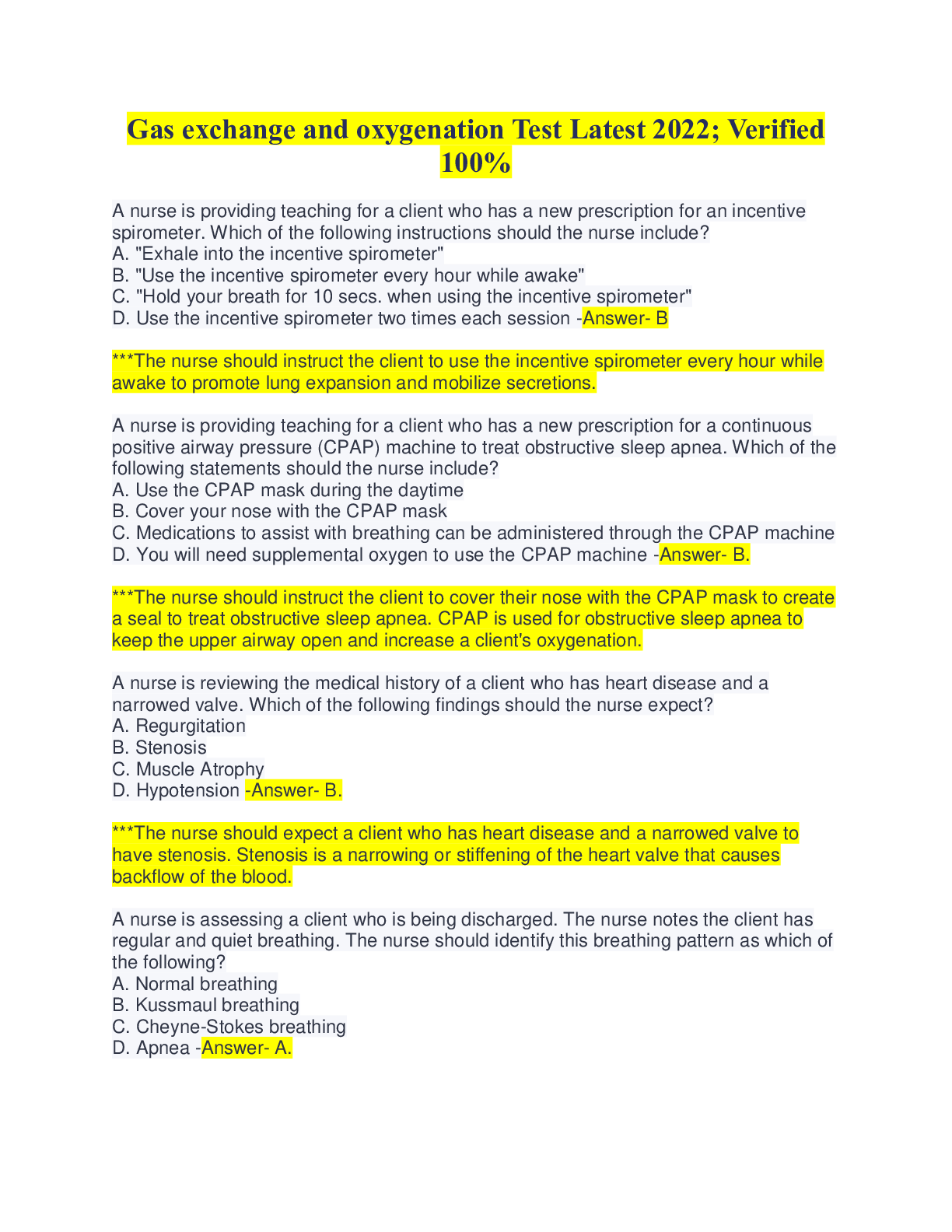
Abdominal Pathology Final Review Questions with Correct Answers
pWhat feature helps distinguish cirrhosis from other hepatocellular diseases?
A - Change in liver echgenicity
B - Elevated LFTs
C - Loss of smooth c
...
Abdominal Pathology Final Review Questions with Correct Answers
pWhat feature helps distinguish cirrhosis from other hepatocellular diseases?
A - Change in liver echgenicity
B - Elevated LFTs
C - Loss of smooth contour
D - Increased attenuation -Answer- C - Loss of smooth contour
Focal fatty sparing is ____ to the surrounding liver tissue. -Answer- hypoechoic
Screening for ultrasounds are often ordered for patients with hepatitis infection. What are we screening for? -Answer- HCC - Hepatocellular Carcinoma
The WES sign can be visualized with...
A - Chronic cholecystitis
B - A GB filled with stones
C - Porcelain GB
D - All of the above -Answer- D - All of the above
Starry Sky is seen with what two hepatocellular diseases? -Answer- Hepatitis and AIDS
When imaging the liver in acute hepatitis infection, the size of the liver would be? -Answer- Enlarged
If a patient complains of abnormal weight loss with normal appetite and no changes in diet/exercise you should be suspicious of - -Answer- Cancer
The elevation of which lab value would make you suspicious of carcinoma over other liver pathologies? -Answer- AFP - Alpha feto protein
The characteristic feature of this pathology is the creation of daughter cysts. -Answer- Echinoccocal Infection
What pathology causes jaundice?
A - Hepatocellular disease
B - Biliary obstruction
C - Portal Hypertension
D - Carcinoma -Answer- B - Biliary obstruction
This benign liver mass is composed of a network of blood-filled vascular spaces - -Answer- Hemangioma
The sign associated with dilated bile ducts is the - -Answer- Double-barreled shot gun
A hydronic GB is -
A - Full of pus
B - Full of sludge
C - enlarged
D - A and C -Answer- C - Enlarged
What is Mirizzi syndrome? -Answer- A stone obstructs the cystic duct causing inflammation os the common duct
T/F
Increased attenuation can be seen in the presence of chronic hepatitis -Answer- True
T/F
The most common cause of cirrhosis is genetics -Answer- False - alcohol abuse
T/F
Cirrhosis is not reversible -Answer- True
T/F
Hepatocellular carcinoma (HCC) can also be called hepatoma -Answer- True
T/F
Hepatoma is the term for HCC in children -Answer- False - Hepatoblastoma
T/F
Hepatitis is the most common cause of portal hypertension -Answer- False - Cirrhosis
What does TIPS stand for? -Answer- transjugular intrahepatic portosystemic shunt
T/F
Sludge within the GB can mimic a tumor -Answer- True
T/F
The GB wall can be thickened for reasons other than cholecystitis -Answer- True
T/F
Another term for Cholesterolosis is blueberry GB -Answer- False - strawberry
What is encephalopathy? -Answer- disease of the brain - high amounts of ammonia in blood (due to liver dx) that infiltrates the brain, making the patient act "crazy"
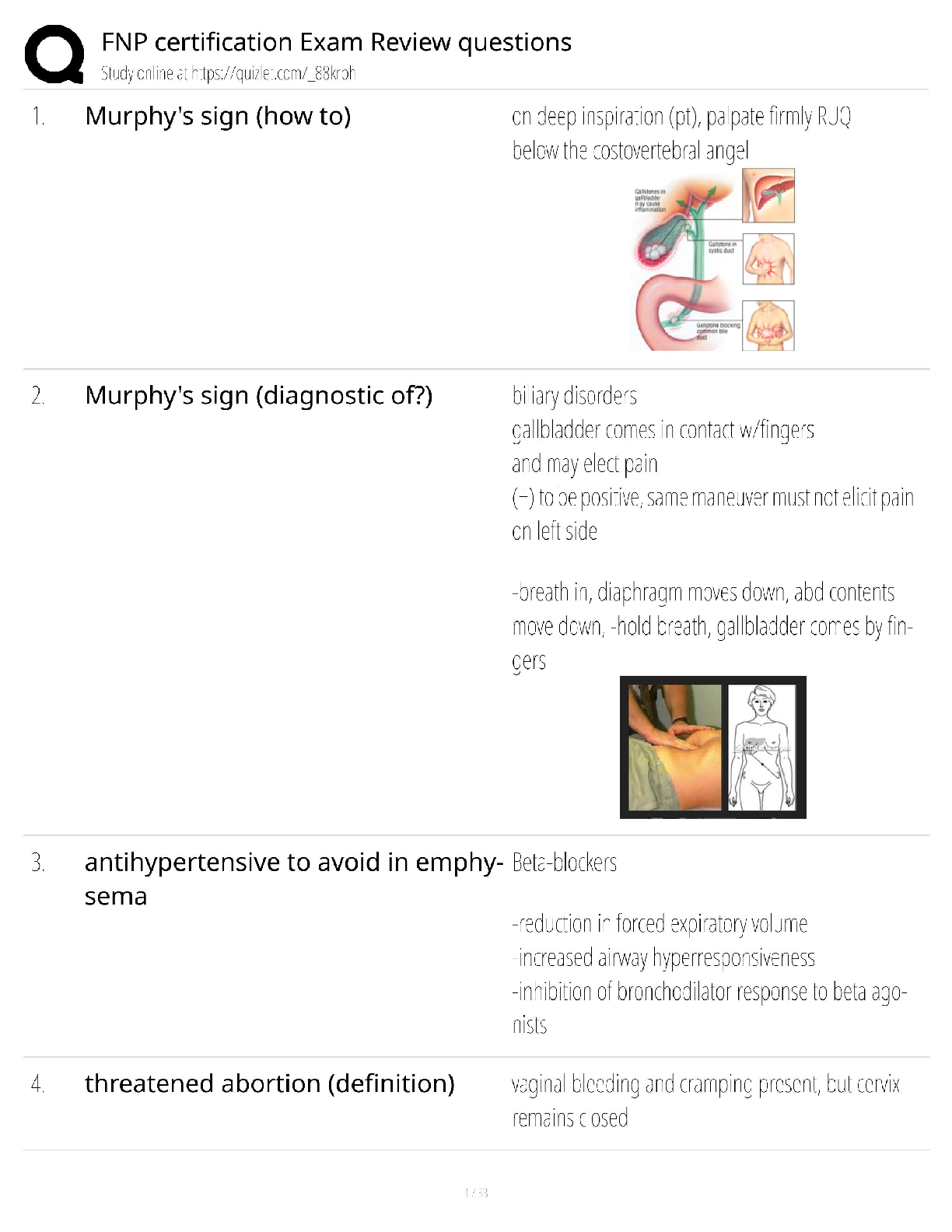
In the case of gangrenous cholecystitis, why may the patient NOT have a positive Murphy's sign? -Answer- Nerve damage
When/Why are collateral vessels formed? -Answer- They are formed when a patient has Portal Hypertension. They are formed near the aorta hepatis to relieve pressure on the portal veins.
Name two clinical signs/symptoms of hepatocellular disease? -Answer- Abnormal LFTs and jaundice
List of describe the stages of hepatocellular disease -Answer- Stage 1 - moderate and reversable
Stage 2 - Chronic, non-reversible, edema/ascites
Stage 3 - Severe, non-reversible, end-stage cirrhosis, THC
The first branch of the abdominal AO is the... -Answer- Celiac trunk
Which of the below is NOT a risk factor for AAA?
A - Smoking
B - Diabetes
C - Female
D - Hypertention
E - All are risk factors -Answer- C - female
The most common location for a AAA is - -Answer- Infrarenal
Which of the following is NOT important to document when you find an aneurysm?
A - Largest diameter both in AP and width
B - Long measurement
C - Distance from left atrium
D - relationship to the renal arteries and bifurcation -Answer- C - Distance from left atrium
The most common disease of the aorta is - -Answer- Arteriosclerosis
Name three symptoms of IVC thrombosis - -Answer- Leg edema
Back pain
Pelvic pain
Budd-Chiari syndrome is characterized by - -Answer- Hepatic vein thrombosis
Nonvisualization of the spleen could be due to-
A - Asplenia
B - Wandering Spleen
C - Atrophy
D - All of the above -Answer- D - All of the above
Polycythemia Vera is -Answer- A blood disorder resulting in uncontrolled RBC production and therefore hyper viscosity and hyper coagulation
With Glycogen storage disease, on ultrasound the liver will appear - -Answer- Hyperechoic and attenuating
Which of the following is characteristic of Caroli's disease?
A - Enlarged tongue, hemihypertophy, abdominal mass
B - Dilated intrahepatic ducts
C - Excess iron in the blood causing liver disease
D - Mass within the common bile duct -Answer- B - Dilated intrahepatic ducts
Which of the following statements it INCORRECT?
A - the pancreas is retroperitoneal
B - The pancreas lies in the C loop of the duodenum
C - The CBD enters the panc head anteriorly
D - The primary duct of the panc is the duct of Wirsung
E - All are correct -Answer- C - The CBD enters the panc head anteriorly
Pancreatic pseudocysts commonly form in patients with... -Answer- Pancreatitis
T/F
The rest of rupture of a AAA goes up significantly each 1cm bigger it gets. -Answer- True
T/F
Pseudoaneurysm can be caused by surgical procedures such as catheter. -Answer- True
Wandering spleen can be caused by (3 things) -Answer-
[Show More]

.png)