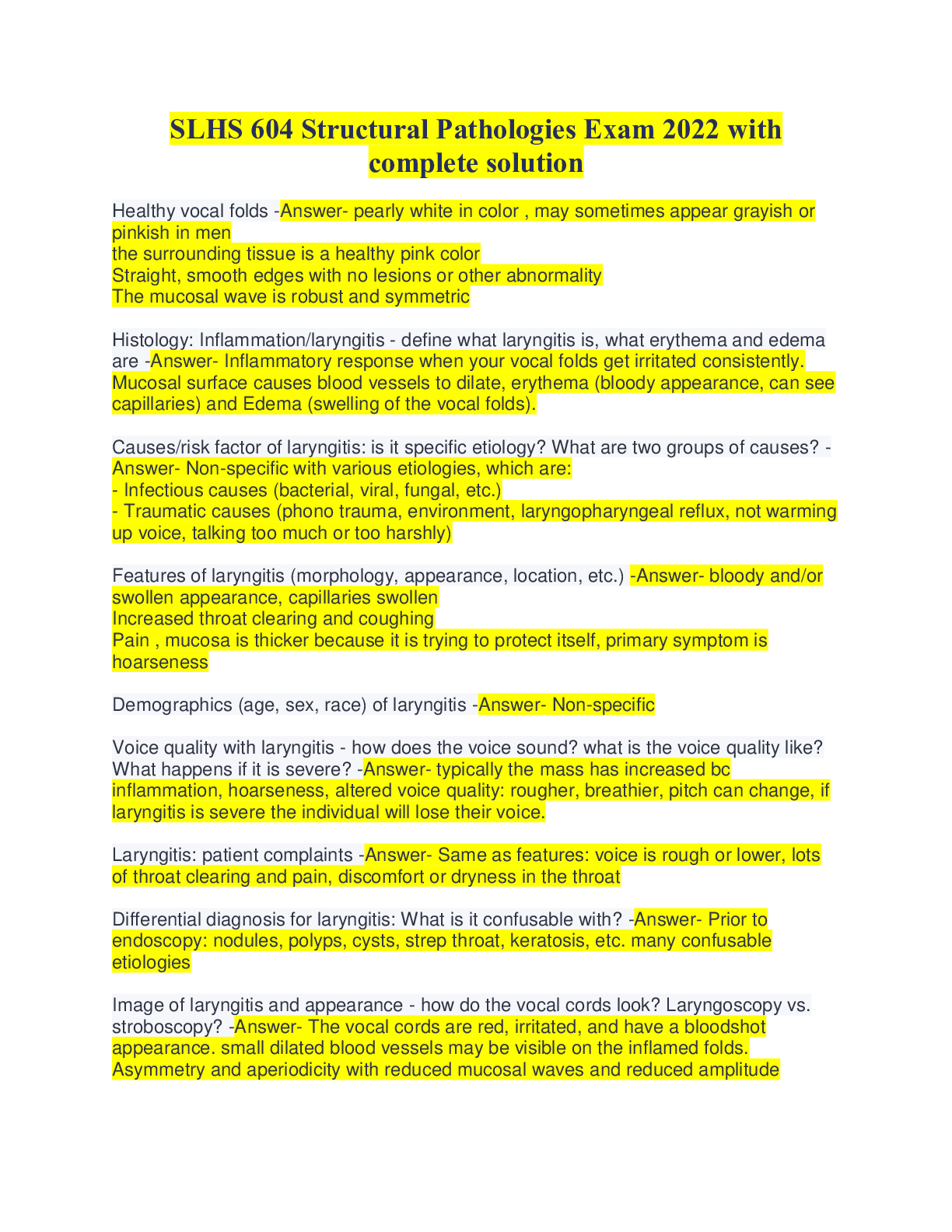
SLHS 604 Structural Pathologies Exam 2022 with complete solution
Healthy vocal folds -Answer- pearly white in color , may sometimes appear grayish or pinkish in men
the surrounding tissue is a healthy pink color
St
...
SLHS 604 Structural Pathologies Exam 2022 with complete solution
Healthy vocal folds -Answer- pearly white in color , may sometimes appear grayish or pinkish in men
the surrounding tissue is a healthy pink color
Straight, smooth edges with no lesions or other abnormality
The mucosal wave is robust and symmetric
Histology: Inflammation/laryngitis - define what laryngitis is, what erythema and edema are -Answer- Inflammatory response when your vocal folds get irritated consistently. Mucosal surface causes blood vessels to dilate, erythema (bloody appearance, can see capillaries) and Edema (swelling of the vocal folds).
Causes/risk factor of laryngitis: is it specific etiology? What are two groups of causes? -Answer- Non-specific with various etiologies, which are:
- Infectious causes (bacterial, viral, fungal, etc.)
- Traumatic causes (phono trauma, environment, laryngopharyngeal reflux, not warming up voice, talking too much or too harshly)
Features of laryngitis (morphology, appearance, location, etc.) -Answer- bloody and/or swollen appearance, capillaries swollen
Increased throat clearing and coughing
Pain , mucosa is thicker because it is trying to protect itself, primary symptom is hoarseness
Demographics (age, sex, race) of laryngitis -Answer- Non-specific
Voice quality with laryngitis - how does the voice sound? what is the voice quality like? What happens if it is severe? -Answer- typically the mass has increased bc inflammation, hoarseness, altered voice quality: rougher, breathier, pitch can change, if laryngitis is severe the individual will lose their voice.
Laryngitis: patient complaints -Answer- Same as features: voice is rough or lower, lots of throat clearing and pain, discomfort or dryness in the throat
Differential diagnosis for laryngitis: What is it confusable with? -Answer- Prior to endoscopy: nodules, polyps, cysts, strep throat, keratosis, etc. many confusable etiologies
Image of laryngitis and appearance - how do the vocal cords look? Laryngoscopy vs. stroboscopy? -Answer- The vocal cords are red, irritated, and have a bloodshot appearance. small dilated blood vessels may be visible on the inflamed folds. Asymmetry and aperiodicity with reduced mucosal waves and reduced amplitude
Histology of Scarring -Answer- Damage to the deep layer of the lamina propria/ vocal ligament of the vocal fold. Damage does not heal correctly and there are increased amounts of disorganized extra-cellular matrix proteins of lamina propria
Causes and risk factors of scarring -Answer- Chronic long term and possibly severe phonotrauma (misuse)
ruptured cyst or polyp; hemorrhage; chronic LPRD
iatrogenic (surgery, radiation, etc)
Features of scarring -Answer- reduced or absent mucosal wave at the lesion site, no lump or bump, aperiodic vibration because of the scar tissue
Demographics : scarring -Answer- Non- specific
Voice quality with scarring -Answer- Voice will present as rough with asthenia and may have reduced intensity and range, altered pitch, voice breaks, and may have Diplophonia or pitch instability
Patient complaints with scarring -Answer- Rough voice, increased effort, asthenia, weak voice, breathiness, altered pitch or pitch changes and breaks, instability on holding a pitch
Differential diagnosis with Scarring - what does it get confused with? -Answer- These symptoms could be just about anything prior to endoscopy - however they are very closely confused symptomology wise with: Sulcus vocalis, Sulcus vergeture
No lump or bump - there will be a loss of tissue so you will be able to see it is not confusable with a lump on endoscopy
Image of vocal fold scarring -Answer- Irregularities on the vocal fold, inconsistencies in mucosal layer
Histology of sulcus vocalis/sulcus vergeture -Answer- Reduction and deficiency, and absence of the extracellular metric proteins of the lamina propria, appear as a crease or groove on the phonatory margin, lateral to it, or on the surface of it, but always parallel to phonatory margin
[Show More]