SLP 150 Final case studies 2022 with complete solution
A secondary language disorder would be -Answer- a language disorder that is as the result of an intellectual or developmental disorder
A primary language disor
...
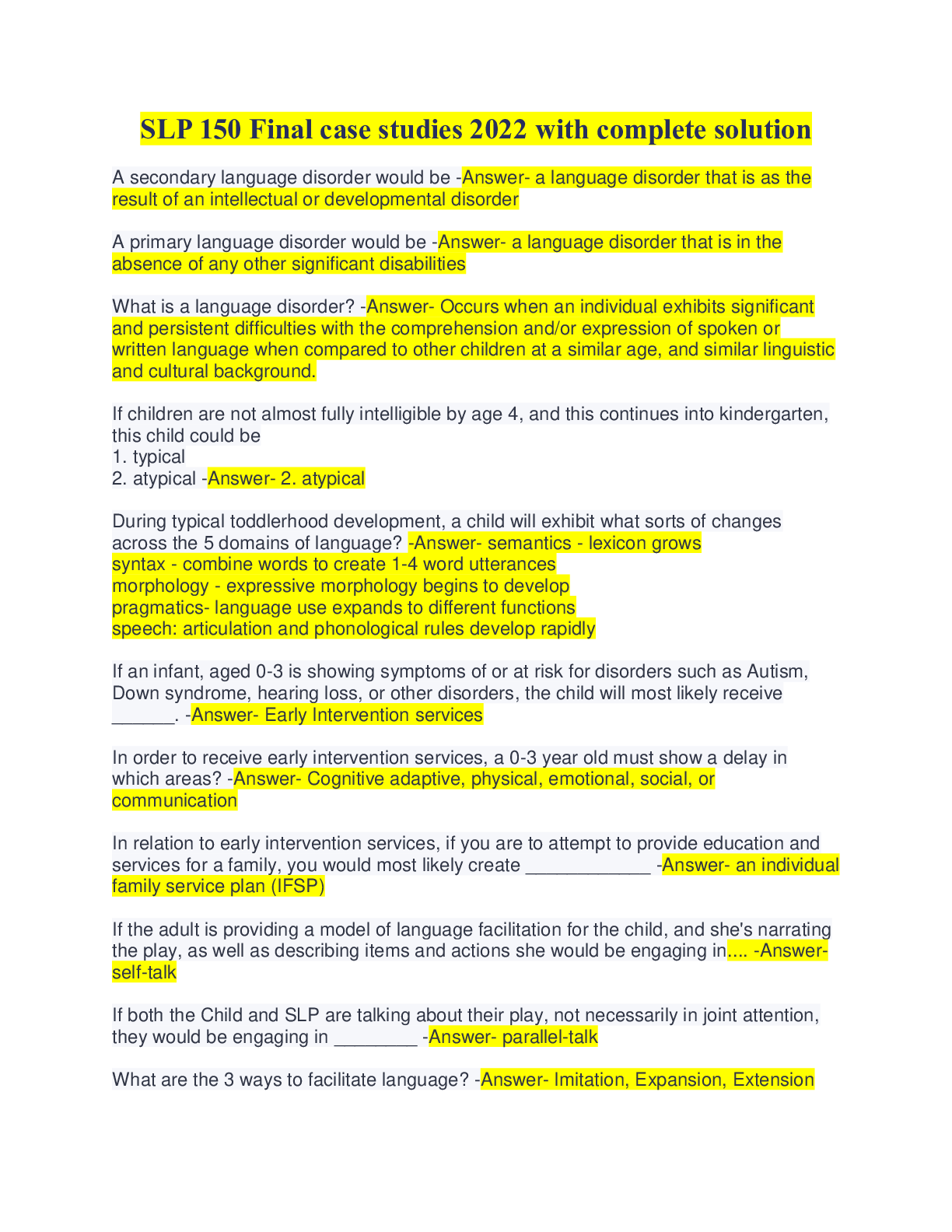
SLP 150 Final case studies 2022 with complete solution
A secondary language disorder would be -Answer- a language disorder that is as the result of an intellectual or developmental disorder
A primary language disorder would be -Answer- a language disorder that is in the absence of any other significant disabilities
What is a language disorder? -Answer- Occurs when an individual exhibits significant and persistent difficulties with the comprehension and/or expression of spoken or written language when compared to other children at a similar age, and similar linguistic and cultural background.
If children are not almost fully intelligible by age 4, and this continues into kindergarten, this child could be
1. typical
2. atypical -Answer- 2. atypical
During typical toddlerhood development, a child will exhibit what sorts of changes across the 5 domains of language? -Answer- semantics - lexicon grows
syntax - combine words to create 1-4 word utterances
morphology - expressive morphology begins to develop
pragmatics- language use expands to different functions
speech: articulation and phonological rules develop rapidly
If an infant, aged 0-3 is showing symptoms of or at risk for disorders such as Autism, Down syndrome, hearing loss, or other disorders, the child will most likely receive ______. -Answer- Early Intervention services
In order to receive early intervention services, a 0-3 year old must show a delay in which areas? -Answer- Cognitive adaptive, physical, emotional, social, or communication
In relation to early intervention services, if you are to attempt to provide education and services for a family, you would most likely create ____________ -Answer- an individual family service plan (IFSP)
If the adult is providing a model of language facilitation for the child, and she's narrating the play, as well as describing items and actions she would be engaging in.... -Answer- self-talk
If both the Child and SLP are talking about their play, not necessarily in joint attention, they would be engaging in ________ -Answer- parallel-talk
What are the 3 ways to facilitate language? -Answer- Imitation, Expansion, Extension
If the SLP repeats the child's speech for reinforcement, she is engaging in -Answer- Imitation
If the SLP adds to the child's words by modeling longer, more complex phrases, such as turning "big dog" into "That dog is so big!" she is engaging in -Answer- Expansion
If the SLP adds semantic info to a child's utterance, such as copying "big dog" and says "Clifford is a big red dog" she would be engaging in -Answer- Extension
At age 3 when the child ages out of early intervention services, where does the family go to receive services? -Answer- school district
If a child needs support past the age of 3, what does the IFSP turn into? -Answer- IEP
[Show More]