SLHS 2204 Exam 1, 2, 3 Answers 2022 with complete solution
Which hypothesis of babbling is supported by the fact that during the second part of the 1st year the babbling of deaf infants diminishes, while the babbling
...
SLHS 2204 Exam 1, 2, 3 Answers 2022 with complete solution
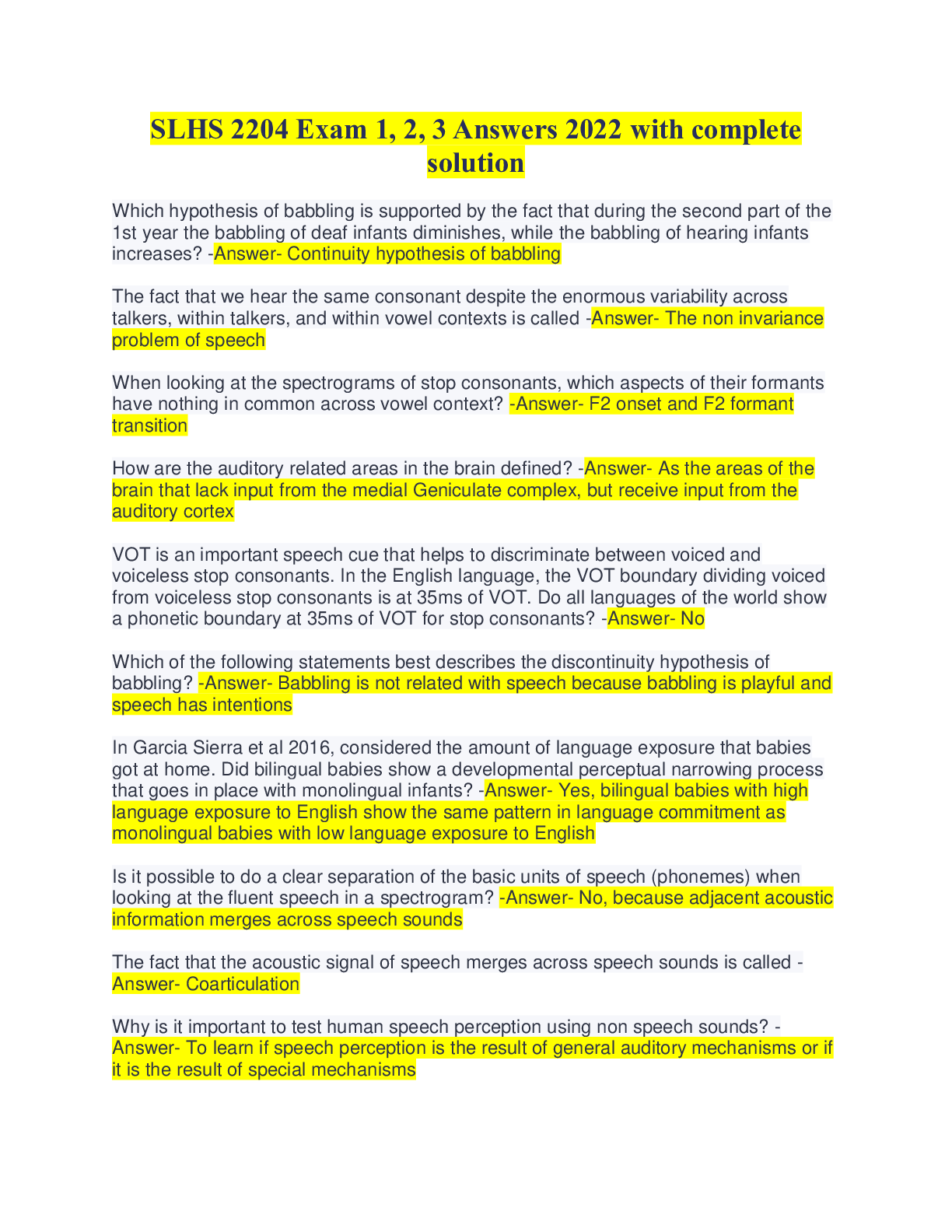
Which hypothesis of babbling is supported by the fact that during the second part of the 1st year the babbling of deaf infants diminishes, while the babbling of hearing infants increases? -Answer- Continuity hypothesis of babbling
The fact that we hear the same consonant despite the enormous variability across talkers, within talkers, and within vowel contexts is called -Answer- The non invariance problem of speech
When looking at the spectrograms of stop consonants, which aspects of their formants have nothing in common across vowel context? -Answer- F2 onset and F2 formant transition
How are the auditory related areas in the brain defined? -Answer- As the areas of the brain that lack input from the medial Geniculate complex, but receive input from the auditory cortex
VOT is an important speech cue that helps to discriminate between voiced and voiceless stop consonants. In the English language, the VOT boundary dividing voiced from voiceless stop consonants is at 35ms of VOT. Do all languages of the world show a phonetic boundary at 35ms of VOT for stop consonants? -Answer- No
Which of the following statements best describes the discontinuity hypothesis of babbling? -Answer- Babbling is not related with speech because babbling is playful and speech has intentions
In Garcia Sierra et al 2016, considered the amount of language exposure that babies got at home. Did bilingual babies show a developmental perceptual narrowing process that goes in place with monolingual infants? -Answer- Yes, bilingual babies with high language exposure to English show the same pattern in language commitment as monolingual babies with low language exposure to English
Is it possible to do a clear separation of the basic units of speech (phonemes) when looking at the fluent speech in a spectrogram? -Answer- No, because adjacent acoustic information merges across speech sounds
The fact that the acoustic signal of speech merges across speech sounds is called -Answer- Coarticulation
Why is it important to test human speech perception using non speech sounds? -Answer- To learn if speech perception is the result of general auditory mechanisms or if it is the result of special mechanisms
To learn how specific acoustic properties of speech relate with general perceptual auditory mechanisms
Regarding coarticulation, which of the following ideas best explains the relation between the brain and vocal tract? -Answer- The brain anticipates the vocal tract for what is next. For this reason, the shape of the vocal tract reflects movements that just happened, movements that are happening and movements that will happen
According to the paper Linguistic Experience Alters Phonetic Perception in infants by 6 months of Age by Kuhl and colleagues, monolingual adult speakers of English show an effect called magnet effect of speech perception. The magnet effect in adults shows that non prototypical English vowels are perceived as belonging to a prototype vowel English category. Do infants show the same magnet effect than the one described in adults? -Answer- Yes
What are the two major structures of the Cerebrum? -Answer- Cerebral hemispheres and basal ganglia
What does EEG (electrocephalogram) represent? -Answer- Voltage changes over time
How is the auditory cortex defined? -Answer- The area of the brain that receives input from the medial Geniculate complex
[Show More]