NR 509 Midterm Questions and Answers
Latest Update
Absence of red reflex Correct Answer- an opacity of the lens (cataract) or, possibly, the vitreous
(or even an artificial eye). Less commonly, a detached retina or, i
...
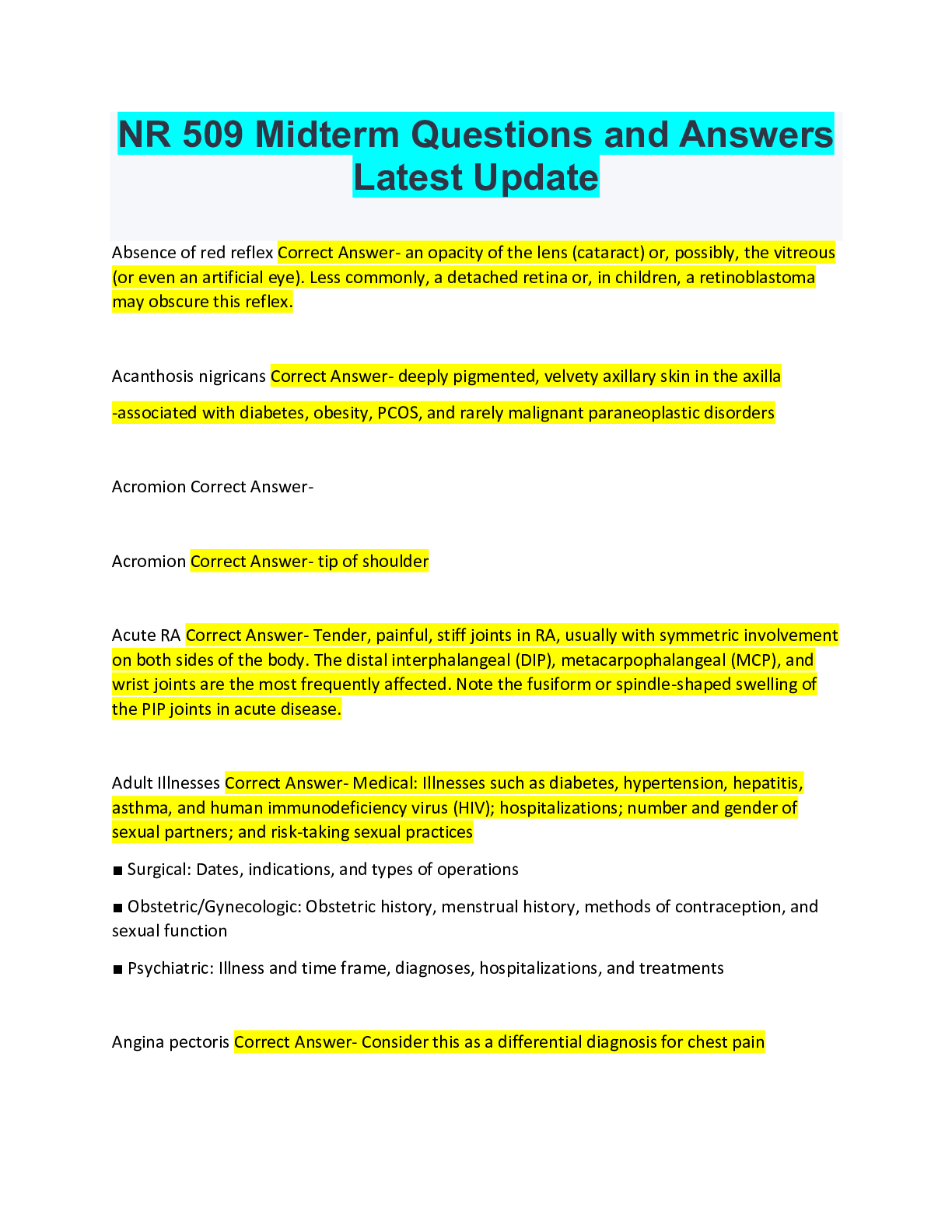
NR 509 Midterm Questions and Answers
Latest Update
Absence of red reflex Correct Answer- an opacity of the lens (cataract) or, possibly, the vitreous
(or even an artificial eye). Less commonly, a detached retina or, in children, a retinoblastoma
may obscure this reflex.
Acanthosis nigricans Correct Answer- deeply pigmented, velvety axillary skin in the axilla
-associated with diabetes, obesity, PCOS, and rarely malignant paraneoplastic disorders
Acromion Correct AnswerAcromion Correct Answer- tip of shoulder
Acute RA Correct Answer- Tender, painful, stiff joints in RA, usually with symmetric involvement
on both sides of the body. The distal interphalangeal (DIP), metacarpophalangeal (MCP), and
wrist joints are the most frequently affected. Note the fusiform or spindle-shaped swelling of
the PIP joints in acute disease.
Adult Illnesses Correct Answer- Medical: Illnesses such as diabetes, hypertension, hepatitis,
asthma, and human immunodeficiency virus (HIV); hospitalizations; number and gender of
sexual partners; and risk-taking sexual practices
■ Surgical: Dates, indications, and types of operations
■ Obstetric/Gynecologic: Obstetric history, menstrual history, methods of contraception, and
sexual function
■ Psychiatric: Illness and time frame, diagnoses, hospitalizations, and treatments
Angina pectoris Correct Answer- Consider this as a differential diagnosis for chest painBronchial Correct Answer- or louder, harsher and higher in pitch, with a short silence be-tween
inspiratory and expiratory sounds. Expiratory sounds last longer than inspiratory sounds.
Bronchovesicular sounds Correct Answer- with inspiratory and expiratory sounds about equal in
length, at times separated by a silent interval. Detecting differences in pitch and intensity is
often easier during expiration.
Bulging discs Correct Answer- Vertebral bodies of the spin associated with bulging disc are
cartilaginous
C-section should be listed under surgeries Correct AnswerCause of falsely high BP Correct Answer- -too small of a BP cuff
- if the brachial artery is below heart level
- loose cuff
- bladder that balloons outside the cuff
Cause of saddle numbness and urinary retention Correct Answer- Cauda equina syndrome
Check for nystagmus Correct Answer- -involuntary jerking movement of the eyes with quick and
slow components.
- It is named for the direction of the quick component
- seen in cerebellar disease and vestibular disorders and in internuclear ophthalmoplegia
Cherry angiomas Correct Answer- Benign
Chronic RA Correct Answer- swelling and thickening of the MCP and PIP joints. Range of motion
becomes limited, and fingers may deviate toward the ulnar side. The interosseous muscles
atrophy. The fingers may show "swan neck" deformities (hyperextension of the PIP joints with
fixed flexion of the distal interphalangeal [DIP] joints). Less common is a boutonnière deformity(persistent flexion of the PIP joint with hyperextension of the DIP joint). Rheumatoid nodules
are seen in the acute or the chronic stage.
CN 1-6 Correct Answer- 1) Olfactory- smell
2)Optic- visual acuity with eye chart & pupil response
3)Oculomotor- conjugate gaze with EOM
4)Trochlear- conjugate gaze with EOM
5) Trigeminal- palpate masseter & touch face and have pt identify where
6) Abducens- Conjugate gaze with EOM
CN 7-12 Correct Answer- 7)Facial- Blow cheeks out, smile, frown, pucker lips
8)Vestibulocochlear (Acoustic)- Whisper test
9) Glossopharyngeal- Gag reflex
10)Vagus- say "ahhh". soft palate and uvula rise symmetrically
11) Accessory- shrug shoulders
12) Hypoglossal- Stick out tongue and move left to right
Condylar joints Correct Answer- Knee & TMJ
-Movement of two articulating surfaces not dissociable
constitutional ROS Correct Answer- fatigue, weakness, fever, chills, night sweats, weight
changes, pain
crackles Correct Answer- -intermittent, nonmusical, brief
- Come from abnormalities of the lung parenchyma (pneumonia, interstitial lung disease,
pulmonary fibrosis, atelectasis, heart failure) or of the airways (bronchitis, bronchiectasis
-can be indicative of heart failureCranial nerve for lateral gaze Correct Answer- CN6: Abducens
Dim response of olfactory nerve in elderly Correct Answer- Normal finding
Dysfunction of the cerebellum Correct Answer- Impaired speech and judgement with an
otherwise normal exam
epistaxis causes Correct Answer- nosebleed
- cause: trauma, inflammation, drying and crusting of the mucosa, tumors and foreign bodies
Glaucoma Correct Answer- Increased cup-to-disc ratio
Headache warning signs Correct Answer- Progressively frequent or severe over a 3-month
period
● Sudden onset like a "thunderclap" or "the worst headache of my life"
● New onset after age 50 years
● Aggravated or relieved by change in position
● Precipitated by Valsalva maneuver or exertion
● Associated symptoms of fever, night sweats, or weight loss
● Presence of cancer, HIV infection, or pregnancy
● Recent head trauma
● Change in pattern from past headaches
● Lack of a similar headache in the past
● Associated papilledema, neck stiffness, or focal neurologic deficits
[Show More]