NUR 2755 MDC 3 EXAM 2 (Latest 2021 / 2022)-
Rasmussen College
Anthrax risk factors Correct Answer- Occupational exposure and drug use
Asthma
Nursing care and education Correct Answer- Adherence to medication regimen,
...
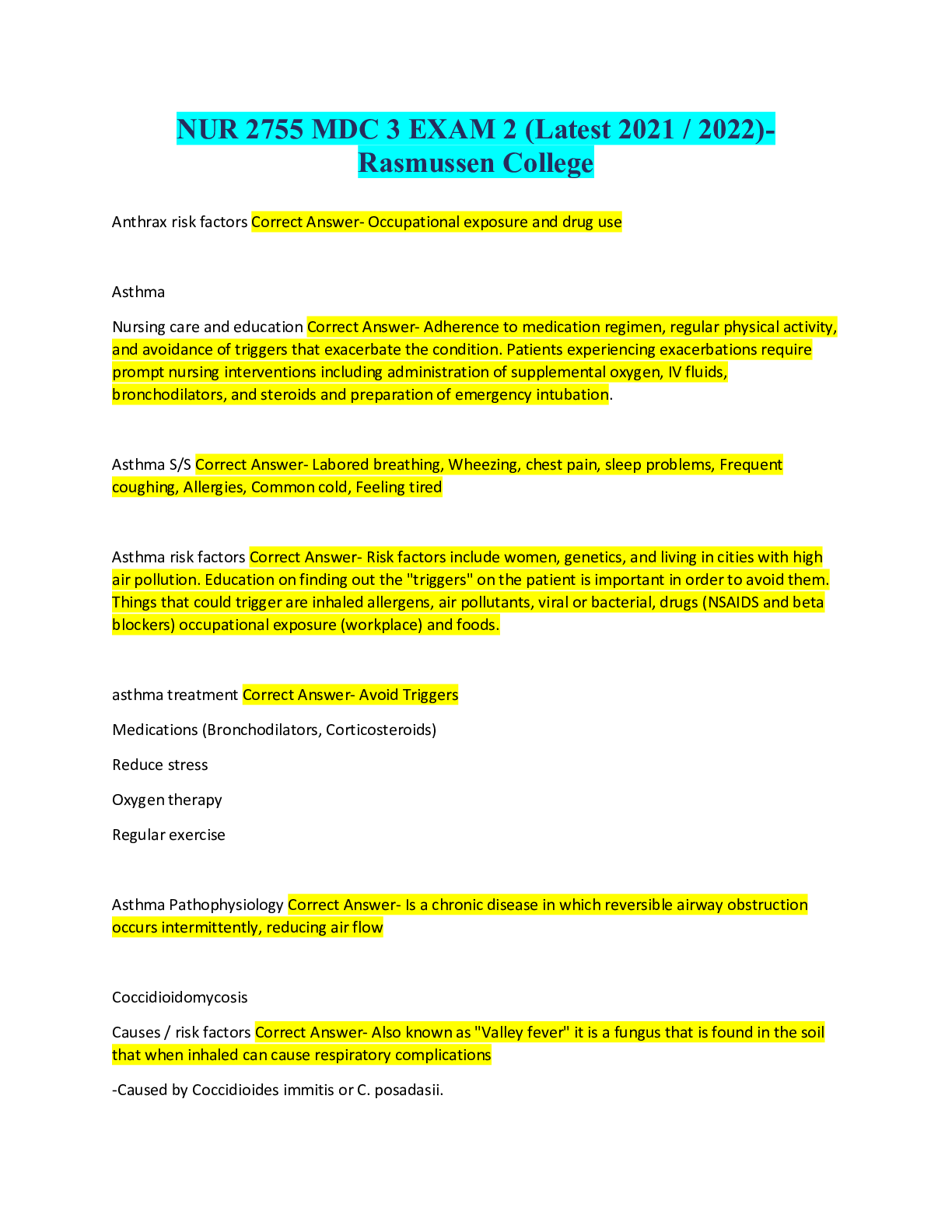
NUR 2755 MDC 3 EXAM 2 (Latest 2021 / 2022)-
Rasmussen College
Anthrax risk factors Correct Answer- Occupational exposure and drug use
Asthma
Nursing care and education Correct Answer- Adherence to medication regimen, regular physical activity,
and avoidance of triggers that exacerbate the condition. Patients experiencing exacerbations require
prompt nursing interventions including administration of supplemental oxygen, IV fluids,
bronchodilators, and steroids and preparation of emergency intubation.
Asthma S/S Correct Answer- Labored breathing, Wheezing, chest pain, sleep problems, Frequent
coughing, Allergies, Common cold, Feeling tired
Asthma risk factors Correct Answer- Risk factors include women, genetics, and living in cities with high
air pollution. Education on finding out the "triggers" on the patient is important in order to avoid them.
Things that could trigger are inhaled allergens, air pollutants, viral or bacterial, drugs (NSAIDS and beta
blockers) occupational exposure (workplace) and foods.
asthma treatment Correct Answer- Avoid Triggers
Medications (Bronchodilators, Corticosteroids)
Reduce stress
Oxygen therapy
Regular exercise
Asthma Pathophysiology Correct Answer- Is a chronic disease in which reversible airway obstruction
occurs intermittently, reducing air flow
Coccidioidomycosis
Causes / risk factors Correct Answer- Also known as "Valley fever" it is a fungus that is found in the soil
that when inhaled can cause respiratory complications
-Caused by Coccidioides immitis or C. posadasii.-Risk factors include Agricultural workers
COPD
Nursing care and education Correct Answer- Improve gas exchange, ensure adequate dietary input:
weight loss common as progresses as the increase work of breathing increase metabolism, physical
therapy and support, and psychosocial support-manage anxiety and post-op care
COPD positioning Correct Answer- Tripod and Fowler's/semi-fowler's promote effective breathing
COPD treatment Correct Answer- Medical management, Surgical management for some such as Lung
transplant (rare), Lung reduction surgery is more common in emphysema (Remove hyperinflated lungs
that are filled with mostly stagnant air)
COPD S/S Correct Answer- chronic cough (bronchitis), chronic sputum production (bronchitis), barrel
chest (emphysema), recurrent dyspnea (both), wheezing & chest tightness and weight loss. (clubbed
fingers as a result of chronic hypoxemia)
COPD lab results Correct Answer- polycythemia (elevated hematocrit or hemoglobin), chronic
hypoxemia, acidosis, increased risk for respiratory infection
COPD nutrition Correct Answer- Increased breathing efforts leads to increased nutritional needs.
Cystic Fibrosis
Signs and symptoms Correct Answer- -Non pulmonary:
Abdominal distention, GERD, Rectal prolapse, Foul smelling stools, Malnourished,Diabetes mellitus (type
1 variation), Osteoporosis and osteopenia
-Pulmonary issues:
Frequent or chronic respiratory infections, Chest congestion, Limited exercise tolerance, Chronic cough,
Sputum production, Use of accessory muscles, Decreased pulmonary function test.
Cystic Fibrosis nursing care/education Correct Answer- Adequate hydration, weight management,
medications, chest physiotherapy, manage other organ complications (especially pancreatic) and insulin
therapy if neededCystic Fibrosis complications and management Correct Answer- Do NOT nurse CF patients near other CF
patients (Burkholderia cepacia bacteria) because it is easily spread to another. Complete daily
physiotherapy, positive expiratory pressure, oxygen therapy, and lung transplant. Client will need
vitamins to prevent malnutrition and osteoporosis. Pancreatic enzymes.
Cystic fibrosis diagnosis Correct Answer- -*Sweat chloride test
-Pulmonary function test
-Chest X ray
-ABG
Cystic Fibrosis treatment Correct Answer- Treat active symptoms, Vitamin supplementation (struggle to
absorb fat soluble vitamins (ADEK) - so at risk of bone issue, Diabetes management - loss of pancreatic
function leads to loss of insulin production, Pancreatic enzyme replacement, Daily chest physiotherapy,
LUNG TRANSPLANT
Epistaxis
Nursing care Correct Answer- Management of bleeding by holding lateral pressure on the nose for 10
mins with cool compress. If bleeding does not stop, nasal packing may be applied.
Upright position to prevent aspiration
Do not blow nose for 24 hrs
Avoid straining or bending over
Epistaxis treatment Correct Answer- Seek care if traumatic cause, sit forward, Apply pressure, Apply ice
or cool compress if possible, 15min-by the clock, pack if needed, explore cause (Blood work, humidifier,
Behavior); Capillary cauterization, silver nitrate, electrocautery, nasal packing and pitaxis catheters
Facial trauma
Diagnostics and testing Correct Answer- Xray, CT, and cervical spine Xray; S&S: Stridor, SOB/dyspnea,
anxiety/restlessness/confusion, hypoxia/decreased saturation/hypercarbia, cyanosis and loss of
consciousnessFacial Trauma Treatment Correct Answer- Fixed occlusion, Internal fixation (ORIF), and inner maxillary
fixation (IMF); Nurse: Assess AIRWAY, assess for bleeding, look for facial asymmetry, edema, obvious
fractures, check for CSF leakage from the nose or ears, check vision and eye movement, and check
behind the ear for bruising swelling or bleeding.
Facial trauma nursing care/education Correct Answer- Patient airway, Control bleeding (Treat
hypotension and hypovolemia), Stabilize patient for likely surgery
Head and neck cancer
signs & symptoms Correct Answer- Red and white patch in mouth, Ulcer that does not heal, change in fit
for dentures, changes to vocal quality including prolonged hoarseness for 2wks, Lump in throat,
Difficulty swallowing along with chewing, moving tongue, or breathing (Late symptoms), weight loss,
Persistent pain/discomfort (Anywhere in head or neck area)
head and neck cancer treatment/education Correct Answer- Radiation therapy, chemotherapy,
biotherapy, laryngectomy (partial and total), tracheostomy, oropharyngeal cancer resection, transoral
cordectomy, hospice and palliative care
radiation education Correct Answer- consulting speech therapy to assist patient with communication
(can cause voice changes/hoarseness/sore throat), manage sore throat by implementing pain
management strategies (gargling with saline, sucking on ice, and use of mouthwash and throat sprays),
instruct the patient to refrain from being in the sun and avoid shaving, and teach the patient to wear
protective clothing and gently clean soap with a mild soap.
Influenza
Nursing care and education Correct Answer- Treatment includes: Rest, increase fluid intake, saline
gargles, antihistamines, supportive care and isolation precautions (airborne, droplet, contact)
(Tamiflu) oseltamivir
Zanamivir (Relenza)
peramivir (Rapivab)
Flu vaccine
Laryngectomy
Post-operative care Correct Answer- -Focus care on ensuring a patent airway-Confirm the presence of bilateral breath sounds
-Preform a respiratory assessment at least hourly
-Assess the patient for complications from the procedure
Lung cancer
Signs & symptoms Correct Answer- Persistent or change in cough
Blood tinged sputum
Changes in respiratory pattern
Hemoptysis
Chest pain
Clubbing of fingers
Hoarseness
Late signs include: Anorexia, fatigue, weight loss, and NV
Lung cancer treatment Correct Answer- Chemotherapy, targeted drug therapy, symptoms management,
oxygen therapy, thoracotomy with partial lung removal, pneumonectomy, hospice and palliative care.
Medications Correct Answer- SABA=albuterol and levalbuterol
LABA=salmeterol, formoterol
Leukotriene= montelukast
Steroids= ICS=fluticasone, beclomethasone, budesonide, oral/IV=prednisone, methylprednisolone
Nasal fracture
signs and symptoms Correct Answer- Pain, Disfigurement, Signs of injury to face/nose, bleeding,
difficulty breathing through nose, Swelling (Inside and outside the nose), Bruising (around the eyes)
nasal fracture nursing care/education Correct Answer- Semi-Fowler, pain mgmt (avoid NSAIDs), move
slowly, soft foods, humidifier, and limit stress and strain. *Test for CSF when basal skull fracture possible
or suspected*Nose & Sinus cancer
diagnostics Correct Answer- CT, or Xray, MRI, Biopsy
nose & sinus cancer S/S Correct Answer- Sinusitis symptoms: Nasal discharge, Pressure, Persistent nasal
obstruction, Bloody drainage
Obstructive sleep apnea
Signs and symptoms Correct Answer- Interrupted breathing during sleeping (Stopping and starting,
gasping, snoring, choking sounds), waking up alot, Loud snoring, Daytime symptoms include feelings
tired, difficulty concentrating, mood swings
Peritonsillar abscess
Signs and symptoms Correct Answer- a collection of pus behind the tonsil causing swelling on one side
of the throat, pushing the uvula toward the unaffected side. The patient may have severe throat pain
radiating to the ear or teeth, a muffled voice, fever, and difficulty swallowing. He or she may also have a
tonic contraction of the muscles of chewing (trismus) and difficulty breathing. Bad breath is present, and
lymph nodes on the affected side are swollen
Peritonsillar abscess Nursing priorities Correct Answer- Most patients can be treated as outpatients with
antibiotics. However, antibiotics alone are often ineffective. The patient may need steroids to reduce
the swelling, and some may need drainage of the abscess. Pain control is important; drugs may include
topical anesthetics, over-the-counter analgesics, and opioids. The patient may need liquid drugs because
of swallowing difficulty.
Pneumonia
Nursing care and education Correct Answer- Decrease amount of secretions in airway
Increase physical activity in order to reduce risk
Use if incentive spirometer when in hospital
sepsis prevention
pneumonia prevention Correct Answer- Get a vaccine (pneumococcal)pneumonia immunization Correct Answer- There are two pneumonia vaccines: pneumococcal
polysaccharide vaccine (PPSV 23), known as Pneumovax; and pneumococcal conjugate vaccine (PCV-13),
known as Prevnar 13. The CDC recommends that adults older than 65 years be vaccinated with both,
first with Prevnar 13 followed by Pneumovax about 6 to 12 months later
pneumonia S/S Correct Answer- chest pain/discomfort, myalgia, headache, chills, fever, cough,
tachycardia, dyspnea, tachypnea, hemoptysis, sputum production, crackles upon auscultation,
hypoxemia, and increased respiratory rate.
pneumonia treatment Correct Answer- oxygen, IS, bronchodilator, steroids, expectorants, antibiotics
and sepsis prevention
Rhinosinusitis
Treatment Correct Answer- Broad-spectrum antibiotics (amoxicillin), decongestants such as
phenylephrine (Neo-Synephrine), antipyretics and surgery to relieve obstruction and promote drainage
Rhinosinusitis education Correct Answer- Teach him or her about correct use of the drug therapy
prescribed. Teach patients to reduce the risk for spreading infections by thoroughly washing hands,
especially after nose blowing, sneezing, coughing, rubbing the eyes, or touching the face. Other
precautions include staying home from work, school, or other crowded places; covering the mouth and
nose with a tissue when sneezing or coughing; disposing properly of used tissues immediately; and
avoiding close contact with others.
[Show More]