SSI Open Water Final Exam Questions
and Answers Already Passed
The term Surface Interval is defined as: ✔✔The amount of time a diver stays out of the water or
on the surface between dives.
The most serious lung over
...
SSI Open Water Final Exam Questions
and Answers Already Passed
The term Surface Interval is defined as: ✔✔The amount of time a diver stays out of the water or
on the surface between dives.
The most serious lung over expansion injury is: ✔✔Arterial Gas Embolism
Diving at altitude or flying after diving: ✔✔Requires special diving computer functions, altitude
tables and/or refraining from flying for at least 24 hours after the completion of a dive
If a diver is injured by harmful sea life, it is usually because of:
A. The diver's negligence
B. All answers are correct
C. The diver's ignorance
D. The diver's aggressive behavior ✔✔All answers are correct
Which of the statements concerning sound transmission underwater is correct:
A. Divers find it difficult to locate the direction of a sound producing source
B. All answers are correct
C. Sound will travel farther underwater than in air
D. Sound travels four times faster underwater than in air ✔✔All answers are correct
Panic can be prevented by:
A. Taking specialty training
B. Honestly evaluating your diving limitations
C. Properly maintaining your Total Diving System
D. All answers are correct ✔✔All answers are correct
Use of the SSI Total DiveLog is important because:
A. All answers are correct
B. It keeps an accurate record of your personal information and dives
C. It contains your medical history and provides important emergency information
D. It is important information resource for future dives ✔✔All answers are correct
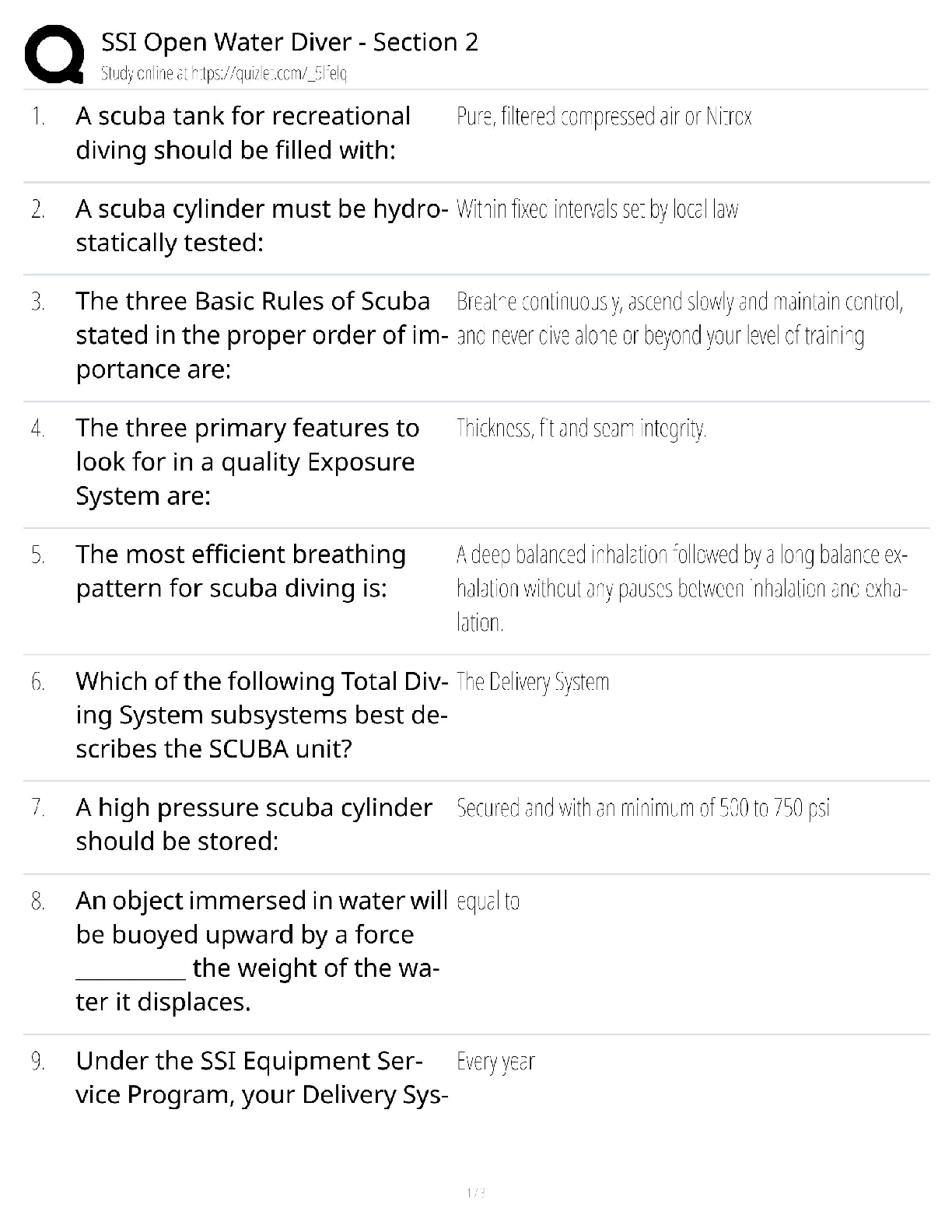
An object immersed in water will be buoyed upward by a force __________ the weight of the
water it displaces. ✔✔Equal to
In an out-of-air emergency, if your buddy is close enough, you should: ✔✔Swim to your buddy,
give the out-of-air signal, and share air
A scuba tank for recreational diving should be filled with: ✔✔Pure, filtered compressed air or
Nitrox.
Signs of a panicked diver are: ✔✔Wide-eyed, fearful look and a fast and erratic breathing pattern.
During normal diving activities, divers should never exceed an ascent rate of ______ feet per
minute ✔✔30
Overexpansion injuries can be prevented by:
A. All answers are correct
B. Never holding your breath while diving
C. Learning the correct breathing patterns reinforced in classroom, pool, and open water training
D. Dive with a properly maintained high-quality Total Diving System ✔✔All answers are correct
The most efficient breathing pattern for scuba diving is: ✔✔A deep balanced inhalation followed
by a long balanced exhalation without any pause between inhaling and exhaling
[Show More]