NURS 3230 Chapter 29 Perioperative
Nursing NCLEX Already Passed
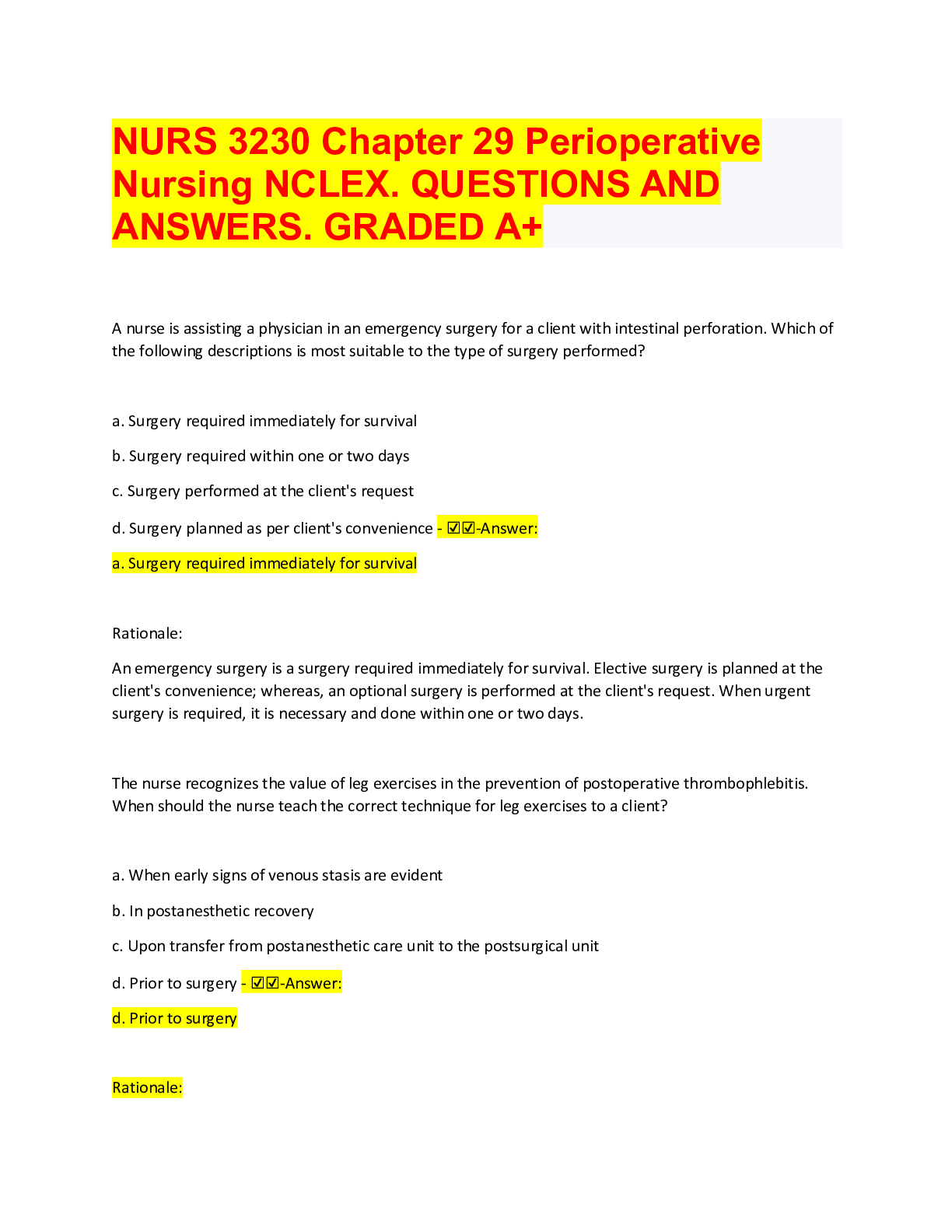
A nurse is assisting a physician in an emergency surgery for a client with intestinal perforation.
Which of the following descriptions is most suitable t
...
NURS 3230 Chapter 29 Perioperative
Nursing NCLEX Already Passed
A nurse is assisting a physician in an emergency surgery for a client with intestinal perforation.
Which of the following descriptions is most suitable to the type of surgery performed?
a. Surgery required immediately for survival
b. Surgery required within one or two days
c. Surgery performed at the client's request
d. Surgery planned as per client's convenience ✔✔Answer:
a. Surgery required immediately for survival
Rationale:
An emergency surgery is a surgery required immediately for survival. Elective surgery is planned
at the client's convenience; whereas, an optional surgery is performed at the client's request. When
urgent surgery is required, it is necessary and done within one or two days.
The nurse recognizes the value of leg exercises in the prevention of postoperative
thrombophlebitis. When should the nurse teach the correct technique for leg exercises to a client?
a. When early signs of venous stasis are evident
b. In postanesthetic recovery
c. Upon transfer from postanesthetic care unit to the postsurgical unit
d. Prior to surgery ✔✔Answer:
d. Prior to surgery
Rationale:
Though leg exercises are begun after surgery, such preventative measures should ideally be taught
to the patient during the preoperative period.
A nurse is preparing a client for endotracheal intubation. The anesthesiologist has ordered an
anticholinergic medication for this client. Which of the following is an action of this medication?
a. It promotes induction of anesthesia.
b. It decreases respiratory secretions.
c. It promotes sleep or conscious sedation.
d. It decreases gastric acidity and volume. ✔✔Answer:
b. It decreases respiratory secretions.
Rationale:
An anticholinergic medication decreases respiratory secretions and prevents vagal nerve
stimulation during endotracheal intubation. Antianxiety drugs slow motor activity and promote the
induction of anesthesia. Histamine-2 receptor antagonists decrease gastric acidity and volume.
Sedatives promote sleep or conscious sedation.
A client has been taking aspirin since his heart attack in 1997. The client is at risk for what?
a. Thrombophlebitis
b. Blood clots
c. Hemorrhage
d. Infection ✔✔Answer:
c. Hemorrhage
Rationale:
Current medication use, especially use of medications that can affect coagulation status (warfarin,
nonsteroidal anti-inflammatory drugs, aspirin) is important and should be reported to the surgeon.
In the postoperative phase of abdominal surgery, the client complains of severe abdominal pain.
In the second postoperative day, the client's bowel sounds are absent. What does the nurse suspect?
a. Abdominal infection
b. Paralytic ileus
c. Normal response
d. Hernia development ✔✔Answer:
b. Paralytic ileus
Rationale:
A potential complication after surgery is paralytic ileum, a condition in which there is decreased
bowel functioning.
A nurse is caring for an older adult client who has been prescribed fluid restriction before surgery.
Which of the following should the nurse check to asses the risk of fluid restriction in elderly
clients?
a. Cardiac status
b. Anxiety level
c. Vital signs
d. Self-therapy ✔✔Answer:
c. Vital signs
Rationale:
The nurse should assess the client's vital signs, weight, and sternal skin turgor prior to fluid
restriction to serve as a baseline for comparison. The period of fluid restriction before surgery may
be shortened for older adults to reduce their risk of dehydration and hypotension. Nurses check a
client's self-therapy practices and cardiac status to avoid any complications of bleeding and
elimination of intravenous fluids given at a standard rate.
A client is undergoing surgery for an appendectomy. This would be considered what type of
surgery?
a. Emergency surgery
b. Palliative surgery
c. Diagnostic surgery
d. Elective surgery ✔✔Answer:
a. Emergency surgery
Rationale:
An appendectomy is considered emergency or urgent surgery. Elective surgery can be scheduled
in advance, and delay has no ill effects. Palliative surgery is done to relieve or reduce the intensity
of an illness, and diagnostic surgery is done to make or confirm a diagnosis.
A nurse is preparing to receive a client in post-anesthesia care unit (PACU). The client is diabetic
and has undergone knee surgery. Which information would be most important for the receiving
nurse to obtain to develop an appropriate plan of care for this client?
a. Environment of the operating room
b. Information about allergic agents
c. Amount of blood loss
d. Chronic disease history ✔✔Answer:
c. Amount of blood loss
Rationale:
To plan care effectively in the postoperative period, the nurse needs to know about the amount of
blood lost during the surgery, the type of surgery that was performed on the client, and whether
there were any surgical or anesthetic complications. Information on chronic disease history and
allergy history are done in the pre-operative period, not in the postoperative period. Information
on the environment in the operation room is checked by the circulatory nurse during the intraoperative care plan; it is not associated
[Show More]