ATI MED SURGE QUESTIONS AND ANSWERS 2022
LATEST UPDATE SOLUTION
A nurse monitors for increased intracranial pressure (ICP) on a client who has a
leaking cerebral aneurysm. If
the client manifests increased intracra
...
ATI MED SURGE QUESTIONS AND ANSWERS 2022
LATEST UPDATE SOLUTION
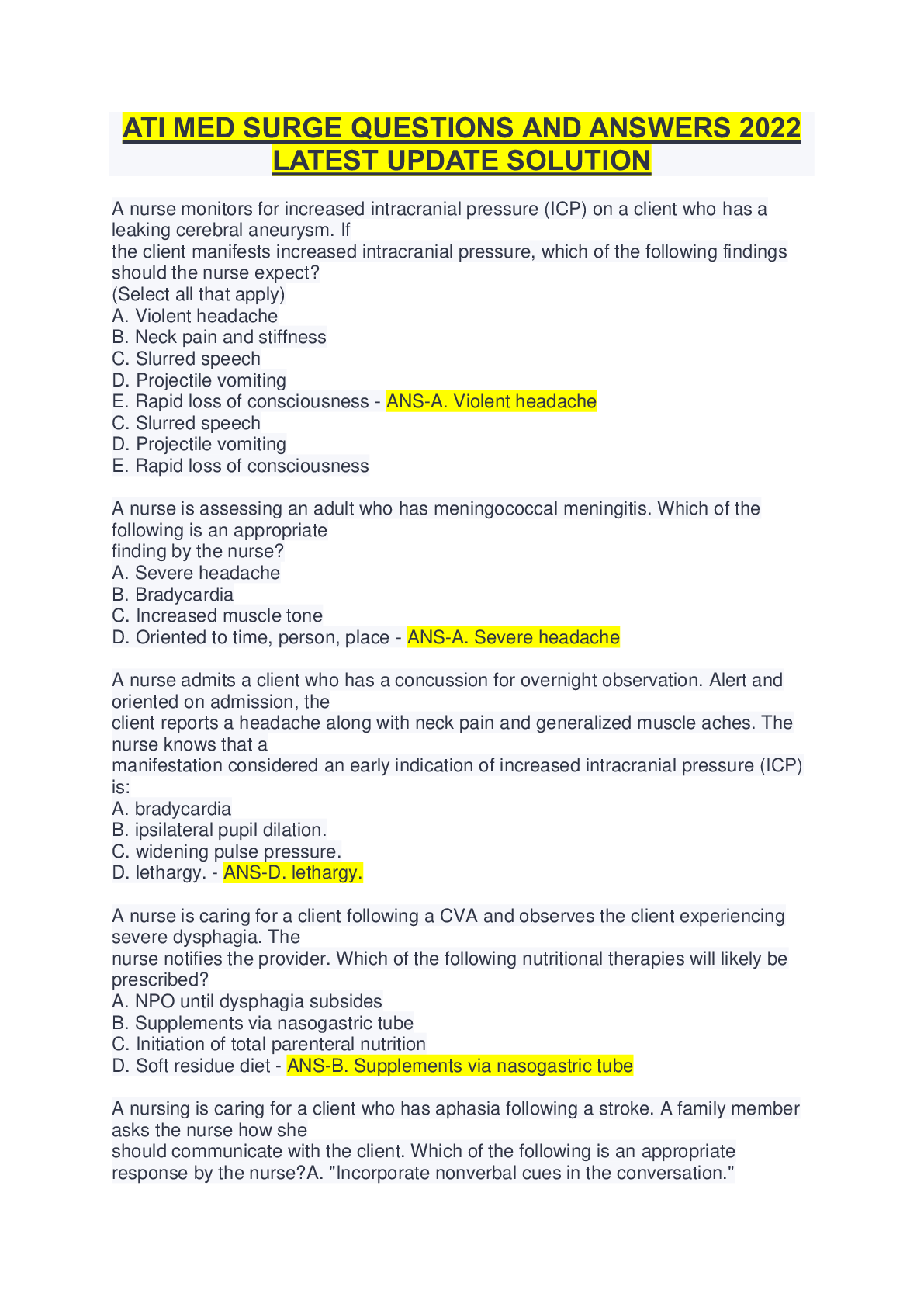
A nurse monitors for increased intracranial pressure (ICP) on a client who has a
leaking cerebral aneurysm. If
the client manifests increased intracranial pressure, which of the following findings
should the nurse expect?
(Select all that apply)
A. Violent headache
B. Neck pain and stiffness
C. Slurred speech
D. Projectile vomiting
E. Rapid loss of consciousness - ANS-A. Violent headache
C. Slurred speech
D. Projectile vomiting
E. Rapid loss of consciousness
A nurse is assessing an adult who has meningococcal meningitis. Which of the
following is an appropriate
finding by the nurse?
A. Severe headache
B. Bradycardia
C. Increased muscle tone
D. Oriented to time, person, place - ANS-A. Severe headache
A nurse admits a client who has a concussion for overnight observation. Alert and
oriented on admission, the
client reports a headache along with neck pain and generalized muscle aches. The
nurse knows that a
manifestation considered an early indication of increased intracranial pressure (ICP)
is:
A. bradycardia
B. ipsilateral pupil dilation.
C. widening pulse pressure.
D. lethargy. - ANS-D. lethargy.
A nurse is caring for a client following a CVA and observes the client experiencing
severe dysphagia. The
nurse notifies the provider. Which of the following nutritional therapies will likely be
prescribed?
A. NPO until dysphagia subsides
B. Supplements via nasogastric tube
C. Initiation of total parenteral nutrition
D. Soft residue diet - ANS-B. Supplements via nasogastric tube
A nursing is caring for a client who has aphasia following a stroke. A family member
asks the nurse how she
should communicate with the client. Which of the following is an appropriate
response by the nurse?A. "Incorporate nonverbal cues in the conversation."
B. "Ask multiple choice questions as part of the conversation."
C. "Use a higher-pitched tone of voice when speaking."
D. "Use simple child-like statements when speaking." - ANS-A. "Incorporate
nonverbal cues in the conversation."
A nurse is caring for a client who has meningitis, a temperature of 39.7° C (103.5°
F), and is prescribed a
hypothermia blanket. While using this therapy, the nurse should know that the client
must carefully be
observed for which of the following complications?
A. Dehydration
B. Seizures
C. Burns
D. Shivering - ANS-D. Shivering
An acute care nurse is caring for an adult client who is undergoing evaluation for a
possible brain tumor. When
performing a neurological examination, which of following is the most reliable
indicator of cerebral status?
A. Pupil response
B. Deep tendon reflexes
C. Muscle strength
D. Level of consciousness - ANS-D. Level of consciousness
A nurse is caring for a client at a rehabilitation center 3 weeks after a
cerebrovascular accident (CVA).
Because the client's CVA affected the left side of the brain, which of the following
goals should the nurse
anticipate including in the client's rehabilitation program?
A. Establish the ability to communicate effectively.
B. Have a regular, formed stool at least every other day.
C. Learn to control impulsive behavior
D. Improve left-side motor function. - ANS-A. Establish the ability to communicate
effectively.
A nurse is assessing a client who has meningitis and notes when passively flexing
the client's neck there is an
involuntary flexion of both legs. Which of the following conditions is the client
displaying?
A. Kernig's sign
B. Nuchal rigidity
C. Brudzinski sign
D. Bradykinesia - ANS-C. Brudzinski sign
A nurse is caring for a child with a suspected diagnosis of bacterial meningitis. Which
of the following is the
priority action by the nurse?
A. Administer antibiotics when available.
B. Reduce environmental stimuli.
C. Document intake and output.
D. Maintain seizure precautions. - ANS-A. Administer antibiotics when available.
A client has right-sided paralysis from a cerebral vascular accident (CVA). Which of
the following interventions
should the nurse implement to prevent foot-drop?
A. Place sandbags to maintain right plantar flexion.
B. Position soft pillows against the bottom of the feet.
C. Support the right foot in dorsiflexion with a footboard.
D. Splint the right lower extremity to maintain proper alignment. - ANS-C. Support
the right foot in dorsiflexion with a footboard.
A nurse is collaborating on care for a client following a cerebrovascular accident
(CVA). Which of the following
should be addressed by an occupational therapist?
A. Using assistive devices
B. Completing self-care
C. Thickening clear liquids
D. Transferring from chair to bed - ANS-B. Completing self-care
A nurse is caring for an adolescent client in the emergency department who
sustained a head injury. The
nurse notes the client's IV fluids are infusing at 125 mL/hour. Which of the following
is an appropriate action by
the nurse?
A. Slow the rate to 20 mL/hr.
B. Continue the rate at 125 mL/hr.
C. Slow the rate to 50 mL/hr.
D. Increase the rate to 250 mL/hr. - ANS-C. Slow the rate to 50 mL/hr.
A nurse suspects that a client admitted for treatment of bacterial meningitis is
experiencing increased
intracranial pressure (ICP). The nurse should know that which of the following client
findings supports this
suspicion?
A. Cyanotic fingertips
B. Nuchal rigidity.
C. Fever.
D. Diplopia. - ANS-D. Diplopia.
A nurse is caring for a client following surgical treatment for a brain tumor near the
hypothalamus. For which of
the following is the client at risk?
A. Inability to regulate body temperature
B. Bradycardia
C. Visual disturbances
D. Inability to perceive sound - ANS-A. Inability to regulate body temperature
A nurse creates a plan of care for a client who has a traumatic head injury to
determine motor function
response. Which of the following client responses to painful stimulus is within normal
limits?
A. Pushes the painful stimulus away.
B. Extends the body part toward the stimuli.
C. Shows no reaction to the painful stimuli.
D. Flexes the upper and extends the lower extremities. - ANS-A. Pushes the painful
stimulus away.
An older adult client in a long-term care facility had a cerebrovascular accident
(CVA) 4 weeks ago and has
been unable to move independently since that time. The nurse caring for her should
observe for which of the
following findings that indicates a complication of immobility?
A. A reddened area over the sacrum
B. Stiffness in the lower extremities
C. Difficulty moving the upper extremities
D. Difficulty hearing some types of sounds - ANS-A. A reddened area over the
sacrum
A nurse is caring for a client who is 6 days postoperative following a craniotomy for
removal of an intracerebral
aneurysm. The client has been transferred from the ICU to the PACU. The nurse
should assess the client for
early signs of increased intracranial pressure (ICP) when the client states:
A. "Could you get me a bowl? I feel nauseated."
B. "I'm so bored in here. I want to go home."
C. "Can you assist me to the bathroom? I need to urinate."
D. "I think I'm constipated. I haven't had a stool since before surgery." - ANS-A.
"Could you get me a bowl? I feel nauseated."
A nurse is planning care for a client who has a decreased level of consciousness
from bacterial meningitis.
The client is receiving continuous nourishment via gastrostomy tube (G-tube)
feedings due to an inability to
swallow. Which of the following is the priority action by the nurse?
A. Turn and position the client every 2 hr
B. Elevate the head of the client's bed 30° to 45
C. Change the client's G-tube dressing.
D. Place sequential compression devices (SCDs) on the client while in bed. - ANS-B.
Elevate the head of the client's bed 30° to 45
A nurse is admitting a client who has bacterial meningitis. The nurse notes during the
physical examination
that the client cannot extend his leg when his hip is flexed so that his thigh rests on
his abdomen. The nurse
should document this as which of the following?
A. Brudzinski's sign
B. Chvostek's sign
C. Goodell's sign
D. Kernig's sign - ANS-D. Kernig's sign
CONTINUES...
[Show More]


![Preview of ATI MED SURG 2 EXAM | MED SURG 2 ACTUAL EXAM QUESTIONS AND ANSWERS [RATED A 2024 UPDATED]](https://scholarfriends.com/storage/88QwpFN32024-07-16-11-176696d571c0d42.png)

 Adult Medical Surgical.png)








.png)