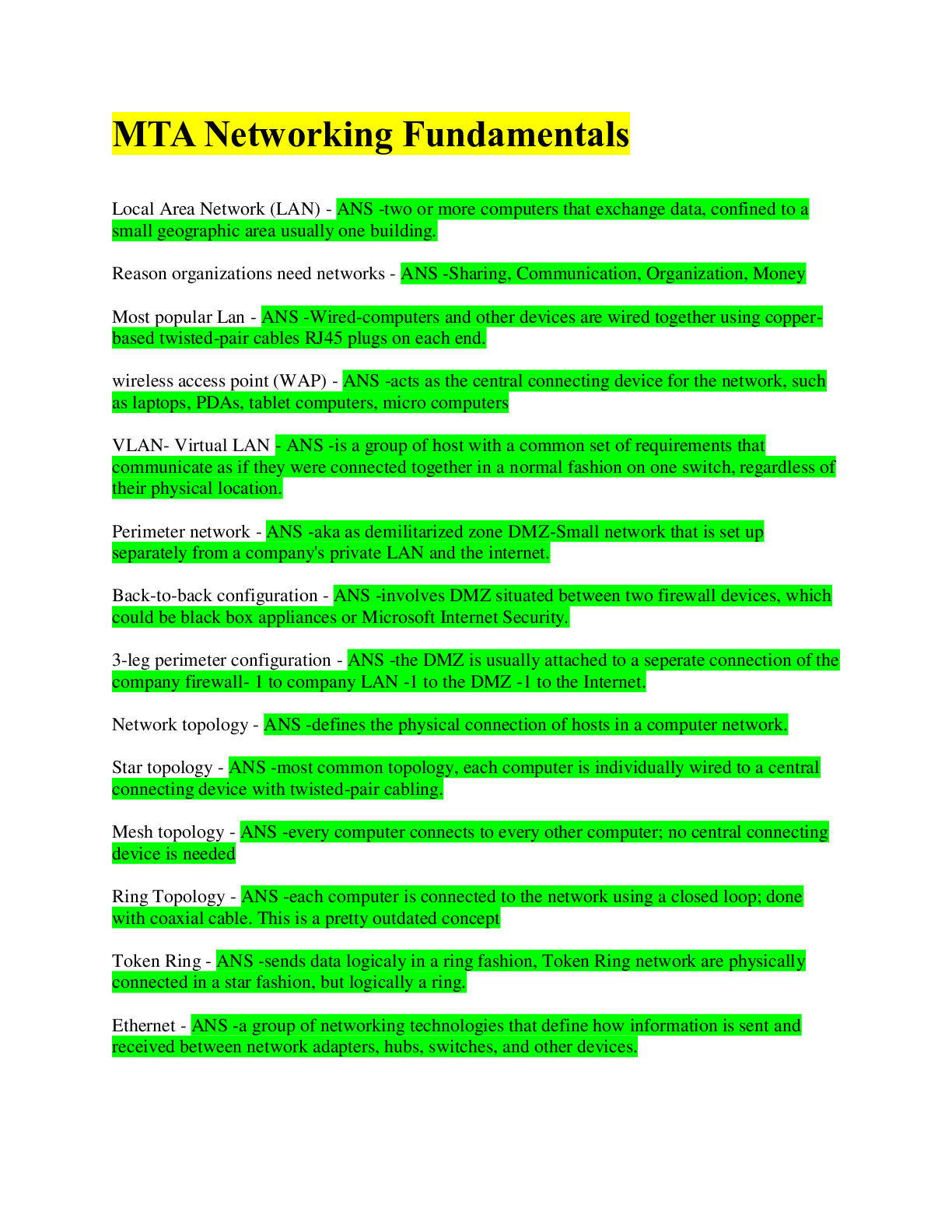
Local Area Network (LAN) - ANS -two or more computers that exchange data, confined to a small geographic area usually one building.
Reason organizations need networks - ANS -Sharing, Communication, Organization, Money
...
Local Area Network (LAN) - ANS -two or more computers that exchange data, confined to a small geographic area usually one building.
Reason organizations need networks - ANS -Sharing, Communication, Organization, Money
Most popular Lan - ANS -Wired-computers and other devices are wired together using copper-based twisted-pair cables RJ45 plugs on each end.
wireless access point (WAP) - ANS -acts as the central connecting device for the network, such as laptops, PDAs, tablet computers, micro computers
VLAN- Virtual LAN - ANS -is a group of host with a common set of requirements that communicate as if they were connected together in a normal fashion on one switch, regardless of their physical location.
Perimeter network - ANS -aka as demilitarized zone DMZ-Small network that is set up separately from a company's private LAN and the internet.
Back-to-back configuration - ANS -involves DMZ situated between two firewall devices, which could be black box appliances or Microsoft Internet Security.
3-leg perimeter configuration - ANS -the DMZ is usually attached to a seperate connection of the company firewall- 1 to company LAN -1 to the DMZ -1 to the Internet.
Network topology - ANS -defines the physical connection of hosts in a computer network.
Star topology - ANS -most common topology, each computer is individually wired to a central connecting device with twisted-pair cabling.
Mesh topology - ANS -every computer connects to every other computer; no central connecting device is needed
Ring Topology - ANS -each computer is connected to the network using a closed loop; done with coaxial cable. This is a pretty outdated concept
Token Ring - ANS -sends data logicaly in a ring fashion, Token Ring network are physically connected in a star fashion, but logically a ring.
Ethernet - ANS -a group of networking technologies that define how information is sent and received between network adapters, hubs, switches, and other devices
[Show More]