WGU C429 Questions and Answers
Already Passed
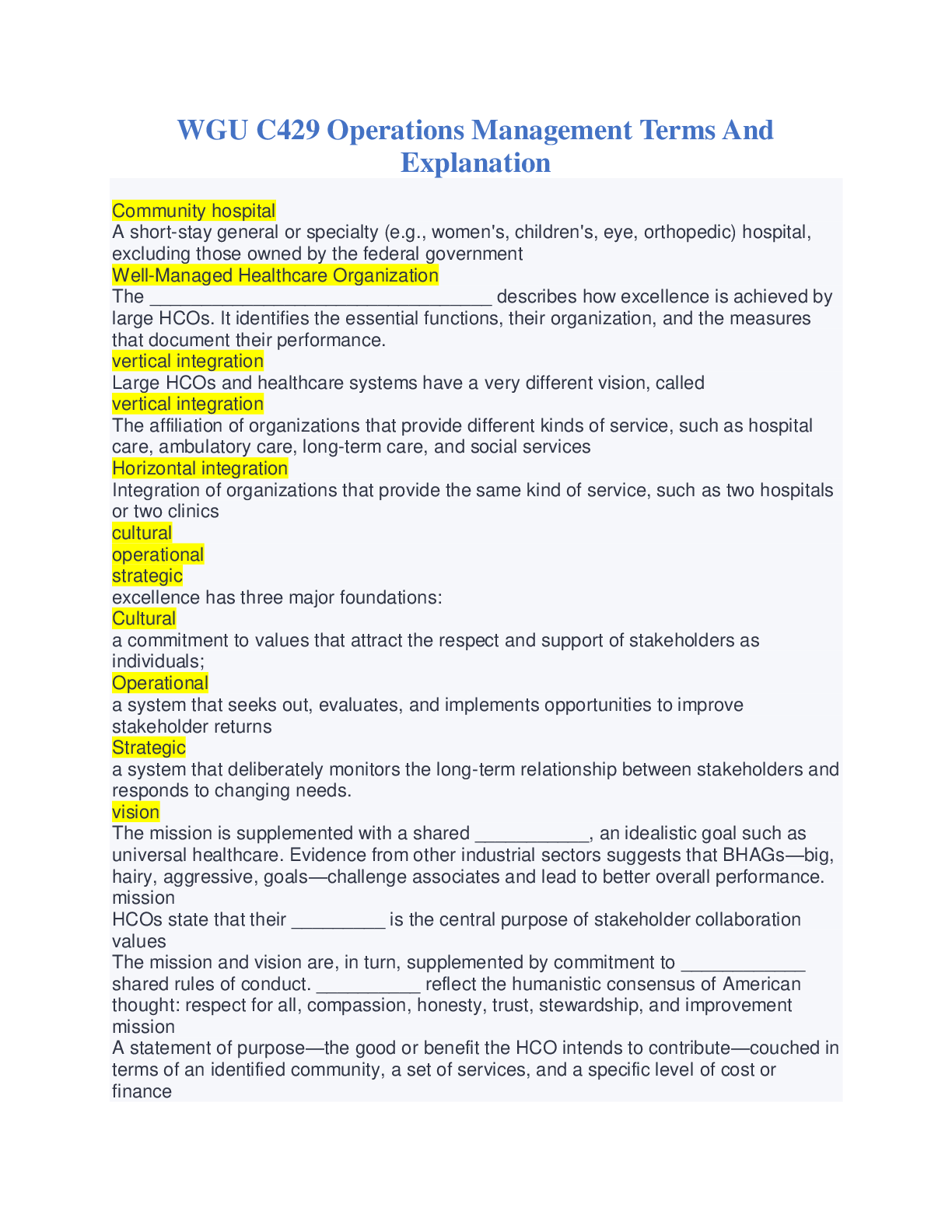
Community hospital ✔✔A short-stay general or specialty (e.g., women's, children's, eye,
orthopedic) hospital, excluding those owned by the federal government
Well-Managed
...
WGU C429 Questions and Answers
Already Passed
Community hospital ✔✔A short-stay general or specialty (e.g., women's, children's, eye,
orthopedic) hospital, excluding those owned by the federal government
Well-Managed Healthcare Organization ✔✔The _________________________________
describes how excellence is achieved by large HCOs. It identifies the essential functions, their
organization, and the measures that document their performance.
vertical integration ✔✔Large HCOs and healthcare systems have a very different vision, called
vertical integration ✔✔The affiliation of organizations that provide different kinds of service, such
as hospital care, ambulatory care, long-term care, and social services
Horizontal integration ✔✔Integration of organizations that provide the same kind of service, such
as two hospitals or two clinics
cultural
operational
strategic ✔✔excellence has three major foundations:
Cultural ✔✔a commitment to values that attract the respect and support of stakeholders as
individuals;
Operational ✔✔a system that seeks out, evaluates, and implements opportunities to improve
stakeholder returnsStrategic ✔✔a system that deliberately monitors the long-term relationship between stakeholders
and responds to changing needs.
vision ✔✔The mission is supplemented with a shared ___________, an idealistic goal such as
universal healthcare. Evidence from other industrial sectors suggests that BHAGs—big, hairy,
aggressive, goals—challenge associates and lead to better overall performance.
mission ✔✔HCOs state that their _________ is the central purpose of stakeholder collaboration
values ✔✔The mission and vision are, in turn, supplemented by commitment to ____________
shared rules of conduct. __________ reflect the humanistic consensus of American thought:
respect for all, compassion, honesty, trust, stewardship, and improvement
mission ✔✔A statement of purpose—the good or benefit the HCO intends to contribute—couched
in terms of an identified community, a set of services, and a specific level of cost or finance
vision ✔✔An expansion of the mission that expresses intentions, philosophy, and organizational
self-image
values ✔✔An expansion of the mission that expresses basic rules of acceptable conduct, such as
respect for human dignity or acceptance of equality
empowerment ✔✔The ability of an associate to control his or her work situation in ways consistent
with the mission
Protocols ✔✔Agreed-on procedures for each task in the care process
Procedures or processes ✔✔Actions or steps that transform inputs to outputsAgency or accountability ✔✔The notion that the organization can rely on an individual or team to
fulfill a specific, prearranged expectation
Service excellence ✔✔Associates anticipate and meet or exceed customer needs and expectations
on the basis of the mission and values
Evidence-based management ✔✔Relies heavily on formal process specification and performance
measurement
Patient care protocols or guidelines ✔✔Formally established expectations that define the normal
steps or processes in the care of a clinically related group of patients at a specific institution
Functional protocols ✔✔These determine how functional elements of care are carried out
Boundary spanning ✔✔establishing and maintaining effective relationships with all stakeholders,
and adapting the HCO to the needs of its community
Knowledge management ✔✔maintaining a detailed fact base about the organization, including
performance measures, benchmarks, and work processes, and making that fact base accessible to
associates through training and communication
Accountability and organizational design ✔✔identifying and integrating the contribution and
goals of each HCO component
Continuous improvement ✔✔continually analyzing and improving all work processes, following
a systematic cycle of measurement, opportunity identification, analysis, trial, goal setting, and
training for implementation
data warehouse ✔✔Knowledge management is sometimes called the _____________________
or the source of truth for the organizationOperational measures or operational scorecards ✔✔Six dimensions of measurement that include
three measures of inputs or resources and three measures of outputs or results
strategic measures or strategic scorecard ✔✔Four dimensions of measurement (finance,
operations, customer relations, and learning/human resources) appropriate for service lines or the
HCO as a whole
Accountability hierarchy ✔✔A reporting and communication system that links each operating unit
to the governing board, usually by grouping similar centers together under middle management
Benchmark ✔✔The best-known value for a specific measure, from any source
Opportunities for improvement (OFIs) ✔✔Result of comparing actual outcome against goal and
goal against benchmark; also arise from qualitative assessments, including listening
Process improvement team (PIT) ✔✔A group that analyzes processes and translates OFIs to actual
performance improvement
Root causes ✔✔The underlying factors that must be changed to yield consistently better outcomes
Performance improvement council (PIC) ✔✔A formal coordinating structure composed of
representatives from all major activities or activity groups; the PIC's first job is to prioritize the
OFIs
Strategy ✔✔A systematic response to a specific stakeholder need
Strategic positioning ✔✔The set of decisions about mission, ownership, scope of activity, location,
and partners that defines the organization and relates it to stakeholder needsStrategic protection ✔✔Safeguards the assets of the organization
Promote shared values by establishing, disseminating, and modeling attractive mission, vision, and
values.
Empower associates so that they feel they can change their work environment to improve mission
achievement.
Listen responsively to associates so that their needs are met and the responses model the
organization's values.
Support service excellence that helps delighted associates delight patients.
Celebrate and reward success. ✔✔Leadership under this culture has five functions:
Creating the best place to give care in order to be the best place to get care. Listen to associates,
identify what they need to fulfill the mission, and provide it.
Implementing responsive leadership to build and sustain the culture. Use training, selection, and
modeling to create an environment where the values become real.
Measuring and continuously improving the HCO's culture. Use associate and customer
satisfaction measures to improve relationships and communication.
Establishing a program to respond to resistance and protect against damage. At the senior
management and governance level, handle potentially divisive issues and destructive behavior.
✔✔Critical Issues in Cultural Leadership
to effectively implement transformational management of teams from the bedside to the
boardroomand
to sustain an environment where all associates are empowered and motivated to meet their
customers' needs. ✔✔The purpose of cultural leadership is
Internal customers ✔✔Associates and teams who work inside the HCO
Promoting key messages, including the mission, values, and negotiated goals, by deliberate
repetition and multiple displays
Listening and responding so that barriers to achievement are promptly identified and removed
Modeling the desired behaviors
Providing training in job processes so that the associate is not only competent but also confident
Training leaders and managers so that their actions consistently reinforce the values and the
commitment to the mission (The tools to promote culture are themselves learnable.)
Negotiating to reach agreement on realistic limits and points of contention
Rewarding desired behavior with celebrations and tangible incentives ✔✔Working from a strong
operational base, seven approaches can promote the culture:
Chief executive officer (CEO) ✔✔The agent of the governing board who holds the formal
accountability for the entire organization
Servant leadership ✔✔The leader's obligation to be sensitive and responsive to associate needs
✔✔AIDET acronym:Acknowledge: Acknowledge people with a smile and use their names.
Introduce: Introduce yourself to others politely.
Duration: Keep in touch to ease waiting times.
Explanation: Explain how procedures work and who to contact if they need assistance.
Thank You: Thank people for using Sharp HealthCare.
Every position is entitled to an honest hearing.
The best answer is driven by two fundamental statements:
Mission achievement is the basic criterion.
Fact and science guide our evaluation of each decision.
Each decision is subject to test as it is implemented. The strategy is to measure the emerging
reality, catch OFIs quickly, and correct them. Any process can be improved.
This decision process, while not perfect, meets every stakeholder's needs better than any
alternative process does. ✔✔Training, mentoring, and counseling create a culture where the
following goals are universally understood and accepted and almost universally met:
Help the conflicting parties fully understand all aspects of their position, including the causes,
implications, and alternative solutions.
Explore carefully for areas of agreement, and build solutions upon these.Conduct the negotiations openly and show respect for all participants and a clear commitment to
the fundamentals of mission achievement and scientific evidence ✔✔Some leaders become
specialists at helping people resolve disagreement. The basic elements of this process are as
follows:
It trains, empowers, and rewards associates, making them partners, not agents, in turning the
service excellence model into a reality.
It encourages a blame-free environment that facilitates PITs.
It creates the "best place to give care" mind-set, which encourages associates to remain with the
HCO, thus increasing the return on the ongoing training investment. ✔✔The culture itself, distinct
from the work processes, contributes to mission achievement in several ways:
Obtaining a graduate degree in healthcare management and moving up the organizational
hierarchy from an initial administrative, support position
Developing an interest in management and learning its skills from being a patient care or clinical
support professional; this interest then grows as the person is given broad exposure and
opportunities for executive education
Transitioning from a strategic or logistic position into a management role through building a
record of excellent performance in large HCOs or consulting companies and then pursuing
graduate education in healthcare management ✔✔Senior managers usually reach their positions
by following one of three routes:
Competency ✔✔Having requisite or adequate ability or quality that results in effective action
and/or superior performance in a job
[Show More]


.png)


 - PreAssessment.png)