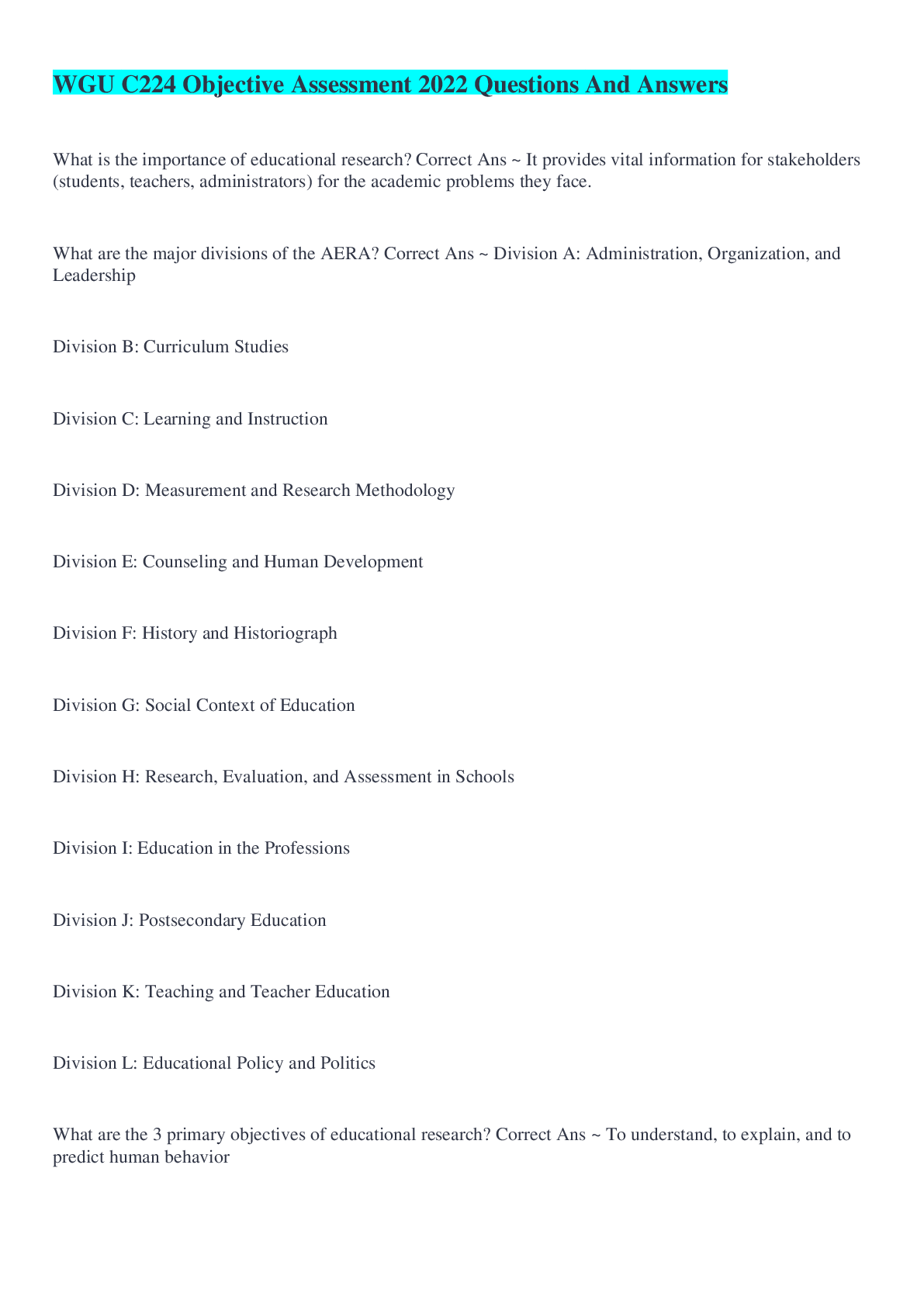
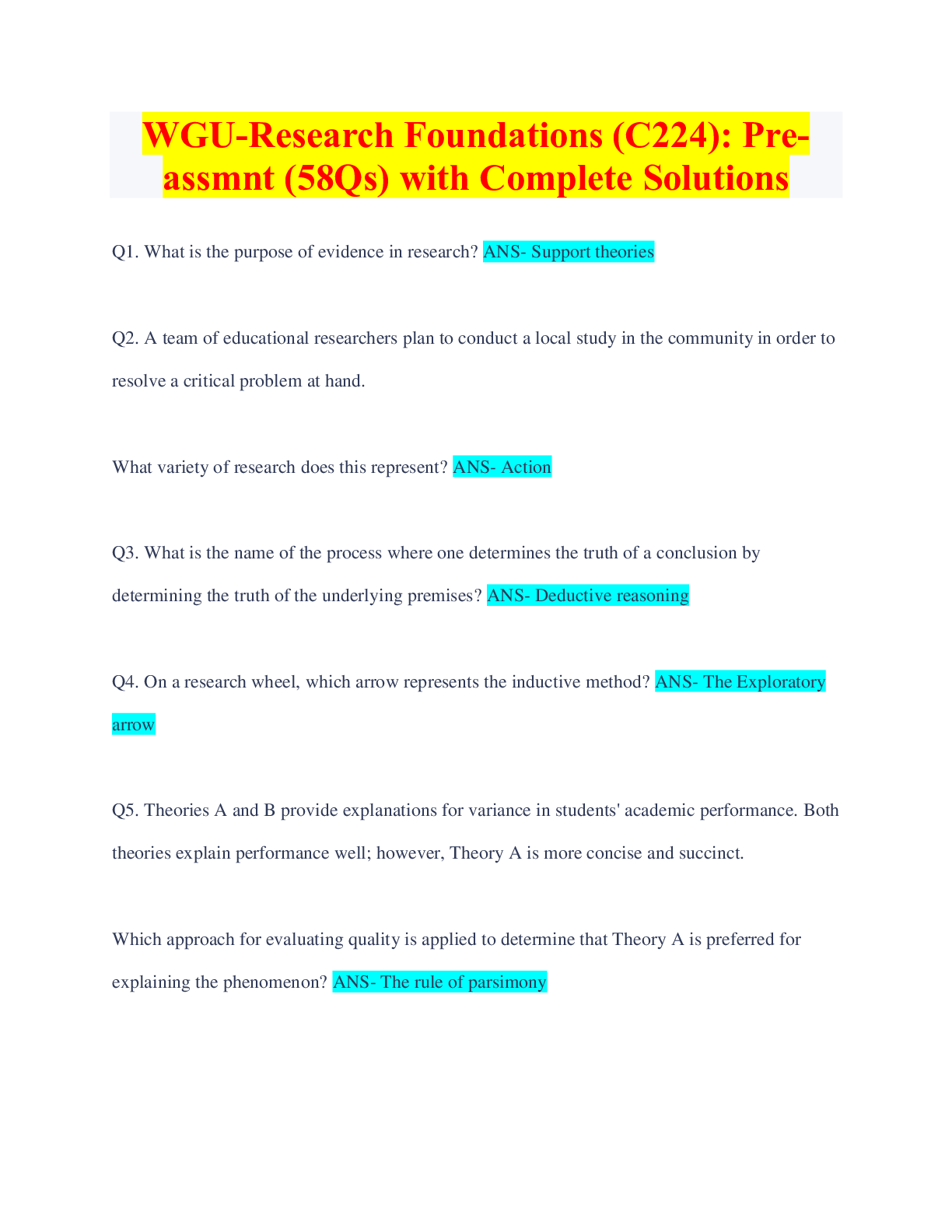
WGU C224 Research Foundations
Questions and Answers Already Passed
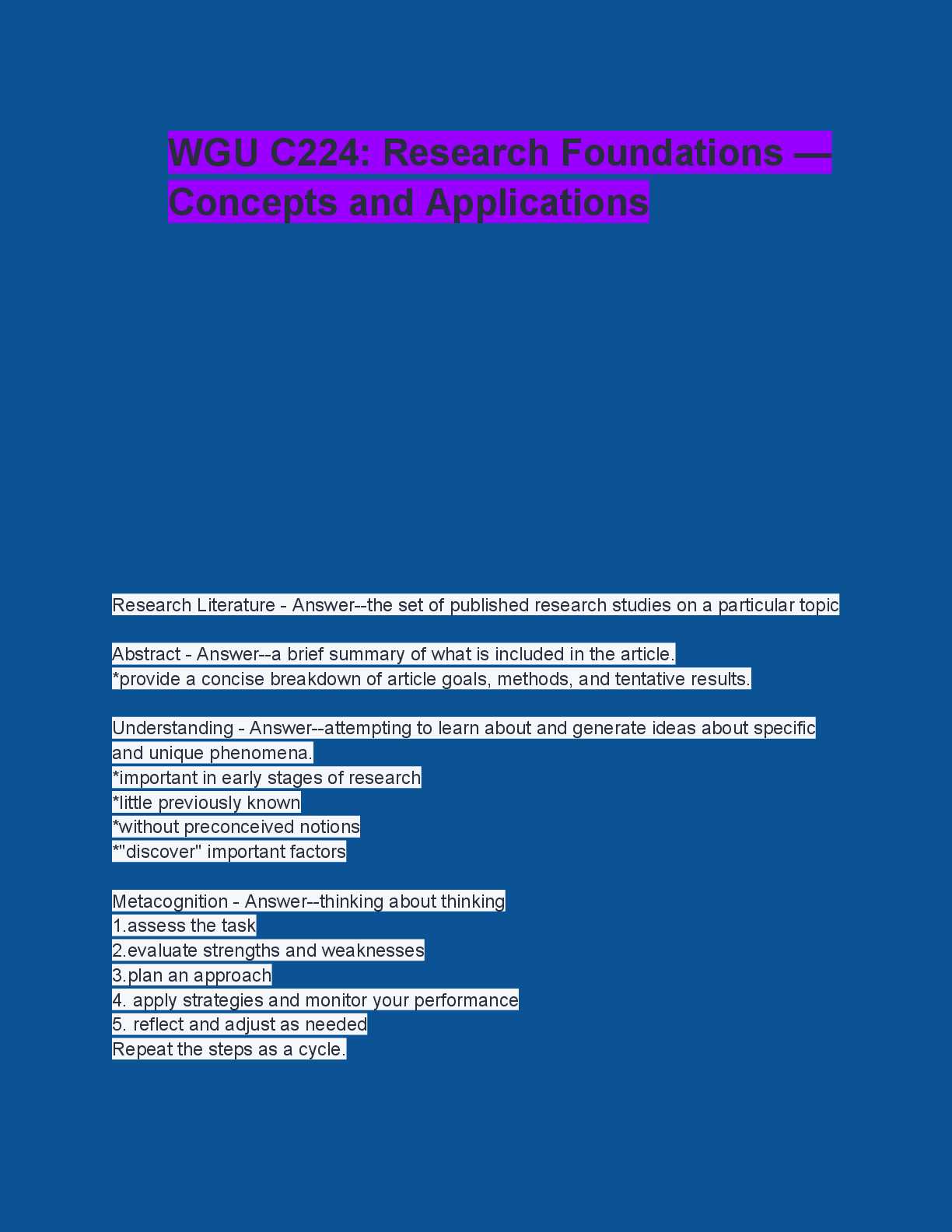
Research Literature ✔✔the set of published research studies on a particular topic
Abstract ✔✔a brief summary of what is included in the article.
*pro
...
WGU C224 Research Foundations
Questions and Answers Already Passed
Research Literature ✔✔the set of published research studies on a particular topic
Abstract ✔✔a brief summary of what is included in the article.
*provide a concise breakdown of article goals, methods, and tentative results.
Understanding ✔✔attempting to learn about and generate ideas about specific and unique
phenomena.
*important in early stages of research
*little previously known
*without preconceived notions
*"discover" important factors
Metacognition ✔✔thinking about thinking
1.assess the task
2.evaluate strengths and weaknesses
3.plan an approach
4. apply strategies and monitor your performance
5. reflect and adjust as needed
Repeat the steps as a cycle.
Description ✔✔an attempt to describe the characteristics of a phenomenon.
*describing a phenomenon?
*documenting characteristics of phenomenon?
Decriptive Research ✔✔provide an accurate description or picture of the status or characteristics
of a situation or phenomenon*deeper level than description
1. randomly selected from defined population
2.determine the sample characteristics
3.infer the characteristics of the population based on the sample
Explanation ✔✔researchers attempt to show how and why a phenomenon operates as it does.
1.develop a theory about how and why the phenomenon operates as it does
2.identify the cause and effect relationships
explanatory research ✔✔testing hypotheses and theories that explain the functions of a
phenomenon in detail
*strongest form of explanatory research for providing evidence of cause and effect
Prediction ✔✔forecast a phenomenon, wherin there is an association made between two points in
a time
*can be made from research studies
predictive research ✔✔predict the future status of one or more dependent (or criterion) variables
on the basis of one or more independent (or predictor) variables
influence ✔✔attempting to apply research to make certain outcomes occur
*an objective which refers to the application of research knowledge to control various aspects of
the world.
1.make something useful happen
2.checking a demonstration program to see if it works.
Integration ✔✔consolidating insights from multiple investigators, theories/perspectives, sets of
data, methods in order to understand a given entity of study
emic perspective ✔✔*insider's perspective*meanings and views of people being studied
*getting inside the heads of group members
*ex. local languages, forms of expression, jargon/slang
Etic Perspective ✔✔*external, social scientific perspective
*perspective of objective researcher
*use social scientific concepts, terms and procedures to describe and explain behavior
*used to bring research questions from the outside
Five types of Educational Research ✔✔1.Basic
2.Evaluation
3. Action
4. Orientational
5. Applied
Basic Educational Research ✔✔*focuses on generating fundamental knowledge
*aimed at generating fundamental knowledge and theoretical understanding about primary human
functions and other natural processes
Evaluation Educational Research ✔✔focuses on deciding the worth/quality of intervention
programs
*determine how well social or educational programs work in real-world settings, as well as any
improvement possibilities.
*worth, merit, or quality of specific program
*Two types: formative and summative
Action Educational Research ✔✔*focuses on solving local problems that practitioners face
*addressing and solving specific problems which local practitioners confront in their schools and
communities, conducting research directly within the classroom or work environmentOrientational Educational Research ✔✔focuses on reducing inequality and giving voice to
disadvantaged
* focuses on collecting information to aid in advancing a specific ideological, political position or
orientation which a researcher believes will improve society.
*another focus is "giving voice" to disadvantaged
Applied Educational Research ✔✔*focuses on real-world questions and applications
*focuses on answering real-world, practical questions in order to provide relatively immediate
solutions.
Formative Evaluation ✔✔concerned with developing judgments of how a program can be
improved and aids developers and staff design and implement programs.
Summative Evaluation ✔✔focuses on cultivating judgements of a program's effectiveness and any
decisions regarding continuation
especially helpful for policymakers to appraise previous future-funding decisions and make future
ones.
Evaluation Varieties ✔✔1. Needs Assessment
2. Theory Assessment
3. Implementation Assessment
4. Impact Assessment
5. Efficiency Assessment
Needs Assessment ✔✔is there a need for this type of program?
Theory Assessment ✔✔is this program conceptualized in a way that it should work?
Impact Assessment ✔✔did this program have an impact on its intended targets?Efficiency Assessment ✔✔Is this program cost-effective?
Implementation Assessment ✔✔Was this program implemented properly and according to the
program plan?
Common areas of orientational research ✔✔class stratification
gender inequality
racial and ethnic inequality
sexual orientation inequality
international inequality
disability rights and inequality
epistemology ✔✔"theory of knowledge and its justification"
*the overall understanding of how knowledge is created or shared*
involves studying knowledge itself - including its nature, process of generation, how it is
necessary, and the standards that are used to judge its adequacy
Sources of Knowledge ✔✔Experience leads to Empiricism.
Reasoning leads to Rationalism, Deductive Reasoning, and Inductive Reasoning
Empiricism ✔✔idea that all knowledge comes from experience
Empirical Statement ✔✔a statement based on an observation, experiment, or experience
are capable of being verified or disproved by the same methods of creation
Reasoning or Rationalism ✔✔philosophical idea that reason is
[Show More]


.png)
.png)
.png)

.png)

.png)
.png)