WGU C224 Research Foundations
Questions and Answers Already Passed
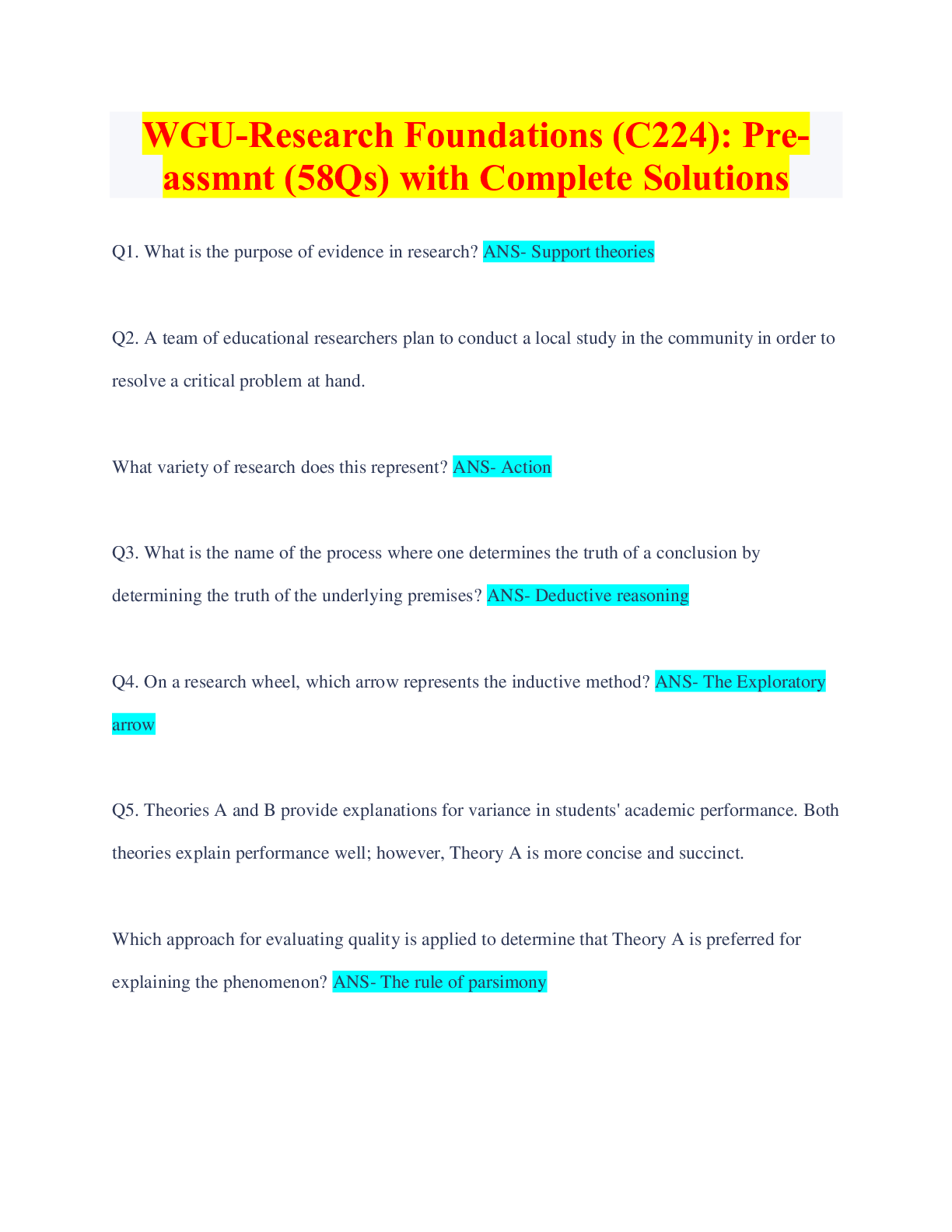
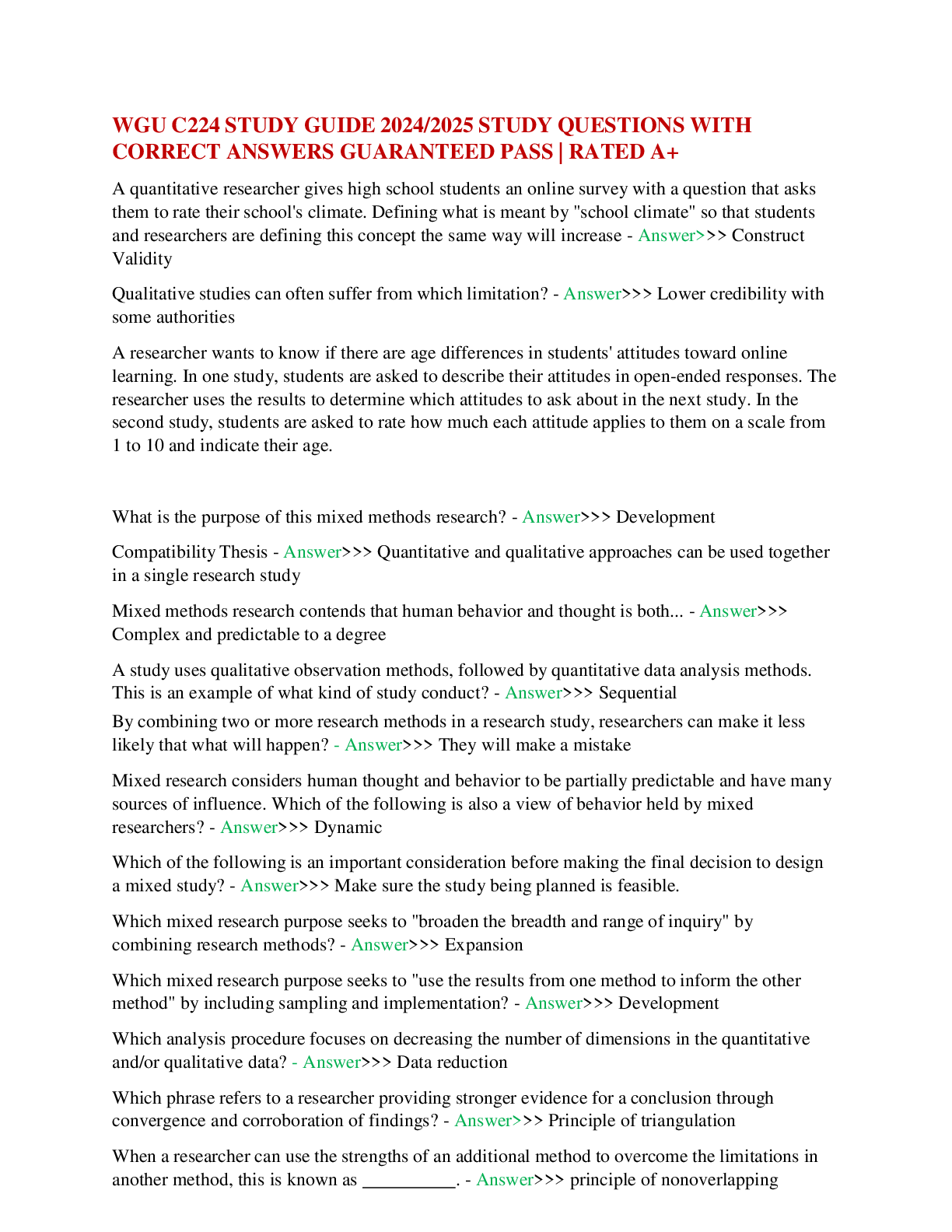
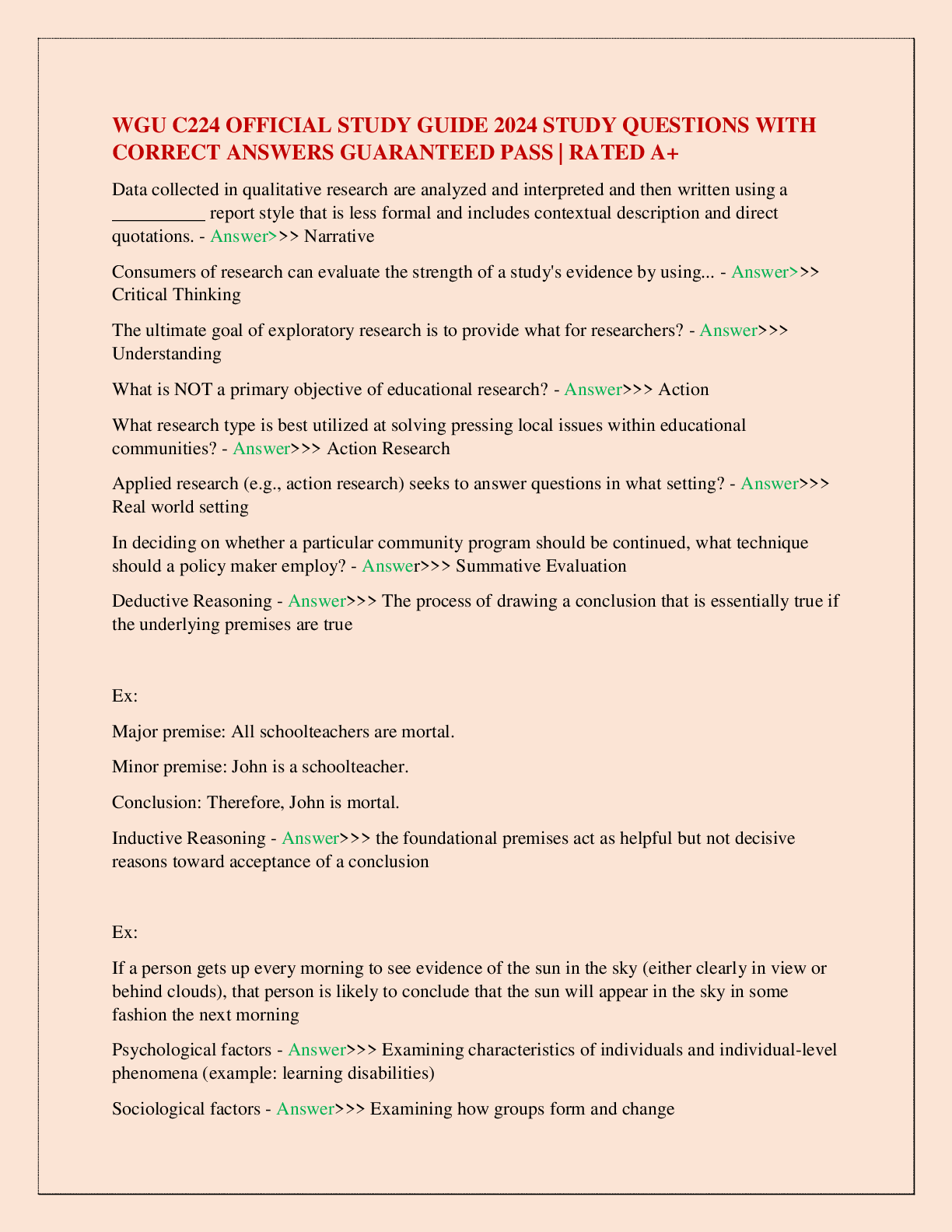
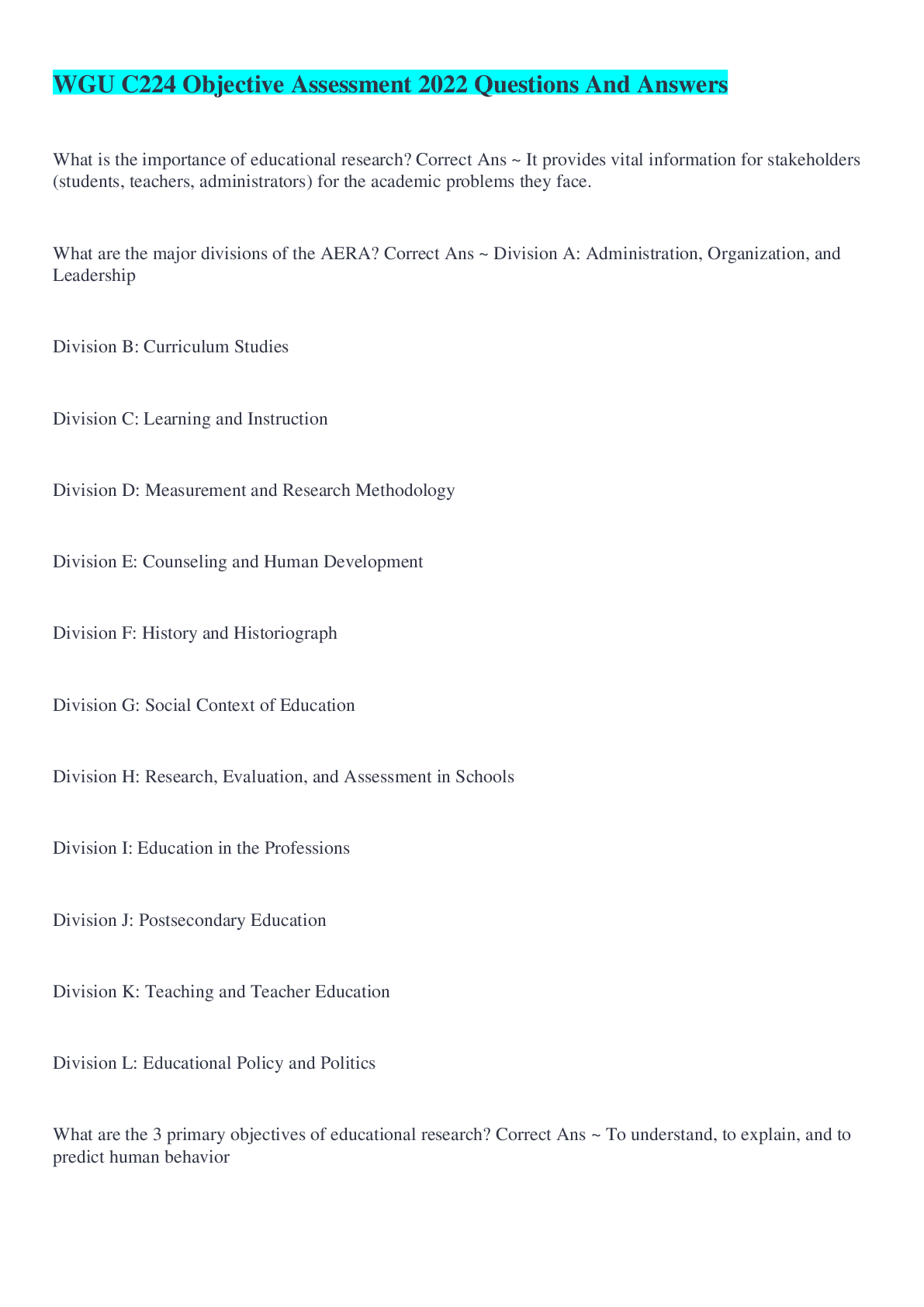
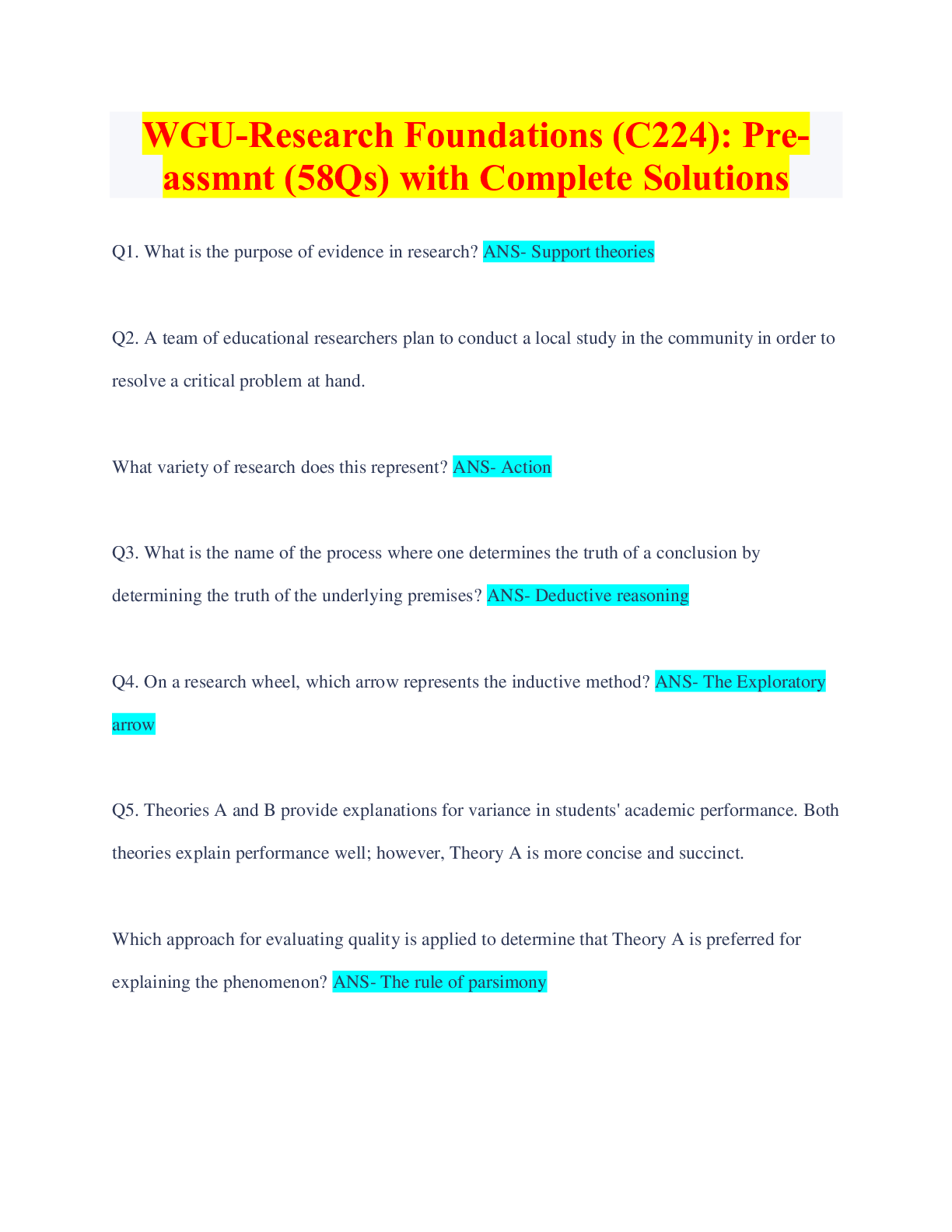
Deductive Reasoning ✔✔Drawing conclusions. Logical deductive process working down - going
from big to small. ex. All books sold at that store are new,
...
WGU C224 Research Foundations
Questions and Answers Already Passed
Deductive Reasoning ✔✔Drawing conclusions. Logical deductive process working down - going
from big to small. ex. All books sold at that store are new, and all the books I bought came from
that store. Therefore, all the books I own are new.
Inductive Reasoning ✔✔Starts specific. Accepting conclusions. Going from small to big. Ex. The
water at the beach has been about 75 degrees anytime I visit in July. Today is July 15th, so I expect
the water will be about 75 degrees when I go to the beach tomorrow.
Epistemology ✔✔the overall pursuit of knowledge, not a specific knowledge contention. The
study of knowledge itself.
Rule of Parsimony ✔✔Simple and concise, succint
Criterion of Falsifiability ✔✔if it can't be rejected, then its going in the right direction
The Principle of Evidence ✔✔researchers conduct research to acquire evidence that may support
a theory and/or hypothesis. Researchers do not attempt to prove what is true.
Ontology ✔✔Inherent understanding. Nature of reality/truth
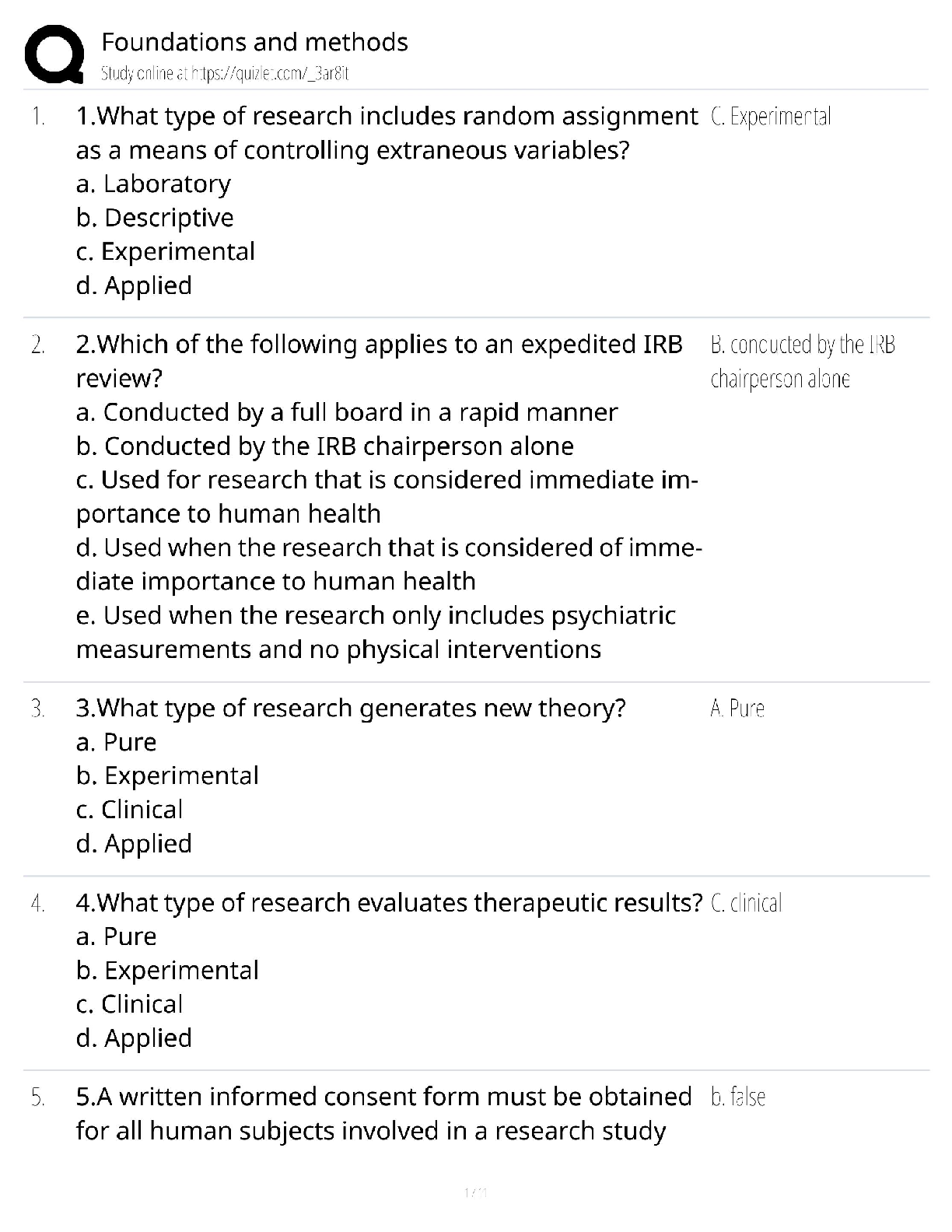
Experimental Research ✔✔Quantitative. Random assignment - not random selection.
Quantitation Research Methods ✔✔Experimental and Non-Experimental
Non-Experimental Research Methods ✔✔Correlation and Casual ComparativeCorrelation research method ✔✔Quantitative. A process to collect data to determine if a
relationship exists between two or more quantitative variables, and to what degree.
Correlation Coefficient ✔✔Strength and direction of a relationship between two variables. range
of +1 to -1
Positive Correlation ✔✔r=+1 (points follow along a line)
Negative Correlation ✔✔r=-1 (no correlation is a 0 and looks like a gun shot all over)
Variables ✔✔a condition or characteristic that can take on different values or categories (such as
age, GPA, gender, etc.)
Quantitative Variable ✔✔a variable that varies in degree or amount of a phenomenon (ex.
Temperature, weight, GPA, reading performance, etc.)
Categorical Variables ✔✔a variable that is made up of different types of categories of a
phenomenon (gender, ethnicity, type of school, teaching method, religion, social class)
Descriptive Statistics ✔✔Goal is to describe, summarize, or make sense of a particular set of data.
Inferential Statistics ✔✔where researchers use the laws of probability to make inferences about
populations based on sample data. In the branch of inferential statistics known as estimation,
researchers want to estimate the characteristics of populations based on their sample data. To make
valid statistical estimations about populations, they use random samples (i.e., "probability"
samples). In the branch of inferential statistics known as hypothesis testing, researchers test
specific hypotheses about populations based on their sample data.
Help researchers to know whether they can generalize to a population of individuals based on
information obtained from a limited number of research participants.Strengths of Quantitative Research ✔✔Testing and validating already constructed theories
Can generalize research findings when based on random samples
Determining nomothetic consumption (general scientific casual relationships)
Quick and cheap
Qualitative Research ✔✔Bottom-up philosophy
Qualitative Research purpose ✔✔Collects text or imagery data to gain a deeper understanding of
existing phenomena, gain insight on insider perspective. Exploration, discovery, understanding
Quantitative Research Purpose ✔✔Collect numerical data. Purpose is to describe, predict, control,
or explain. Narrow lens approach (top-down)
Linguistic-relativity hypothesis ✔✔(assumptions of qualitative research) Intuits' local languages
might allow them to see distinctions that you do not notice.
Empathetic Understanding ✔✔(assumptions of qualitative research) I can appreciate where you're
coming from. I have an interest in you
Ontology (Qualitative Assumption) ✔✔(inherit understanding) Take on personal, mental,
subjective, personal, constructed
Epistemology (Qualitative Assumption) ✔✔(theory of knowledge) Everything is relative, varying
standards, individual/group justification, social construction. Overall understanding of how
knowledge is created.
Criterion Based aka Purposive Sampling ✔✔selecting participants because they meet the criteria
or purpose of the study.Phenomenology ✔✔Rich narrative allowing researcher to vicariously experience the phenomenon
through the eyes of the participant.
Purpose: Describing the individuals experience of the phenomena.
Ethnography ✔✔Extensive physical description of the physical and social settings aimed at
holistic understanding.
Purpose: Describing cultural characteristics of a group of people
Narrative Inquiry ✔✔Narrative account including patterns, connections, and insights uncovered
and carefully synthesized.
Purpose: Describing people's lives/stories to add to our understanding. Chronological story
Case Study ✔✔Rich, holistic narrative which triangulates data and places the case into a
meaningful context
Purpose: Addressing research questions through in-depth analysis. Environment based on a set of
circumstances.
Grounded Theory ✔✔Contains methodological description, then proposes and discusses the
grounded theory built during the research study.
Purpose: Inductively generating a theory describing a phenomenon. Does this dynamic of people
in this environment hold true to a theory that's related to it? Not manipulating data.
Triangulation ✔✔Observations --> Interviews --> Questionnaires. Is everybody in sync with one
another?
It validates the story
Major characteristics of qualitative research analysis ✔✔Unique Case Orientation, Inductive
Analysis & Creative Synthesis, Holistic Perspective, Context Sensitivity, Voice Perspective &
ReflectivityVoice, Perspective & Reflectivity ✔✔The qualitative analyst owns and is reflective about his or
her own voice and perspective; a credible voice conveys authenticity and trustworthiness
Context Sensitivity ✔✔Be sensitive to the environment around you. Research places findings in a
context that is: social, historical, and temporal.
Holistic Perspective ✔✔The whole phenomenon under study is understood as a complex system
that is more than the sum of its parts.
Inductive Analysis & Creative Synthesis ✔✔taking all the specific info and creating the big story.
Looking for patterns, themes, and interrelationships to get the big picture
Unique Case Orientation ✔✔Researcher assumes that each case is special and unique. The first
level of analysis is being true to, respecting, and capturing the details of the individual cases being
studies
Qualitative Research Strengths ✔✔Responsive to local situations, conditions, stakeholders, needs
and changes that occur during conduct study
Is useful for determining idiographic causation
Is useful for studying a limited number of cases in depth and describing complex phenomena
Researcher can inductively generate a tentative but explanatory theory about a phenomenon
Can conduct cross-case comparisons
Mixed Method Research ✔✔Confirmatory and exploratory according to given situation.
Purpose: combining quantitative and qualitative data collection and analysis elements in a research
study. Description, understanding, explanation, prediction, influence, and integration
[Show More]


.png)
.png)

.png)


.png)