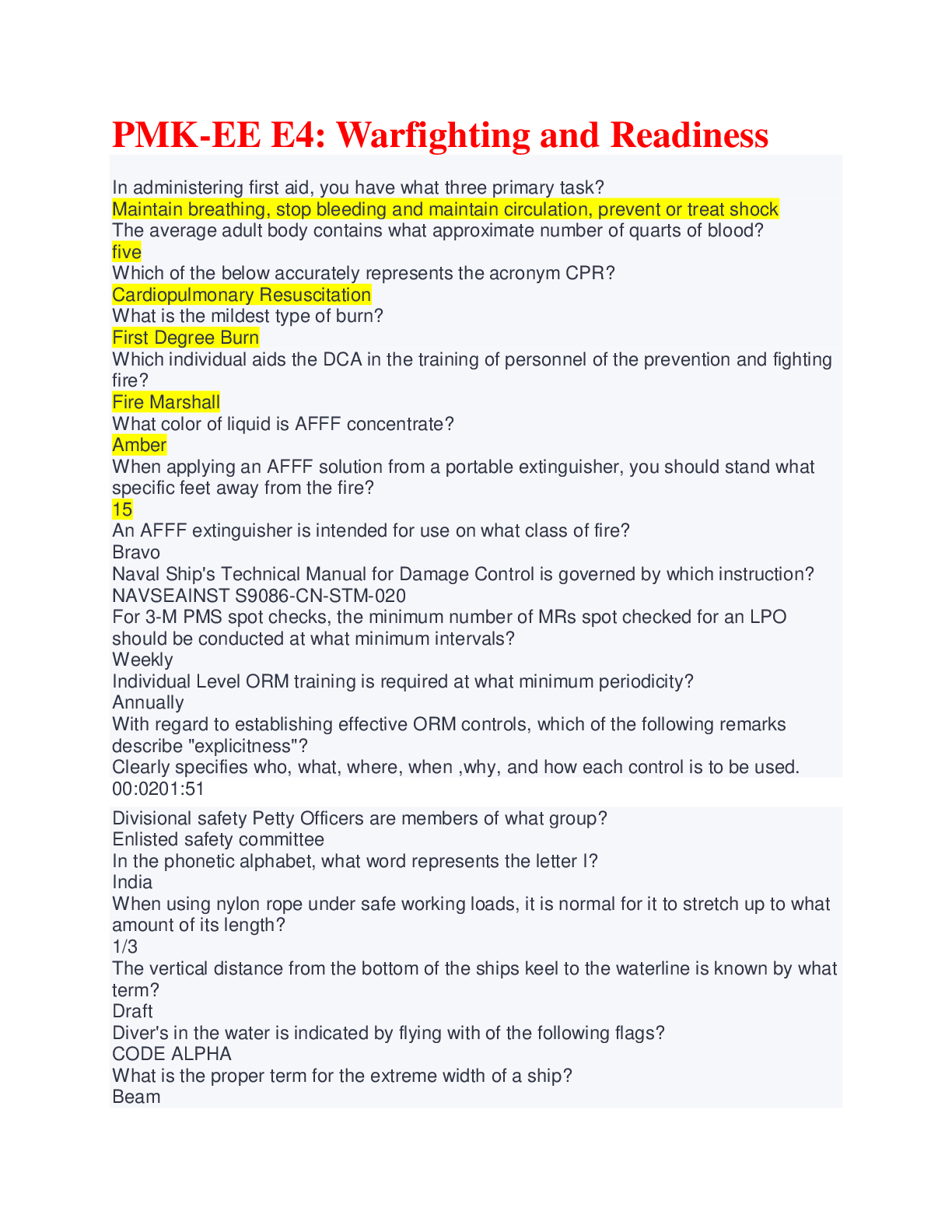
RVE Study Guide Latest Updated 2022
Graded A+
Why should flexible grouping be used in the reading classroom? ✔✔Flexible grouping allows
teachers to tailor instruction to address students' changing needs. When teachers
...
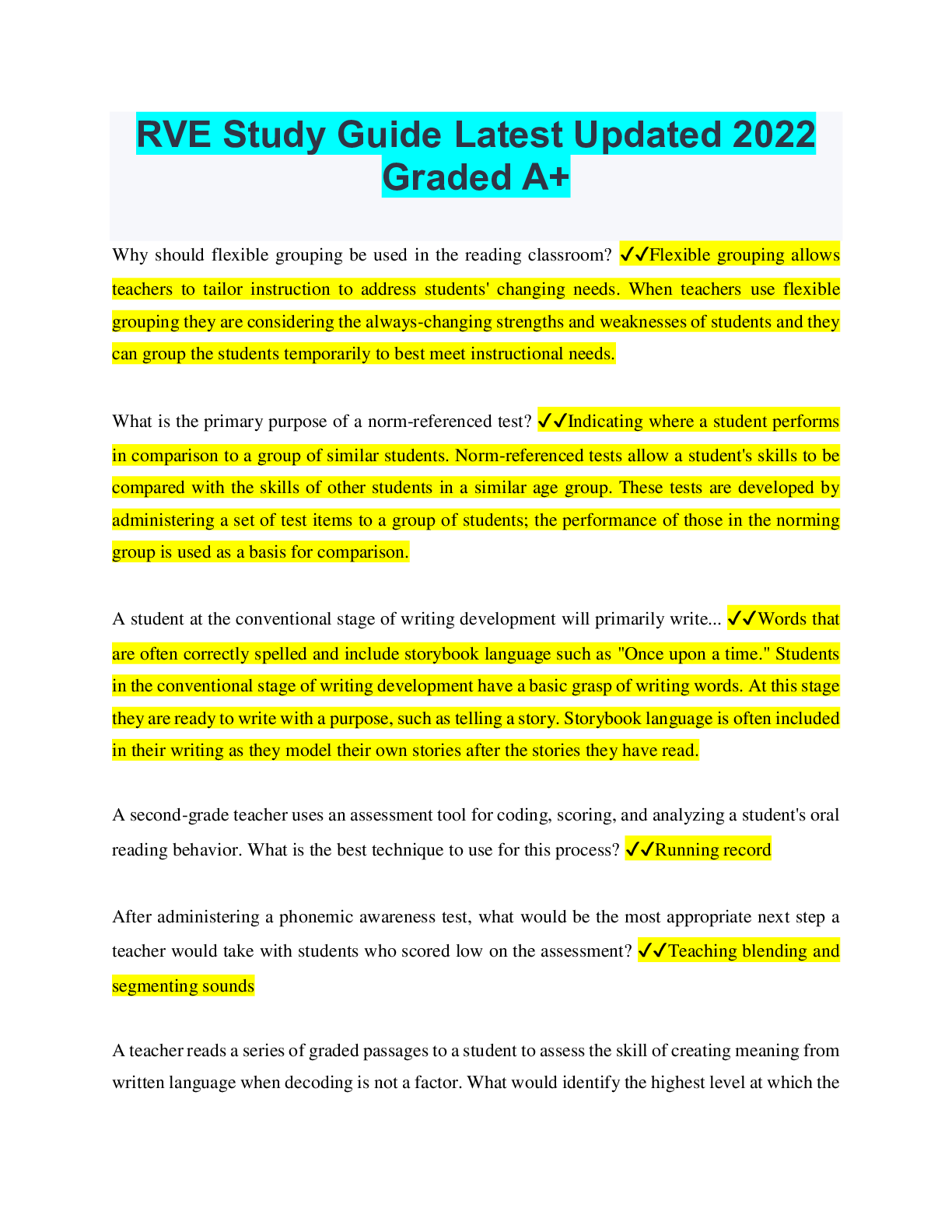
RVE Study Guide Latest Updated 2022
Graded A+
Why should flexible grouping be used in the reading classroom? ✔✔Flexible grouping allows
teachers to tailor instruction to address students' changing needs. When teachers use flexible
grouping they are considering the always-changing strengths and weaknesses of students and they
can group the students temporarily to best meet instructional needs.
What is the primary purpose of a norm-referenced test? ✔✔Indicating where a student performs
in comparison to a group of similar students. Norm-referenced tests allow a student's skills to be
compared with the skills of other students in a similar age group. These tests are developed by
administering a set of test items to a group of students; the performance of those in the norming
group is used as a basis for comparison.
A student at the conventional stage of writing development will primarily write... ✔✔Words that
are often correctly spelled and include storybook language such as "Once upon a time." Students
in the conventional stage of writing development have a basic grasp of writing words. At this stage
they are ready to write with a purpose, such as telling a story. Storybook language is often included
in their writing as they model their own stories after the stories they have read.
A second-grade teacher uses an assessment tool for coding, scoring, and analyzing a student's oral
reading behavior. What is the best technique to use for this process? ✔✔Running record
After administering a phonemic awareness test, what would be the most appropriate next step a
teacher would take with students who scored low on the assessment? ✔✔Teaching blending and
segmenting sounds
A teacher reads a series of graded passages to a student to assess the skill of creating meaning from
written language when decoding is not a factor. What would identify the highest level at which thestudent can comprehend 75 percent of the material? ✔✔Listening capacity. When a teacher reads
a series of graded texts to a student, the teacher is assessing the student's ability to comprehend
written language when the student doesn't have to attend to decoding issues which are present
when the text is read by the student.
Ms. Osborn teaches a variety of reading strategies to help her students become strategic readers.
The strategies include predicting, previewing, monitoring comprehension while reading,
generating questions, and summarizing. Which of the following most likely explains Ms. Osborn's
purpose in teaching the strategies? ✔✔Research has shown that reading comprehension improves
when teachers provide explicit instruction. According to research cited in Reutzel and Cooter's
Strategies for Reading Assessment and Instruction: Helping Every Child Succeed, evidence
supports that providing explicit instruction in comprehension strategies improves student literacy
development.
A teacher plans to differentiate reading instruction for students but first needs to gather and analyze
assessment data to determine students' needs. What would be two effective ways to assess?
✔✔Informal reading inventories and Formative reading assessments. Informal Reading
Inventories (IRIs) are effective. IRIs are collection of word lists and leveled passages that are used
to provide a quick snapshot of students' reading abilities. They are often used to determine where
in a commercial reading series students should begin. IRIs utilize leveled sentences and passages
to determine a student's reading level, and they focus primarily on literal recall as a means to
determine comprehension. Formative assessments are effective in helping to diagnose the
individual needs of students. Formative assessments are on-the-spot assessments given while our
students are reading or engaging in pre and post reading activities. This type of assessment should
be given frequently to provide feedback on our lessons and student progress.
A fourth-grade teacher is developing a writing assignment, the goal of which is to help students
persuade readers to agree with an opinion. What kind of writing prompt would be most appropriate
for the assignment? ✔✔Should a limit be placed on the amount of time children spend watching
television? This prompt requires students to establish a position and provide reasons to support it
so that readers can be persuaded to agree.A reading specialist conducts a workshop for teachers on use of the directed reading-thinking
activity (DRTA) method of instruction. In the model, teachers ask students to first make
predictions based on the title and cover of a book. At various points in the story, students stop
reading and check the accuracy of their predictions. Predictions are then changed or clarified, and
new predictions may be made based on new information the students learned while reading. The
DRTA method of instruction is most likely to promote what? ✔✔Applying metacognitive skills
to increase comprehension. Good readers continually make, revise, or confirm predictions as they
read. In this way, they are forming connections between prior knowledge and new information in
the text. In making predictions, proficient readers are aware of their own thought processes. The
reader is developing metacognition — the ability to think about his or her own thinking.
Justin, a fourth-grade student, takes a norm-referenced reading test and receives a stanine score of
7 on a vocabulary subtest. How would you best describes the student's level of performance on the
assessment? ✔✔Above average. Stanine is a measure used to report a student's performance
compared to that of other students. Stanine is a statistical term that is a combination of the words
standard and nine. A stanine is a point on a nine-point scale with the points 1, 2, and 3 being below
average, 4, 5, and 6 being average, and 7, 8, and 9 being above average performance.
A teacher is searching for an assessment tool that will provide specific information to guide
instruction in order to improve each students' writing abilities. What would most likely assist the
teacher in this goal? ✔✔An analytic scoring rubric, an analytic scoring rubric articulates levels of
performance so the teacher can assess student performance and suggest specific educational
solutions. Students receive specific feedback on their performance with respect to each of the
individual scoring criteria, which does not occur with a holistic rubric.
A first-grade student shows evidence of phonological awareness but has difficulty segmenting
words into phonemes. What would be a challenging question for the student to answer? ✔✔Listen
to this word: "sad." How many sounds do you hear? When segmenting words into sounds, the
student listens for and identifies phonemes in the word."My vacation was exciteing. We did many interesting things. We went to the beach. We played in
the sand. We were so hot that we went in the wuter. We played games in the water. We had an
awesome time." A third-grade student wrote the story above about her summer vacation. To further
develop the student's writing, the focus of instruction during a writing conference should be on
what? ✔✔Sentence variety. The student begins most sentences with "we," and the sentences are
all the same type and length. To make the writing more interesting and cohesive, the student would
benefit most from instruction in writing different types of sentences and sentences of different
lengths.
First-grade students Porter and Henry are working together in a learning center where they are
listening to a series of words recorded by the teacher. Each student taps out the speech sounds they
hear in the words and then checks with the other student to see if he agrees. The primary benefit
of the activity for the students is that it... ✔✔Reinforces phonemic awareness. Phonemic awareness
refers to a student's basic knowledge that spoken language is composed of a series of individual
speech sounds known as phonemes. Having a strong sense of phonemic awareness is a good
predictor of whether a student will experience success in learning to read.
What is an accurate statement about the process of language acquisition in young children?
✔✔Young children infer the underlying rules of language to which they are exposed. According
to psycholinguists and others who specialize in human growth and development, young children
infer the underlying rules of language to which they are exposed and begin to acquire the ability
to communicate through the testing of what they have learned (hypothesis testing).
What is an example of a word that contains the soft sound of "g"? ✔✔Urgent. The "g" in "urgent"
is pronounced as /j/ which is the soft sound of the letter. The word follows the phonic rule that
when "g" is followed by "e", "l," or "y," it usually makes the soft sound of the grapheme.
Students in a sixth-grade class are preparing to give an oral report on a famous author they have
researched. What strategy would be most effective for students to do before speaking to an
audience? ✔✔Writing key words on note cards to refer to during the presentation. When studentshave completed their research projects and are asked to develop an oral report, they should consider
how to present information that will be both interesting and well organized. Students should write
the key words or phrases from the information they want to present on note cards to help them
recall the material.
The words "accommodate" and "television" each have how many syllables? ✔✔Four.
Syllabication is the forming of syllables or the division of words into syllables. In this case, both
words can be divided into four word parts: "ac-com-mo-date" and "te-le-vi-sion."
Which of the following scenarios best demonstrates behavior of an emergent reader? ✔✔A student
opens a familiar book and recalls enough of the language and plot to pretend to read it without
actually identifying any of the words. Emergent is the first stage of early literacy development and
is followed by the early, early fluent, and fluent stages. Emergent readers understand that written
language conveys messages. Children may pretend to read by turning the pages of a book and
invent a story by using pictures and their memory of the story.
How many phonemes does the word "shade" have? ✔✔3. The word shade has three phonemes:
/sh/-/a/-/d/. Phonemes roughly correspond to the letters, but the connection is not one-to-one. It
can be confusing because early readers will want to segment the word into four parts /s/-/h/-/a/-/d/.
A first-grade class sorts word cards into categories provided by the teacher. The chart below shows
the results of the sort.
CV CVC CVCE CVVC
to bat make sail
so sat like bait
be got kite mail
What skill does the chart best reinforce? ✔✔Knowledge of vowel patterns. The categories are
common vowel patterns, and sorting words into the categories reinforces students' familiarity with
the patterns in both their reading and their writing.A first-grade teacher plans to instruct students in the decoding strategy of dividing phonetically
regular words into onsets and rimes. What word would the teacher be able to use to effectively
model the skill? ✔✔Stop. Teaching beginning readers about onsets and rimes helps them
recognize common phonetically regular chunks within words. This knowledge can help readers
decode new words with similar spelling patterns. "Stop" contains the major phonogram "-op,"
knowledge of which assists students in decoding unknown words with the same phonemegrapheme pattern.
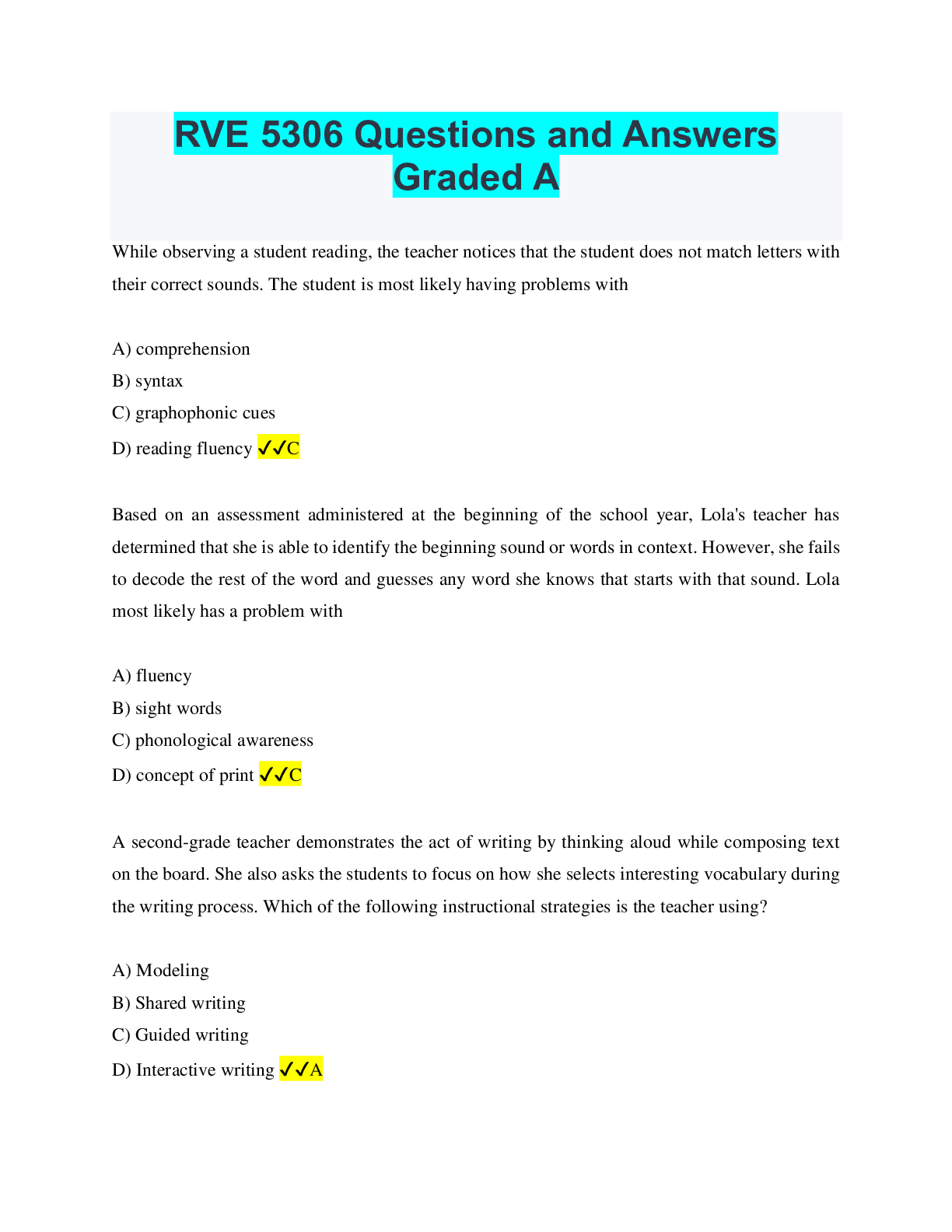
While observing a student reading, the teacher notices that the student does not match letters with
their correct sounds. The student is most likely having problems with what? ✔✔Graphophonic
cues. The student seems to be having trouble with letter-sound correspondence. ("Graph," which
means print, and "phonic," which means sound, refer to letter-sound correspondence.)
A student who reads with expression, appropriate phrasing, and good inflection, is described as
reading with what? ✔✔Prosody. Prosody is the appropriate use of phrasing and expression to
convey meaning.
Teacher: "What is the first sound in van?" Student: "The first sound in van is /v/." The teacher is
assessing the student's ability to do what kind of phonemic awareness task? ✔✔Phoneme isolation.
The student is isolating the initial sound /v/ from the rest of the word. Phoneme isolation requires
the recognition of individual sounds within a word, which is what the student is doing in
identifying the first sound in "van."
To promote family involvement in literacy activities, teachers can encourage parents to...
✔✔Discuss stories and experiences at home. This practice is recommended based on research by
Jim Trelease and the National Institute of Education's Commission on Reading. Discussing stories
and experiences at home promotes family involvement and increases oral language and vocabulary
development, both of which are critical to achieving literacy success.The most appropriate way to assess whether students have generalized the skills acquired in a unit
on recognizing and correcting punctuation errors is to have the students do what? ✔✔Proofread a
short passage and correct any punctuation errors it contains.
After reading a story, a fourth-grade teacher asks the students to compare two characters. What
graphic organizer is best for students to use for the activity? ✔✔Venn diagram. The Venn diagram
is a graphic organizer comprised of overlapping circles that show those features that are either
common or unique to two or more elements in a text. Typically, Venn diagrams are used as visual
representations to enhance a student's ability to understand and organize information presented in
written material.
A classroom teacher and a special education teacher meet to plan a new unit of instruction. What
is the best first step in the planning process? ✔✔Identifying a set of common goals and objectives
for the unit. To start collaborative planning, the classroom teacher and special education teacher
should meet to establish the goals and objectives for the unit. Appropriate assessments, activities,
and instructional strategies can then be chosen that will best help students to meet the stated goals
and objectives.
Before a fourth-grade class reads an article on honeybees, Ms. Stewart displays a word cloud
created from vocabulary in the article. She asks the class the following questions. "What do you
think are the important words from the article?" "How do these words go together?" "What words
do you already know?" As the students answer, Ms. Stewart has them refer to the word cloud
characteristics to support their answers. The best reason for using the strategy is to help students
learn to... ✔✔Build academic vocabulary by making connections between key words.
A student has completed the following word sort:
Flaps Table
Cat Fail
Mask Aim
Slab MatsWhich did the student sort incorrectly? ✔✔Mats. This is correct because "mats" should be in the
short vowel column as it does not say the name of the letter when uttering it. Since it is in the long
vowel column this response would be correct.
What practices are appropriate for children who are learning English as a second language?
✔✔ELLs should be taught strategies for learning new vocabulary so they can acquire new
vocabulary on their own. ELLs should be included with their English-speaking peers in choral and
repeated-reading activities. Research shows that teachers cannot possibly teach all the vocabulary
ELLs need to know to comprehend everything they read and hear. Therefore, it is imperative that
teachers explicitly teach students strategies they can use to independently unlock the meanings of
unknown words and expand their vocabularies without relying on the teacher. Option 3 is
appropriate. Choral reading and repeated reading enable ELLs to practice skill application in a
low-risk environment and improve fluency with the support of teacher and peer modeling.
A teacher wants students to actively listen and comprehend a story read aloud. What instructional
strategy will best focus on individual comprehension throughout the story without interrupting the
reading? ✔✔Encouraging students to apply reading strategies to the listening task. The greatest
listening gains are brought about by applying reading text strategies to listening strategies. This
connection allows for bottom up and top down strategy application so that students are listening
for the details and main ideas.
Which of the following strategies is most likely to increase students' motivation for silent sustained
reading? ✔✔Several times a week the teacher selects different books from the classroom library
and reads short passages to the students. By introducing several books throughout the week to the
class, the teacher encourages students' interest in selecting books for independent reading. Since
the teacher is reading just a short part of the book, the students will want to read the book to find
out the rest of the story.
Which of the teacher intervention is most effective when readers lack the knowledge to read a text
on an unfamiliar topic? ✔✔Providing relevant background information. Giving studentsbackground information on an unfamiliar topic provides a conceptual framework from which
students can access the content.
After studying a classic novel, what instructional activity should a middle school reading teacher
include in a lesson to best promote student higher-order thinking? ✔✔Creating a backstory for a
secondary character in the novel that explains his or her behavior in the book. To promote higherorder thinking is to simply promoting thinking, along with the teaching methodologies that
promote such thinking, that takes place at the higher levels of the blooms hierarchy First, one
critically analyzes the knowledge, information, or situation. Then, they creatively consider
possible next-step options; and then, finally, they construct a new product, decision, direction, or
value. In this example students will be creating a new product: a backstory for a secondary
character.
Mr. Stewart, a third-grade teacher, plans to assess a student's comprehension of a fictional story.
He chooses an informal tool that has the following benefits. In addition to gathering data about
what the student has understood, the assessment shows what the reader has added or inferred from
the story. The assessment gives information about how the reader constructs the story and
organizes a response. Information about the quality of a student's language and the thought
processes in constructing a response can be collected. What is most likely the assessment measure
Mr. Stewart selects? ✔✔Retelling. A retelling is the process of summarizing or describing a story
and is used to assess comprehension. To administer a retelling, a student is asked to read a story
and then recall it, at least initially, without prompting. A student may be asked to elaborate if he
or she does not completely address elements of the story, but the open-ended nature of a retelling
allows a teacher to measure comprehension in a way that has the benefits delineated in the list in
this scenario.
Mr. James, a kindergarten teacher, reads a story aloud to his students. As he reads, he asks the
students to identify which sound is the same in the words "pig," "pumpkin," and "pail," three words
mentioned throughout the story. Which phonemic-awareness skill is he practicing with the
students? ✔✔Phoneme identity. Phoneme identity refers to the ability to recognize the same sound
in different words.In a fifth-grade reading class, the teacher asks students to write a list of words associated with the
American Revolution. Next the teacher draws three columns on the board and labels them
"British," "American," and "Both." Students are asked to come to the board and write their words
in the most appropriate column. The class discusses why each word belongs in the particular
column. This vocabulary-development activity is known as which of the following? ✔✔Listgroup-label. List-group-label is a vocabulary-building activity that encourages students to activate
prior knowledge, share what they know about content-specific concepts, and make connections
between them.
A teacher wants to describe to the class a rule associated with adding a silent "e" to the end of a
consonant-vowel-consonant (CVC) word. The best approach is to tell the students that when a
silent "e" appears at the end of a CVC word, it cannot be heard but it will... ✔✔Make the other
vowel have a long sound. Because when "e" is added to a word with a consonant-vowel-consonant
(CVC) combination, the initial vowel has a long sound. For example, "can" is a CVC word with a
short a sound. When "e" is added to the end, the word becomes "cane" and the "a" has a long
sound.
For which of the following situations would the administration of a miscue analysis be most
appropriate? ✔✔A classroom teacher seeks confirmation of their suspicion that visual processing
is responsible for impeding a child's reading growth. The classroom has already identified a
hypothesis about a student's reading difficulty and a miscue analysis is the most appropriate tool
to yield specific information about miscues made while reading text. Thus, the classroom teacher's
suspicions will either be confirmed or denied.
Research supports that highly skilled readers... ✔✔Read almost every w
[Show More]



- Test Bank.png)


 Block 1 to 7.png)


.png)